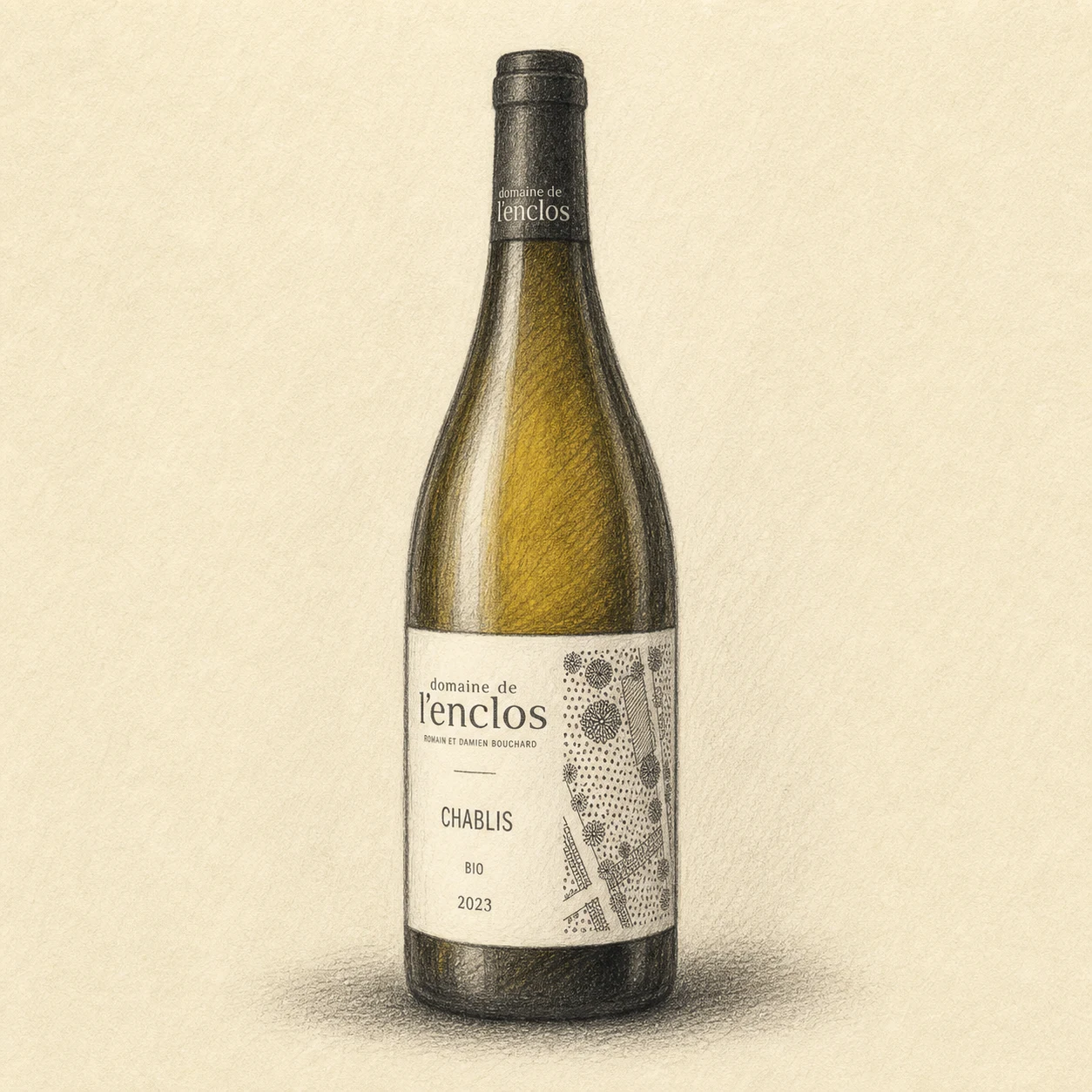
Original bottle illustration — Bacchus Global
Chablis, Burgundy
DOMAINE DE L'ENCLOSChablis 2023
Behind a high stone wall in the heart of Chablis, in a 19th-century enclosure once used by monks from Pontigny Abbey, two brothers rebuilt a family domaine from the ground up — letting gravity, wild yeasts and quiet patience shape a Chardonnay rooted in ancient seabed limestone.
- Wine type
- Dry white wine
- Grape
- Chardonnay 100%
- Appellation
- AOC Chablis
- Origin
- France, Burgundy, Chablis
- Drinking window
- —
- Recommended temperature
- 10–12°C
- Alcohol
- 13.0% ABV
- Bottle size
- 750 ml
The Domaine
Founded in 2016 by brothers Romain and Damien Bouchard, the domaine draws on four generations of grape-growing in Chablis through their mother's family, the Tremblays. Their grandfather André 'Dédé' Tremblay planted some of the estate's oldest Premier Cru vines in the 1960s and 70s, and their parents later built the Pascal Bouchard négociant house before selling that brand in 2015 and keeping the family's own vineyards.
The brothers named their new, independent domaine after L'Enclos, a 19th-century walled property in the centre of Chablis once used by monks from Pontigny Abbey — the site of their gravity-flow cellar today.
Taste profile
In the glass
CHABLIS 2023
Scale1–5
BG wine structure estimate
Comparative profile within the Bacchus Global wine range.
Fresh citrus zest — lemon, lime and orange — opens into cool orchard notes of blackcurrant, cut grass, green apple and pear; with air, lemon tart, mint and crushed almond emerge, framed by a mineral core of chalk dust, crushed oyster shell and flint.
A juicy, generous entry reflects the vintage's ripe fruit, quickly met by bright, invigorating acidity that runs straight through the palate. A subtle creaminess from lees aging fills the mid-palate, building a structure that is both linear and fleshy. The finish is long, saline with an iodine-like minerality, and lifted by a citrus-peel bitterness.
Bright, vivid lemon-yellow, conveying youth and vitality.
Before it reaches the glass
Temperature
Best served at 10–12°C; over-chilling mutes the wine's aromatic complexity and texture.
Timing
—
Glassware
A generously sized white wine or Burgundy glass allows the mineral and floral notes to open against the fruit.
At the table
This Chablis's saline minerality and bright acidity give it a natural affinity for seafood-led cooking across cuisines.
From raw and grilled preparations to citrus-forward dishes, the wine's structure is built to refresh alongside briny, delicate flavors rather than overpower them.
Japanese
- Grilled oysters (yaki-gaki)
- Snow crab sashimi
- White fish sashimi with citrus ponzu
Why it worksThe wine's saline, mineral finish echoes the briny sweetness of oysters and crab, while its bright acidity refreshes against delicate raw fish.
Thai
- Steamed fish with lime and garlic
- Spicy seafood salad with lime dressing (yum talay)
- Stir-fried crab meat with citrus
Why it worksCitrus-forward Thai preparations mirror the wine's own lemon and lime character, and its firm acidity balances sour-spicy notes without competing.
Western
- Freshly shucked oysters
- Sole meunière with brown butter
- Aged Comté or fresh goat cheese
Why it worksClassic Chablis affinities: chalky minerality meets the oysters' brine, acidity cuts through butter-rich sole, and citrus lift balances the tang of goat cheese or the nutty depth of aged Comté.
From cellar to bottle
Winemaking
Hand-picked grapes are sorted on a vibrating table before slow, gentle pressing in a pneumatic press. Free of any pumping, the juice flows entirely by gravity into the former monastic cellar below, where it ferments naturally with indigenous yeasts in temperature-controlled stainless steel. The wine then ages on fine lees without heavy fining or cold stabilization, before a light filtration and minimal sulphur addition ahead of bottling.
Product detail
This village-level Chablis is a blend of estate fruit from about 12 hectares spread across the communes of Chablis, La Chapelle-Vaupelteigne, Beine, Fontenay and Villy. Vines average 30–50 years of age and every parcel is harvested entirely by hand.
Chablis and the Kimmeridgian Soil
The Kimmeridgian limestone that underlies Chablis — a marl studded with small fossilised oysters — is credited across the appellation with giving the wines their bright acidity, flinty reduction and saline lift. This cuvée's plots, spread across five communes in the Chablis area, sit on this same geological base.
Official producer website→Certification

Ecocert Organic · Ecocert
Certified Organic (Ecocert)
This Chablis carries Ecocert organic certification, reflecting the estate's certified-organic viticulture across its Chablis holdings.
Trade information
Contact Bacchus Global for product documentation, availability and trade enquiries.