
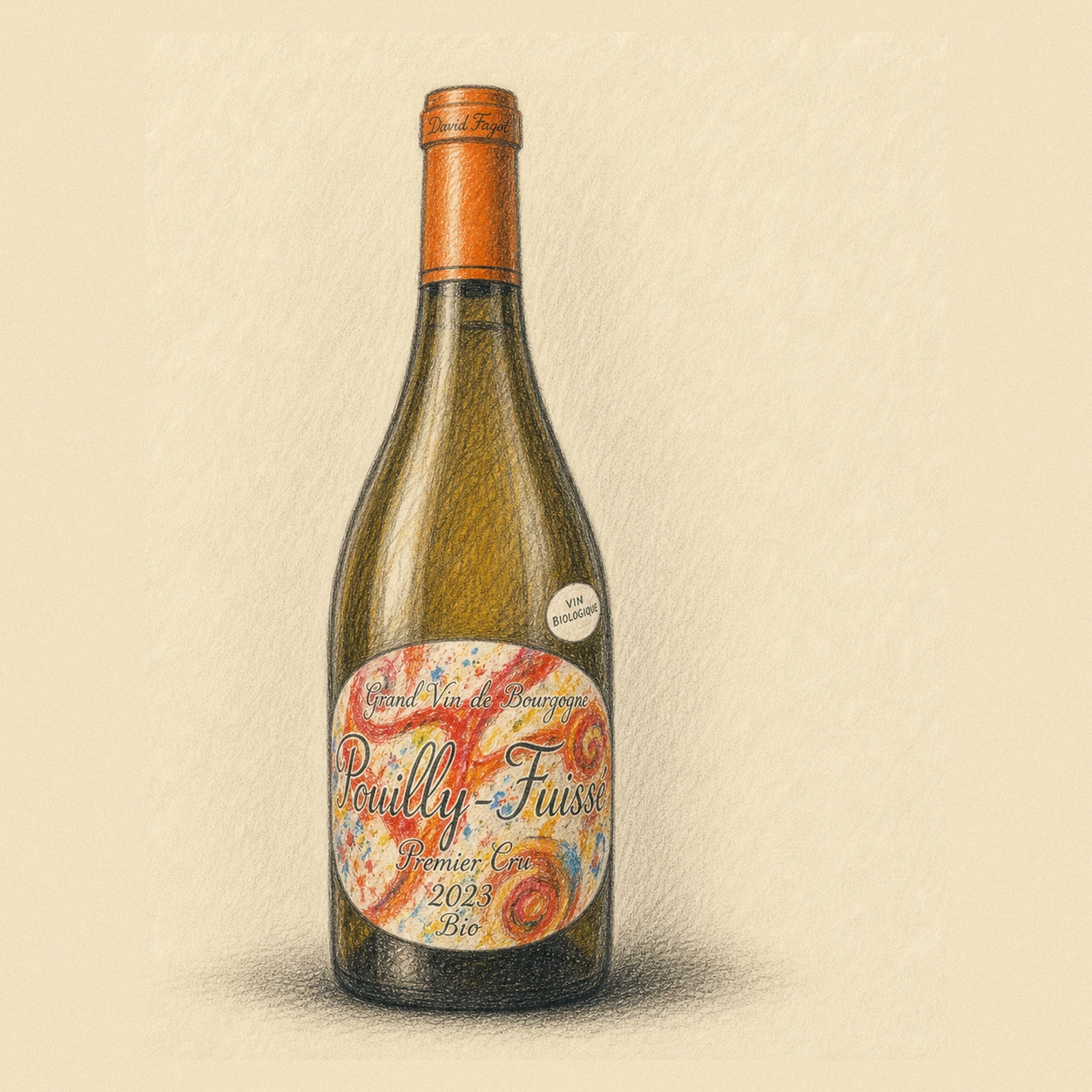
Original bottle illustration — Bacchus Global
DAVID FAGOT
DAVID FAGOTPouilly-Fuissé 2023
In the limestone hills below the Roche de Solutré, one vigneron tends his Chardonnay by hand and by lunar calendar — coaxing a wine that speaks quietly of quince, orchard fruit and stone.
Thailand · Product information
Product information from Bacchus Global Co., Ltd., based in Bangkok, Thailand. About Bacchus Global
- Wine type
- Still white wine
- Grape
- 100% Chardonnay
- Appellation
- AOC Pouilly-Fuissé
- Origin
- Mâconnais, Burgundy, France
- Drinking window
- 2023–2027
- Recommended temperature
- 9–11°C
- Alcohol
- 13% ABV
- Bottle size
- 750 ml
About This Wine
DAVID FAGOT is a small, independent estate in the village of Fuissé, in the heart of the Mâconnais. Founded in 2001 by David Fagot, the domaine farms vineyards across Fuissé, Solutré-Pouilly and Prissé using organic methods, plant-based treatments and a lunar calendar, with vines tended by hand from planting to harvest.
This Pouilly-Fuissé is made entirely from Chardonnay grown on clay-limestone soils typical of the appellation. Fermented with indigenous yeasts and bottled without added sulphites, it reflects the ripe, balanced character of the 2023 vintage — a year Burgundy's wine bureau described overall as rich and opulent, without excess.
Taste profile
In the glass
POUILLY-FUISSÉ 2023
Scale1–5
BG wine structure estimate
Comparative profile within the Bacchus Global wine range.
Yellow apple, pear and quince, joined by a subtle note of vanilla.
Complex and elegant, rich and mineral, with an intense, long finish.
Light golden straw.
Before it reaches the glass
Temperature
Serve at 9–11°C; a slightly warmer 11–13°C allows the aromatics to unfold further.
Timing
Drinking window: 2023–2027 (best enjoyed over the next few years).
Glassware
A Burgundy white wine glass or a Chardonnay-specific tulip glass, such as a Riedel Performance Chardonnay.
Question 1
Which grapes are listed in the product facts?
- 100% Chardonnay
- Viognier 100%
- Riesling 100%
Read the answer and explanation
Correct answer: A — 100% Chardonnay
The linked part of this page lists 100% Chardonnay.
Read the relevant passageQuestion 2
Which appellation is listed in the product facts?
- AOC Pic Saint-Loup
- AOC Pouilly-Fuissé
- AOC Anjou Blanc
Read the answer and explanation
Correct answer: B — AOC Pouilly-Fuissé
The linked part of this page lists AOC Pouilly-Fuissé.
Read the relevant passageQuestion 3
Which origin is listed in the product facts?
- Anjou, Loire Valley, France
- Gan, Jurançon, South-West France
- Mâconnais, Burgundy, France
Read the answer and explanation
Correct answer: C — Mâconnais, Burgundy, France
The linked part of this page lists Mâconnais, Burgundy, France.
Read the relevant passageAt the table
The wine's mineral structure and gentle richness make it a natural match across several culinary traditions.
Ripe orchard fruit, mineral tension and a long finish give it enough weight to stand up to richer preparations while retaining the freshness to suit lighter, seafood-focused dishes.
Japanese
- Grilled shrimp (ebi shioyaki style)
- Steamed white fish in a light broth
- Seafood served with a delicate cream or dashi-based sauce
Why it worksThe wine's minerality and moderate richness echo the delicate umami of lightly prepared seafood, without overwhelming its subtlety.
Thai
- Garlic-steamed prawns
- Mild tom kha gai
- Lemongrass-steamed white fish
Why it worksRipe fruit and a mineral backbone balance the coconut, garlic and citrus notes typical of these dishes, while the wine's structure keeps pace with their gentle spice.
Western
- Lobster or langoustine
- Poultry in a cream sauce
- Goat cheese
Why it worksThe producer describes this wine's richness and mineral structure as able to stand up to buttery shellfish, creamy poultry preparations and the tang of goat cheese.
From cellar to bottle
Winemaking
Grapes are hand-harvested and fermented with indigenous yeasts. According to the estate's usual approach, the wine is then aged on its lees and undergoes malolactic fermentation. No sulphites are added.
Product detail
100% Chardonnay from an estate that describes its farming as organic (Bio); 13% ABV, 750 ml, pale golden-straw in colour.
Origin & Terroir
Pouilly-Fuissé lies in the southern Mâconnais, beneath the limestone escarpment of the Roche de Solutré. In 2020 the appellation received its first Premier Cru classification, recognizing 22 climats. This wine is the estate's village-level Pouilly-Fuissé; the domaine also produces a separate Premier Cru cuvée.
Official producer website→Trade information
Contact Bacchus Global for product documentation, availability and trade enquiries.

