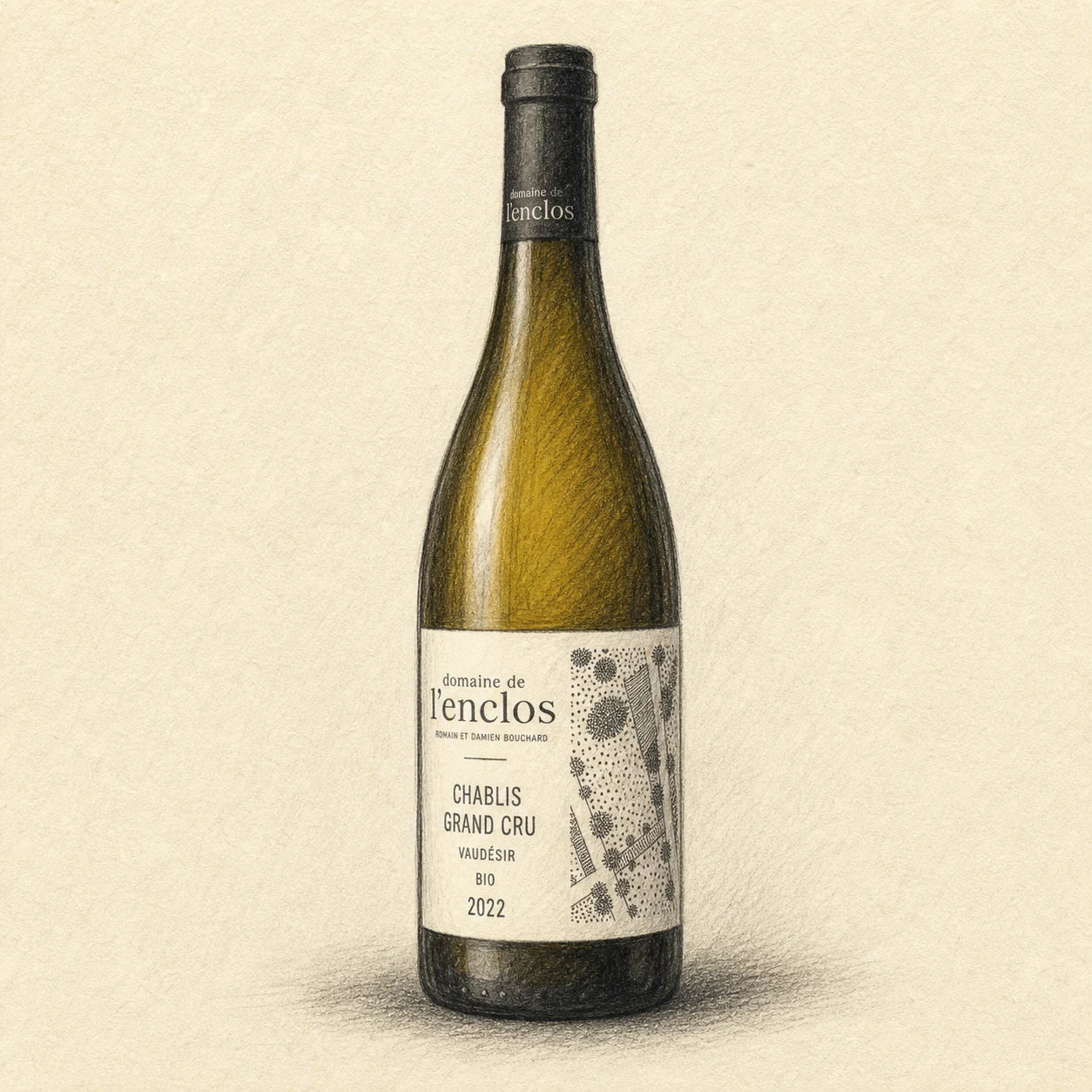
Original bottle illustration — Bacchus Global
Chablis Grand Cru
DOMAINE DE L'ENCLOSChablis Grand Cru Vaudésir
Vaudésir is regarded as the warmest climat within Chablis Grand Cru, its fully south-facing, amphitheatre-shaped slope gathering sun that few other grand cru sites receive. From this parcel, Domaine de l'Enclos draws a Chardonnay where ripe orchard fruit and the bracing, oyster-shell minerality of Kimmeridgian limestone meet in the same glass.
- Wine type
- Still, dry white wine
- Grape
- 100% Chardonnay
- Appellation
- AOC Chablis Grand Cru
- Origin
- Chablis, Yonne, Burgundy, France
- Drinking window
- About 1–10 years from vintage, with extended cellaring potential to around 12 years
- Recommended temperature
- 8–10°C
- Alcohol
- 13.0–13.5% ABV
- Bottle size
- —
About the Wine
Domaine de l'Enclos farms this parcel within Chablis's highest tier, the Grand Cru, on a slope that faces fully south in the shape of a natural amphitheatre.
Hand-harvested grapes ferment spontaneously with native yeasts in French oak, then rest on fine lees for about a year before a further period in stainless steel refines the wine's texture and focus.
Taste profile
In the glass
CHABLIS GRAND CRU VAUDÉSIR
Scale1–5
BG wine structure estimate
Comparative profile within the Bacchus Global wine range.
Lemon curd, fresh apricot, crisp green apple and lime zest open the glass, followed by orange blossom and a pronounced crushed-oyster-shell minerality; deeper notes of toffee, herbs, faint pineapple and the baked bread and yeast character built through lees aging complete the picture.
Silky and velvety in texture, full-bodied yet not heavy, with ripe fruit carried by an energetic acid structure and a saline mineral core; a subtle oak nuance from barrel aging lends elegance to a very long finish.
Bright, clear pale lemon yellow.
Before it reaches the glass
Temperature
8–10°C
Timing
The wine's layered aromatics continue to develop over roughly the first decade after the vintage, with further cellaring potential to around twelve years for those who wish to follow its evolution toward honey, nut and truffle nuances.
Glassware
—
At the table
The wine's saline minerality, ripe fruit and energetic acidity create natural bridges across several culinary traditions.
Its structure favors dishes built on delicate seafood, citrus and light richness, where the wine's acidity and mineral core frame the food rather than compete with it.
Japanese
- Edomae-style nigiri sushi
- Sashimi of white fish
- Chilled scallop with citrus
Why it worksThe saline, oyster-shell minerality mirrors the natural brine of raw seafood, while the wine's acidity lifts the delicate sweetness of white fish and shellfish.
Thai
- Steamed sea bass with lime and garlic
- Grilled river prawns with herb dip
- Citrus-dressed seafood salad
Why it worksThe bright acidity and saline edge echo the citrus and herbal notes common in Thai seafood preparations, while the wine's fuller body supports the natural sweetness of prawns and fish.
Western
- Pan-seared scallops with citrus butter
- Sole meunière
- Lobster or langoustine
Why it worksFull body and energetic acidity stand up to butter-based sauces and the richness of shellfish, echoing the pairing logic long associated with grand cru Chablis.
From cellar to bottle
Winemaking
Hand-harvested grapes are gently whole-cluster pressed and moved by gravity alone, without pumps, into French oak — mostly used tonneaux — where indigenous yeasts carry out a spontaneous fermentation. The wine then ages on fine lees for about 12–13 months before a further six months in stainless steel to settle before bottling.
Product detail
The wine is fully dry with no chaptalization; it undergoes only light filtration with no fining or cold stabilization, and receives only the minimal addition of sulphur necessary prior to bottling.
Origin & Terroir
Vaudésir's fully south-facing, amphitheatre-shaped slope is recognized as the warmest climat within the Chablis Grand Cru appellation.
Official producer website→Certification

Organic Farming · Ecocert
Certified Organic Farming
The domaine's vineyards are certified organic through Ecocert, reflecting estate-wide farming practices.
Recognition
Jasper Morris MW, Inside Burgundy
Jasper Morris MW rated the 2022 Vaudésir from barrel sample 92–94 points, noting its mineral energy, saline undertone and long finish.
Trade information
Contact Bacchus Global for product documentation, availability and trade enquiries.