Drink
You Don’t Need Expertise to Choose: How to Narrow Down Your First Bottle
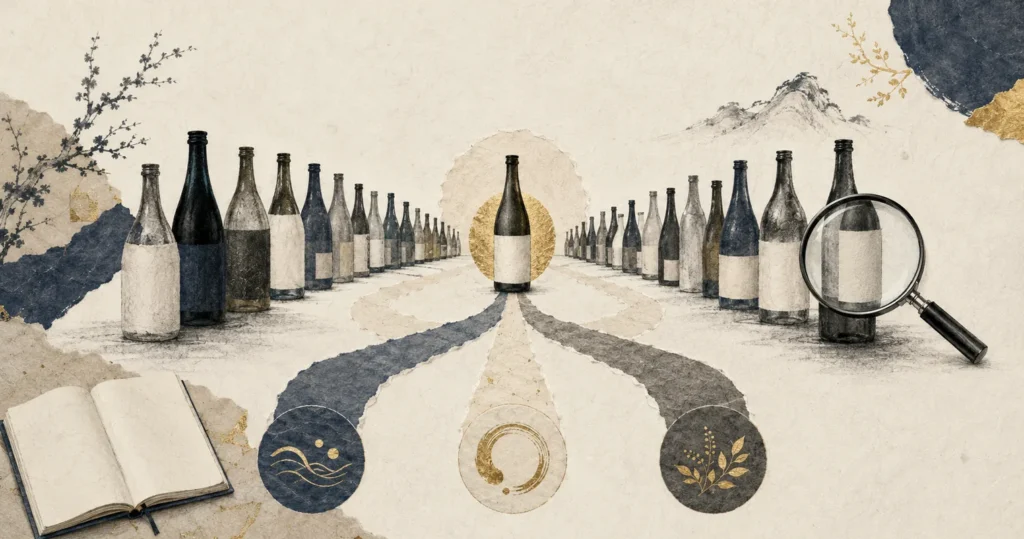
You Don’t Need Expertise to Choose: How to Narrow Down Your First Bottle
The Quiet Hesitation Before the Shelf
Have you ever found yourself hesitating in front of a shelf or while reading a menu when trying to choose a Japanese alcoholic drink?
“Junmai Daiginjo,” “Honkaku Shochu,” and “craft gin.”
The terms on the labels can look like a code, making it hard to know which clue to use.
Many people assume this hesitation is because they lack knowledge. But that is not the only reason. What helps is not the ability to decode every technical term, but having a sequence for narrowing down the options.
For wine, the grape variety can be one clue to its likely taste. Japanese alcoholic drinks require different things to check depending on the category, so first-time drinkers may find it hard to identify where to begin. That is why the order for narrowing down the options matters.
Here are four clues to help people who are not experts find one bottle for themselves.
Clue 1: Start by Sorting Drinks into Three Families
Comparing hundreds of brands one by one can be exhausting. Japanese alcoholic drinks can be divided broadly into three families according to how they are made:
- Fermented beverages, such as sake
- Distilled beverages, such as shochu, Japanese whisky, and craft gin, made by fermenting and then distilling
- Mixed beverages, such as umeshu and yuzushu, made by combining a finished drink with fruit or other ingredients
When selecting a bottle, the initial question is not which brand to choose, but rather:
“Which family does this expression belong to?”
This single distinction brings immediate clarity to the selection process.
Alcohol content can be a rough guide, but an illustrated diagram on our Japanese alcohol map page shows how to tell the three families apart more precisely. You can consult it whenever you need to.
Clue 2: Choose One Thing to Check First on the Label
Trying to understand every detail on a label can be exhausting. In practice, you can get a sense of the direction by choosing just one thing to check first for each family:
- Sake: The designation shown on the label, such as Junmai or Ginjo
- Shochu: The ingredients used, such as sweet potato, barley, or rice
- Liqueurs: What the drink is combined with
- Japanese Whisky: The criteria for labeling it “Japanese whisky”
- Craft Gin: The listed botanicals (aromatic ingredients)
Looking at just one of these details can give you a sense of the production approach. You do not need to learn everything at once. The knowledge pages for each category explain what each point means.
Clue 3: Use Words You Already Know to Describe the Taste
Sophisticated enjoyment does not require specialized sommelier vocabulary. Consider simple preferences:
- Crisp and dry, or rounded and sweet?
- Delicate and refreshing, or deep and full-bodied?
- Aromatic and floral, or subtle and restrained?
Intuitive language is often the most accurate guide to personal preference.
Rather than choosing a bottle simply because it bears the label “Junmai Daiginjo,” it is often more rewarding to seek a flavor profile that feels clean and dry. Technical classifications are not the starting point|they are merely subtle confirmations of a personal preference.
Clue 4: Look Up Any Terms You Don’t Know
Perhaps the most reassuring truth is that technical terms are reference points, not prerequisites.
Encountering terms such as:
- Rice Polishing Ratio (Seimai-buai)
- Vacuum Distillation
- Cask Strength
The “Japanese Alcohol Glossary” page gathers terms people often find tricky, so you can check their meanings on the spot. Not knowing a term is not a reason you cannot choose a bottle.
Choosing Is Not About Guessing the Right Answer
Bringing these four perspectives together creates an intuitive path:
- Identify the beverage family.
- Seek the defining detail on the label.
- Express desired flavors in natural terms.
- Allow terminology to inform, rather than intimidate.
Selecting a bottle is not about arriving at a single “correct” answer. It is about quietly developing a refined palate and enjoying the discovery along the way. Standing before the shelf becomes no longer a moment of hesitation, but an invitation to explore.
Throughout this series, we will take a closer look at each of these four perspectives, exploring them one theme at a time.
Continue Exploring
Related guides: “How to Read a Japanese Bottle Label Without Knowing Japanese” / “Choose by the Table: Food, Serving Style, and Occasion”
Representative product profiles by family: Sake: KAGURA Junmai Clear Non-filter Nama-Genshu / Shochu: SG SHOCHU Mugi / Liqueur: KOKUTO DE LEQUIO Kokuto Liqueur / Japanese Whisky: SABUROMARU Smoky Whisky / Craft Gin: SAKURAO Japanese Craft Dry Gin
This article is intended solely to explore how to understand and navigate the categories of Japanese alcohol as cultural and educational information, and does not aim to promote or encourage the consumption of alcohol. For persons of legal drinking age (20 and over). Please drink responsibly.
Related Product(s)
KAGURA Junmai-Daiginjo White Non-filter Genshu / KAGURA Junmai Midnight Blue Non-filter Nama-Genshu
Discover the culture behind every bottle
We share brewery stories, tasting notes and the craft of koji & fermentation | for educational and cultural purposes only.
เราถ่ายทอดเรื่องราวจากผู้ผลิต บันทึกรสชาติ และศาสตร์แห่งโคจิและการหมัก | เพื่อการศึกษาและวัฒนธรรมเท่านั้น