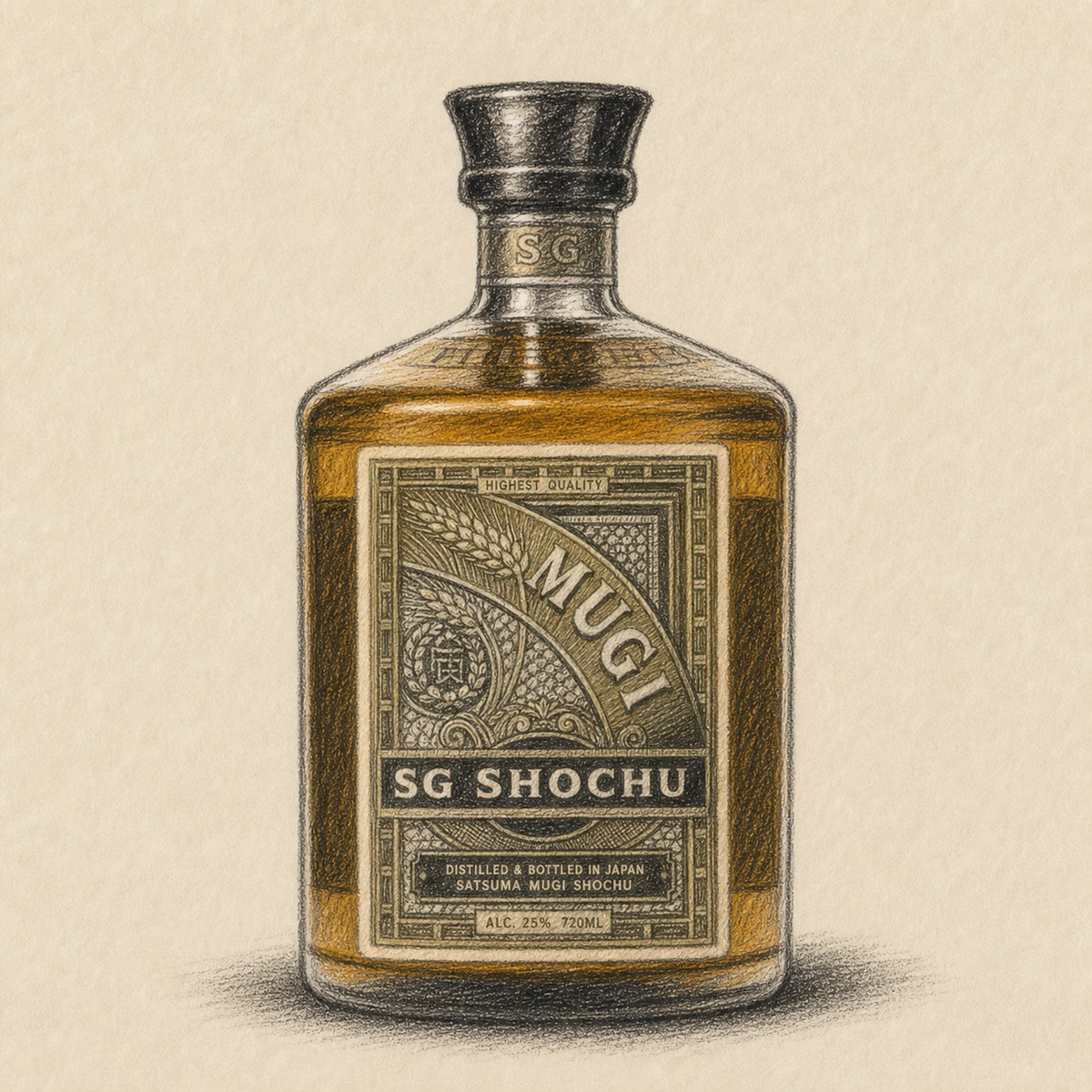
The SG Shochu MUGI
Five barley-shochu components are shaped through two distillation paths and three resting vessels, then assembled at 40%. The interplay of barley, pressure and vessel gives MUGI its layered aromatic structure.
Thailand · Product information
Product information from Bacchus Global Co., Ltd., based in Bangkok, Thailand. About Bacchus Global
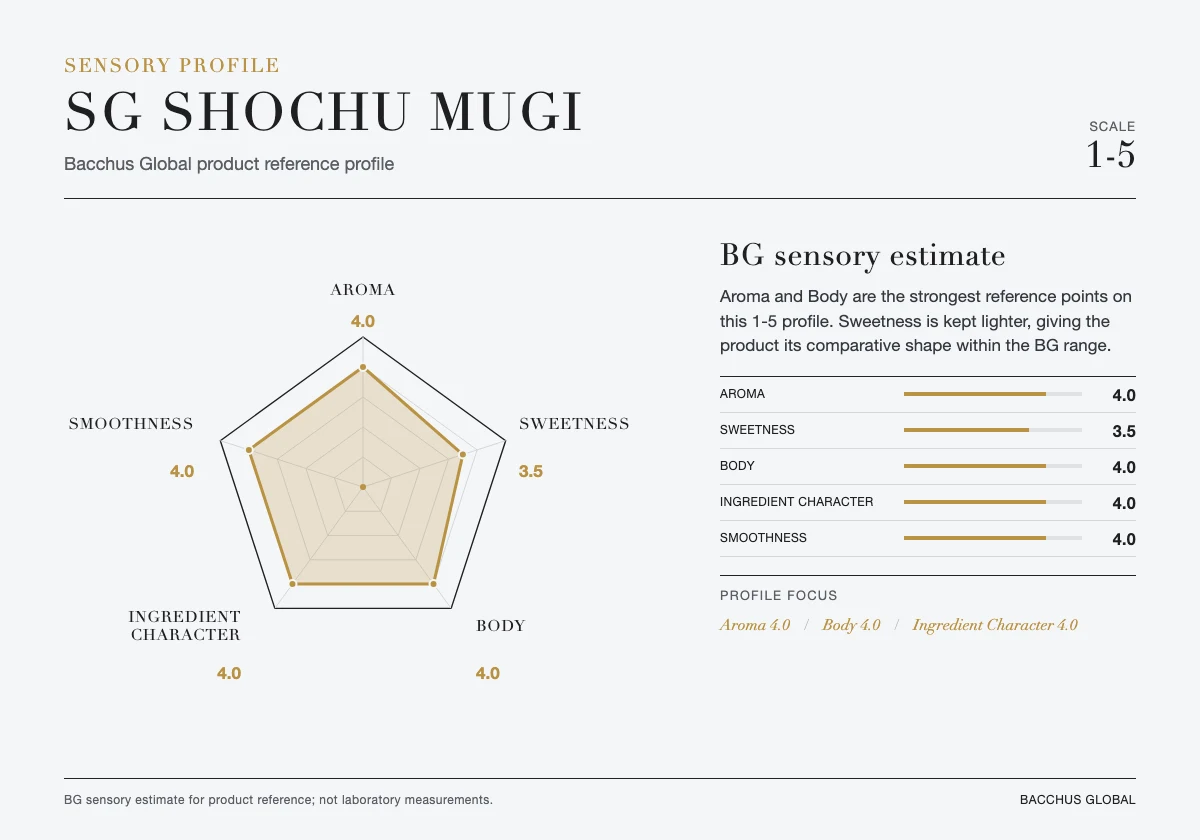
Sensory profile
A blend designed from the bar backwards
MUGI combines five barley-shochu components. Some are made through atmospheric distillation for weight, some through vacuum distillation for lift; they are rested across American white oak, sherry butts and stainless steel before blending.
Two distillations, three vessels, five components
Individual maturation periods are not disclosed. MUGI combines two distillation paths, three vessel types and five barley-shochu components, making the architecture of the blend—not a stated age—the focus.
Award record
The award record shown is specific to this product; it does not guarantee individual preference or quality.
Shingo Gokan × Sanwa Shurui
The project joins Shingo Gokan, founder of SG Group and winner of the 2012 Bacardi Legacy Global Cocktail Competition, with Sanwa Shurui of Usa, Oita, the producer behind iichiko. Gokan brought a bar-side brief: a Japanese spirit with sufficient definition at 40% and an aromatic structure that remains legible when mixed. Sanwa Shurui translated that brief into shochu through fermentation, distillation, resting and blending.
MUGI is the most architectural expression of the collaboration. Five barley-shochu components vary by koji proportion, atmospheric or vacuum distillation, and resting vessel. American white oak, sherry butts and stainless steel supply different layers; the final blend connects cacao, vanilla and oak with the grain and koji character of honkaku shochu. Individual maturation periods and blend ratios are not disclosed.
The story behind this bottle
A conversation that follows three places: where the label was born, where the liquid was born, and where it is now. About six minutes.
Question 1
What does “five components” mean for MUGI?
- Five barley-shochu component spirits with differing production and resting paths
- Only five varieties of barley
- One spirit aged for five years
Read the answer and explanation
Correct answer: A — Five barley-shochu component spirits with differing production and resting paths
MUGI blends five barley-shochu component spirits. “Five” is neither a count of barley varieties nor a statement of years aged.
Question 2
Which combination of methods and vessels does the page describe for MUGI?
- Vacuum distillation alone, with everything in mizunara oak
- Atmospheric and reduced-pressure distillation, plus American white oak, sherry butts and stainless steel
- No distillation, followed only by fermentation in a glass amphora
Read the answer and explanation
Correct answer: B — Atmospheric and reduced-pressure distillation, plus American white oak, sherry butts and stainless steel
The page describes two distillation pressures and three kinds of resting vessel. It does not disclose each component’s maturation period or blend ratio.
Question 3
Which set best matches the three places through which the podcast follows MUGI?
- A barley field, a school and a laboratory
- Three storage rooms, all in Oita
- A label designed in the UK, spirit made in Oita, and a design intended for international bars
Read the answer and explanation
Correct answer: C — A label designed in the UK, spirit made in Oita, and a design intended for international bars
The audio distinguishes where the label was designed, where the shochu is made, and the setting its design addresses. The label’s origin is not the spirit’s place of production.
Cacao, vanilla, grain and umami
Cacao, vanilla and oak lead the nose, followed by toasted cereal, white flowers and a savoury, mushroom-like nuance through the finish. The palate is medium-bodied, with a long yet restrained finish.
Cacao and oak over a savory, toasted grain
These are not pairings the maker has presented, but readings drawn from the characteristics recorded for this shochu. Starting from its cacao, vanilla, and oak aromas, a medium body, and a finish carrying toasted grain and a mushroom-like savoriness, four directions are set out below.
Three producers, three materials, one bar-side question
The SG Shochu launched on 14 February 2020 as three distinct collaborations: MUGI with Sanwa Shurui in Oita, KOME with Takahashi Shuzo in Kumamoto and IMO with Satsuma Shuzo in Kagoshima. Gokan’s shared question was how honkaku shochu could retain its material and koji identity while working at the proof and precision expected in an international bar. Each producer answered with its own regional material and technical strengths; specifications and awards remain product-specific.
For current-lot specifications, availability, storage requirements and trade terms, please contact Bacchus Global.