
Gin Is Defined by Aroma, Not by Raw Material — A Spirit That Translates a Land’s Plants into a Bottle
We have looked at four drinks so far. Every one of them could name itself by its raw material.
Sake is a drink of rice. Shochu, of sweet potato, barley, or rice. Whisky, of barley. Umeshu, of ume. — So what is gin a drink of?
There is no answer. Gin has no fixed raw material.
Make it from grain, if you like. Or rice, sweet potato, grapes, molasses. Whatever the base alcohol, gin can still be gin.
— But here we must add something honestly. Gin is not the only spirit free in its material. Vodka, which appeared in the shochu chapter, also chooses no raw material: grain, sweet potato, grapes — any of them can become vodka.
So what separates two spirits that are equally free in material? They declare themselves in opposite directions.
Vodka, as we saw in the shochu chapter, went the way of distilling again and again to erase the raw material’s character. It becomes itself by subtracting.
Gin goes the other way. It becomes itself by adding one single aroma. Whatever the base, if that scent stands, it is gin. It becomes itself by adding.
Equally free in their foundation, one names itself by erasing and the other by adding. What decides gin is the aroma of a single berry.
One berry decides it: juniper
That berry is the juniper berry. That crisp, faintly forest-like scent of a conifer’s fruit. If it stands as the lead, it is gin.
Free in material, fixed in aroma — this design gave gin a distinctive property. Gin can be made anywhere. And wherever it is made, it may freely add plants beyond juniper.
So gin can be described another way: a spirit that translates a land’s plant catalogue into a single bottle.
What Japan’s gins added
List the plants Japanese craft gin has chosen, and a Japanese landscape rises on its own.
Yuzu — winter citrus, its peel unlike lemon or lime. Sanshō — the Japanese pepper that leaves a tingle. Green tea — layers of astringency and umami. Sakura — the scent of spring in leaf and blossom. Hinoki — the cypress of bathhouses and shrines. Ginger, shiso, and more.
Some makers choose rice for the base. Pair a rice spirit with juniper and Japanese botanicals, and a gin that is Japanese from raw material to botanical is born.
Here lies the charm of gin. A French gin wears a French face; a Japanese gin wears a Japanese one. Under one name, it can speak the memory of entirely different lands. Precisely because the raw material is free, the place steps forward.
Where did umeshu and gin part ways?
Now something we read earlier comes into play.
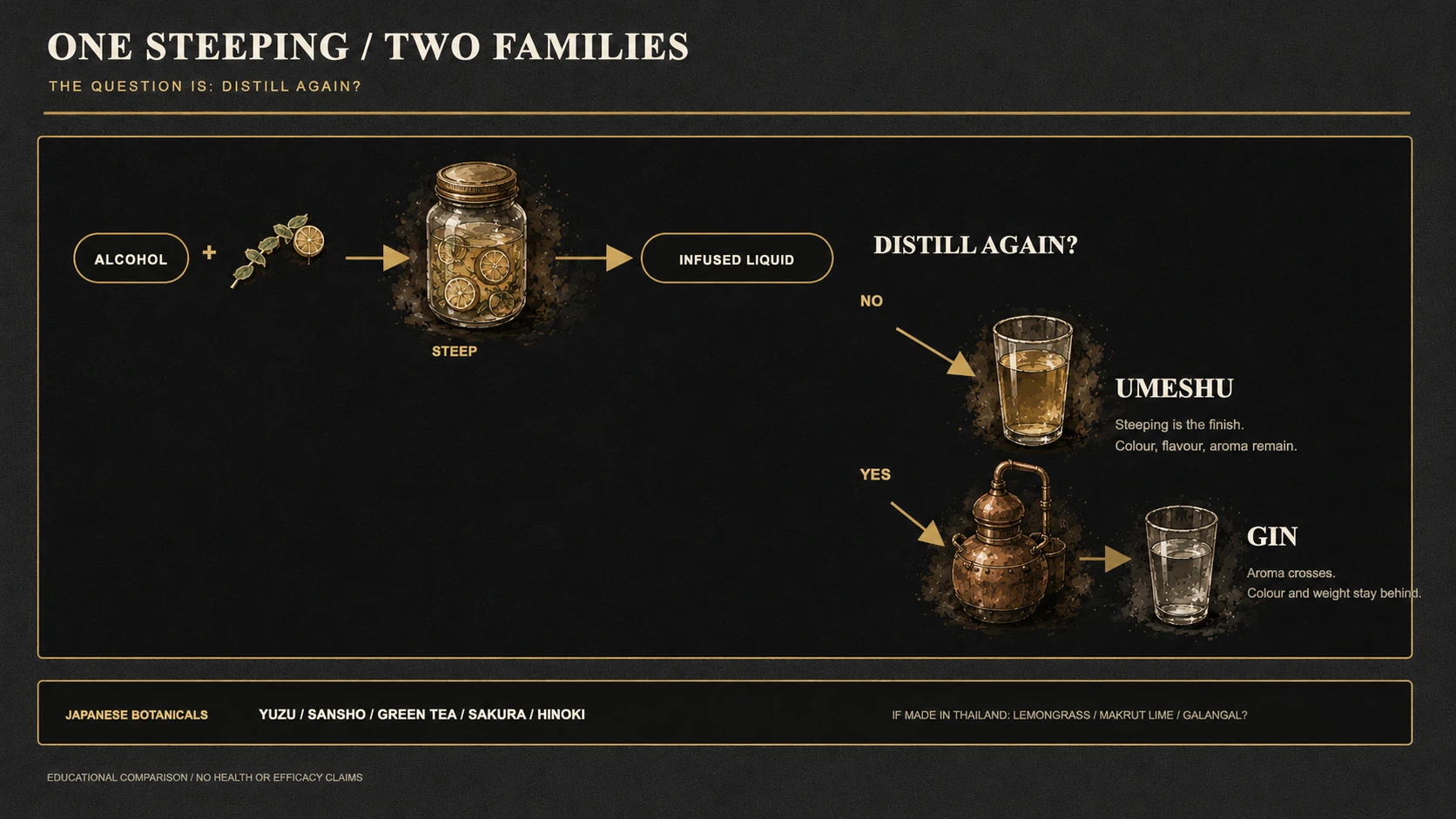
Umeshu and gin are both drinks that steep. Umeshu steeps ume; gin steeps juniper and botanicals. Sink an ingredient in alcohol and move its aroma across — thus far, they are identical.
So why is umeshu an infused drink and gin a distilled one? The fork lies after the steeping.
Umeshu ends with the steeping. The fruit’s colour, tartness, sweetness, and aroma all remain in the liquid. That is why it is amber, viscous, and tastes of ume.
Gin steeps, then distils again. The steeped liquid goes into the still, and only the aroma is lifted as vapour. Colour is left behind; the weight of flavour does not follow. That is why gin is clear and light, with aroma alone standing out.
From the same act of steeping, the families divide at whether or not you distil. This is the border between the map’s three families — umeshu to the house of infused drinks, gin to the house of distilled ones.
(In the shochu chapter, we said that for honkaku shochu, distillation is a technique for choosing what to keep, not for erasing. A gin maker makes a parallel choice — to carry only the plants’ aroma across, and leave the colour and the weight behind.)
There is more than one way to bring botanicals across
How the aroma is moved has its own schools.
- Steep, then distil — botanicals are steeped in alcohol and distilled whole. The most common approach, giving firm aroma.
- Pass the vapour through — botanicals sit in a basket while only the alcohol vapour passes among them. A way of gently carrying delicate aromas that heat would break. Said to suit fragile scents such as yuzu or tea.
- Add aroma without distilling — some are finished by adding flavour without a distillation step. It takes less labour and allows large, consistent production.
None of these is the correct one. Which school suits depends on the botanical. For an aroma as heat-fugitive as yuzu peel, the path of vapour; for the firm core of a root or berry, the path of steeping; and where volume and style call for it, the path without distillation — makers choose a door to suit the plant and the spirit they are aiming for.
For readers in Thailand — if you made gin in Thailand
Imagine something for a moment.
Gin is a spirit that can be made anywhere. Its material is free, and it may add the plants of its own land.
So if you made gin in Thailand, what would you put in it? Lemongrass. Kaffir lime leaf. Galangal. Thai basil. Pandan. — Think of the richness of aroma in a Thai market, and it is a pleasure simply to imagine what face that bottle would wear.
Just as Japan’s gins speak of Japanese landscapes, a Thai gin would speak of Thailand. That is what kind of spirit gin is.
Common misconceptions:
- “Gin is a grain spirit.” → The base material is free — rice, sweet potato, grapes all qualify. Juniper’s aroma defines gin, not its raw material.
- “Gin is an English drink.” → Its origin is genever, from the Netherlands; England took it up and developed its own styles. And its free-material design means it can be made in any land — hence craft gin arising worldwide today.
- “More botanicals, better gin.” → Not a matter of number. It is a design of what you bring across, and how — more does not necessarily mean more complex.
All you need to remember
- Gin is decided by aroma, not by raw material. Where vodka becomes itself by subtracting, gin becomes itself by adding. One thing decides it: the aroma of juniper. So it can be made in any land.
- Umeshu and gin both steep. The fork is whether you distil afterward. Umeshu keeps everything; gin takes only the aroma.
- Japan’s gin is a Japanese plant catalogue. Yuzu, sanshō, green tea, sakura — because the material is free, the place steps forward.
— With this, we have walked all three families on the map: sake among the fermented; shochu, whisky, and gin among the distilled; umeshu and Japanese liqueurs among the infused. You now hold the whole picture of Japanese alcohol.
From here, roads lead deeper into each family. Why is rice polished? What changes between sweet potato and barley? What does a cask hand over? What do yuzu and sanshō add to a single bottle? — Whichever door you enter, you should not lose your way again.
Read next: What Are Umeshu & Liqueurs? / The Map of Japanese Alcohol / Pairing Basics / Glossary of Japanese Drinks
จินถูกนิยามด้วยกลิ่น ไม่ใช่วัตถุดิบ — สุราที่แปลพรรณพืชของแผ่นดินลงในขวดเดียว
เรามองดูเครื่องดื่มมาแล้วสี่ชนิด ทุกชนิดล้วนเรียกชื่อตัวเองด้วยวัตถุดิบได้
สาเกคือสุราจากข้าว โชจูคือสุราจากมันหวาน ข้าวบาร์เลย์ หรือข้าว วิสกี้คือสุราจากข้าวบาร์เลย์ อุเมชูคือสุราจากบ๊วย — แล้ว จินคือสุราจากอะไร?
คำถามนี้ไม่มีคำตอบ จินไม่มีวัตถุดิบตายตัว
จะทำจากธัญพืชก็ได้ จะเป็นข้าว มันหวาน องุ่น หรือกากน้ำตาลก็ได้ ไม่ว่าแอลกอฮอล์ฐานจะเป็นอะไร จินก็ยังเป็นจินได้
— แต่ตรงนี้ต้องเสริมอย่างตรงไปตรงมา ไม่ได้มีแค่จินที่เป็นอิสระในเรื่องวัตถุดิบ วอดก้าที่ปรากฏในบทโชจูก็ไม่เลือกวัตถุดิบเช่นกัน ธัญพืช มันหวาน หรือองุ่น ก็เป็นวอดก้าได้ทั้งนั้น
แล้วอะไรแยกสุราสองชนิดที่เป็นอิสระในวัตถุดิบเหมือนกันออกจากกัน? ทั้งคู่ประกาศตัวตนไปคนละทิศทาง
วอดก้า ดังที่เราเห็นในบทโชจู เดินไปในทางกลั่นซ้ำแล้วซ้ำเล่าเพื่อลบบุคลิกของวัตถุดิบ มันเป็นตัวเองด้วยการลบออก
จินเดินไปอีกทาง มันเป็นตัวเองด้วยการเติมกลิ่นเพียงหนึ่งเดียวเข้าไป ไม่ว่าฐานจะเป็นอะไร ถ้ากลิ่นนั้นยืนเด่น นั่นคือจิน มันเป็นตัวเองด้วยการเติมเข้าไป
รากฐานเป็นอิสระเหมือนกันแท้ ๆ ฝ่ายหนึ่งประกาศตัวด้วยการลบ อีกฝ่ายด้วยการเติม สิ่งที่ตัดสินจินคือกลิ่นของผลเบอร์รีเพียงเม็ดเดียว
ผลเบอร์รีหนึ่งเม็ดเป็นผู้ตัดสิน: จูนิเปอร์
เม็ดนั้นคือ จูนิเปอร์เบอร์รี กลิ่นสดชื่นที่ชวนให้นึกถึงป่าเล็กน้อย หากกลิ่นนั้นยืนเป็นตัวเอก นั่นคือจิน
อิสระในวัตถุดิบ ตายตัวในกลิ่น — การออกแบบนี้มอบคุณสมบัติเฉพาะตัวให้จิน จินทำได้ทุกที่ในโลก และไม่ว่าจะทำที่ไหน ก็สามารถเติมพืชอื่นนอกเหนือจากจูนิเปอร์ได้อย่างอิสระ
จินจึงอธิบายได้อีกแบบว่า: สุราที่แปลบัญชีพรรณพืชของแผ่นดินหนึ่งลงในขวดเดียว
สิ่งที่จินญี่ปุ่นเติมเข้าไป
เรียงพืชที่คราฟต์จินญี่ปุ่นเลือกใช้ออกมา ภูมิทัศน์ญี่ปุ่นก็ผุดขึ้นมาเองเลย
ยูซุ — ส้มฤดูหนาว กลิ่นเปลือกไม่เหมือนทั้งเลมอนและมะนาว ซันโช — พริกไทยญี่ปุ่นที่ทิ้งความซ่าไว้บนลิ้น ชาเขียว — ชั้นเชิงของความฝาดและอูมามิ ซากุระ — กลิ่นฤดูใบไม้ผลิจากใบและดอก ฮิโนกิ — ไม้ไซเปรสของโรงอาบน้ำและศาลเจ้า ขิง ชิโสะ และอื่น ๆ
ผู้ผลิตบางรายเลือกข้าวเป็นฐาน จับคู่สุราข้าวกับจูนิเปอร์และพฤกษาญี่ปุ่น ก็จะได้จินที่เป็นญี่ปุ่นตั้งแต่วัตถุดิบไปจนถึงพฤกษา
เสน่ห์ของจินอยู่ตรงนี้ จินฝรั่งเศสสวมใบหน้าฝรั่งเศส จินญี่ปุ่นสวมใบหน้าญี่ปุ่น ภายใต้ชื่อเดียวกัน มันพูดถึงความทรงจำของแผ่นดินที่ต่างกันโดยสิ้นเชิงได้ เพราะวัตถุดิบเป็นอิสระนี่เอง แผ่นดินจึงก้าวออกมาข้างหน้า
อุเมชูกับจินแยกทางกันตรงไหน?
ตรงนี้สิ่งที่เราอ่านไปก่อนหน้านี้เริ่มออกฤทธิ์
อุเมชูและจินต่างก็เป็นเครื่องดื่มที่ “แช่” อุเมชูแช่บ๊วย จินแช่จูนิเปอร์และพฤกษา จุ่มวัตถุดิบลงในแอลกอฮอล์แล้วย้ายกลิ่นเข้ามา — ถึงตรงนี้ เหมือนกันทุกประการ
แล้วทำไมอุเมชูจึงเป็นสุราแช่ ส่วนจินเป็นสุรากลั่น? ทางแยกอยู่หลังการแช่
อุเมชูจบลงที่การแช่ สีของผลไม้ ความเปรี้ยว ความหวาน และกลิ่นหอม ล้วนคงอยู่ในของเหลว นั่นคือเหตุที่มันเป็นสีอำพัน ข้นหนืด และมีรสบ๊วย
จินแช่ก่อน แล้วจึงกลั่นอีกครั้ง ของเหลวที่แช่แล้วถูกส่งเข้าหม้อกลั่น และเฉพาะกลิ่นเท่านั้นที่ถูกยกขึ้นมาเป็นไอ สีถูกทิ้งไว้เบื้องหลัง น้ำหนักของรสไม่ได้ตามมาด้วย นั่นคือเหตุที่จินใสและเบา โดยมีเพียงกลิ่นที่โดดเด่นออกมา
ออกเดินจากการ “แช่” เหมือนกัน แต่ตระกูลแยกกันตรงที่ว่าจะกลั่นหรือไม่ นี่คือเส้นแบ่งของสามตระกูลบนแผนที่ — อุเมชูไปบ้านของสุราแช่ จินไปบ้านของสุรากลั่น
(ในบทโชจู เราบอกว่า สำหรับฮงกากุโชจูแล้ว การกลั่นคือเทคนิคสำหรับเลือกว่าจะเก็บอะไรไว้ ไม่ใช่เพื่อลบทิ้ง ผู้ผลิตจินก็เลือกในแบบเดียวกัน — พาเฉพาะกลิ่นของพืชไปด้วย และทิ้งสีกับน้ำหนักไว้เบื้องหลัง)
วิธีพาพฤกษาข้ามมามีมากกว่าหนึ่ง
วิธีย้ายกลิ่นก็มีสำนักของมันเอง
- แช่ก่อน แล้วกลั่น — พฤกษาถูกแช่ในแอลกอฮอล์แล้วกลั่นทั้งหมด เป็นวิธีที่พบมากที่สุด ให้กลิ่นที่หนักแน่น
- ให้ไอผ่าน — พฤกษาวางอยู่ในตะกร้าขณะที่เฉพาะไอแอลกอฮอล์ผ่านเข้าไประหว่างมัน เป็นวิธีพากลิ่นบอบบางที่ความร้อนจะทำลายไปอย่างนุ่มนวล ว่ากันว่าเหมาะกับกลิ่นเปราะบางอย่างยูซุหรือชา
- เติมกลิ่นโดยไม่กลั่น — บางชนิดจบด้วยการเติมกลิ่นรสโดยไม่ผ่านขั้นตอนการกลั่น ใช้แรงงานน้อยกว่าและผลิตได้จำนวนมากอย่างสม่ำเสมอ
ไม่มีวิธีใดเป็นวิธีที่ถูกต้อง สำนักไหนเหมาะขึ้นอยู่กับพฤกษาชนิดนั้น ๆ สำหรับกลิ่นที่ระเหยหนีความร้อนง่ายอย่างเปลือกยูซุ ก็เลือกทางของไอ สำหรับแก่นที่แข็งแรงของรากหรือผล ก็เลือกทางของการแช่ และเมื่อปริมาณกับสไตล์ที่ต้องการเรียกร้อง ก็เลือกทางที่ไม่ผ่านการกลั่น — ผู้ผลิตเลือกประตูให้เหมาะกับพืชและสุราที่ตั้งใจจะทำ
ถึงผู้อ่านชาวไทย — ถ้าจะทำจินในเมืองไทย
ลองจินตนาการดูสักครู่
จินคือสุราที่ทำได้ทุกที่ วัตถุดิบเป็นอิสระ และเติมพืชของแผ่นดินตัวเองได้
แล้ว ถ้าจะทำจินในเมืองไทย จะใส่อะไรลงไป? ตะไคร้ ใบมะกรูด ข่า โหระพา ใบเตย — นึกถึงความอุดมของกลิ่นในตลาดไทย แค่จินตนาการว่าขวดนั้นจะสวมใบหน้าแบบไหนก็สนุกแล้ว
เช่นเดียวกับที่จินญี่ปุ่นพูดถึงภูมิทัศน์ญี่ปุ่น จินไทยก็คงพูดถึงเมืองไทย จินคือสุราแบบนั้นเอง
ความเข้าใจผิดที่พบบ่อย:
- “จินคือสุราจากธัญพืช” → วัตถุดิบฐานเป็นอิสระ ข้าว มันหวาน องุ่น ก็ใช้ได้ทั้งนั้น กลิ่นจูนิเปอร์ต่างหากที่นิยามจิน ไม่ใช่วัตถุดิบ
- “จินคือเครื่องดื่มของอังกฤษ” → ต้นกำเนิดคือ เจนีเวอร์ (genever) ของเนเธอร์แลนด์ อังกฤษรับมาแล้วพัฒนาเป็นสไตล์ของตัวเอง และการออกแบบที่วัตถุดิบเป็นอิสระทำให้มันทำได้ในทุกแผ่นดิน คราฟต์จินจึงผุดขึ้นทั่วโลกในทุกวันนี้
- “พฤกษายิ่งเยอะ จินยิ่งดี” → ไม่ใช่เรื่องของจำนวน แต่เป็นการออกแบบว่าจะพาอะไรข้ามมา และพาอย่างไร มากขึ้นไม่ได้แปลว่าซับซ้อนขึ้นเสมอไป
จำแค่นี้ก็พอ
- จินถูกตัดสินด้วยกลิ่น ไม่ใช่วัตถุดิบ ถ้าวอดก้าเป็นตัวเองด้วยการลบ จินก็เป็นตัวเองด้วยการเติม สิ่งที่ตัดสินมีอย่างเดียว: กลิ่นของจูนิเปอร์ จึงทำได้ในทุกแผ่นดิน
- อุเมชูกับจินต่างก็แช่ ทางแยกคือหลังจากนั้นจะกลั่นหรือไม่ อุเมชูเก็บไว้ทั้งหมด จินพาไปเฉพาะกลิ่น
- จินญี่ปุ่นคือบัญชีพรรณพืชญี่ปุ่น ยูซุ ซันโช ชาเขียว ซากุระ — เพราะวัตถุดิบเป็นอิสระ แผ่นดินจึงก้าวออกมาข้างหน้า
— มาถึงตรงนี้ เราได้เดินครบทั้งสามตระกูลบนแผนที่แล้ว: สาเกในกลุ่มสุราหมัก โชจู วิสกี้ และจินในกลุ่มสุรากลั่น อุเมชูและลิเคียวร์ญี่ปุ่นในกลุ่มสุราแช่ ตอนนี้คุณถือภาพรวมทั้งหมดของเครื่องดื่มญี่ปุ่นไว้ในมือแล้ว
จากตรงนี้ มีถนนที่ทอดลึกเข้าไปในแต่ละตระกูล ทำไมข้าวจึงถูกขัดสี? อะไรเปลี่ยนไประหว่างมันหวานกับข้าวบาร์เลย์? ถังไม้ส่งมอบอะไร? ยูซุกับซันโชเติมอะไรลงในขวดเดียว? — ไม่ว่าจะเข้าประตูไหน คุณก็ไม่น่าจะหลงทางอีกแล้ว
อ่านต่อ: อุเมชูและลิเคียวร์คืออะไร / แผนที่เครื่องดื่มญี่ปุ่น / พื้นฐานการจับคู่อาหาร / คำศัพท์สุราญี่ปุ่น
ジンは、原料ではなく香りで決まる — 土地の植物を、一本の瓶に翻訳する酒
ここまで4つの酒を見てきた。そのすべてが、原料の名前で自分を語れる酒だった。
日本酒は、米の酒。焼酎は、芋や麦や米の酒。ウイスキーは、麦の酒。梅酒は、梅の酒。—では、ジンは、何の酒だろう。
この問いに、答えはない。ジンには、決まった原料が存在しない。
穀物から造ってもいい。米でも、芋でも、ぶどうでも、糖蜜でもいい。ベースのアルコールが何であっても、ジンはジンになれる。
—ただし、ここで正直に付け加えておかなければならない。原料が自由なのは、ジンだけではない。 焼酎の章で登場したウォッカもまた、原料を選ばない酒だ。穀物でも、芋でも、ぶどうでも、ウォッカになれる。
では、同じ「原料が自由」な二つの酒を、何が分けているのか。自分の名乗り方が、正反対なのだ。
ウォッカは、焼酎の章で見たとおり、蒸留を繰り返して原料の個性を消していく方向に進んだ。引いて、自分になる酒である。
ジンは、逆をゆく。たった一つの香りを足すことで、自分になる。ベースが何であろうと、その香りさえ立っていれば、それはジンだ。足して、自分になる酒である。
土台が同じく自由でありながら、片方は消すことで、もう片方は足すことで、自分が何者かを名乗る。ジンを決めるのは、たった一粒の実の香りだけなのだ。
ジンを決めるのは、ジュニパーベリーという一粒
その一粒が、ジュニパーベリー(杜松の実)。針葉樹の実の、あの清涼で少し森を思わせる香りだ。それが主役として立っていれば、それはジンである。
原料が自由で、香りだけが決まっている—この設計が、ジンに独特の性質を与えた。ジンは、どこの国でも造れる。 そして造る土地は、ジュニパー以外の植物を自由に足していい。
だからジンとは、こう言い換えられる。その土地の植物図鑑を、一本の瓶に翻訳する酒。
日本のジンが足したもの
日本のクラフトジンが選んだ植物を並べると、それだけで日本の風景が立ちあがる。
柚子—冬の柑橘。皮の香りは、レモンともライムとも違う。山椒—舌に痺れを残す、和の香辛料。緑茶—渋みと旨みの層。桜—葉や花の、春の匂い。檜—湯屋や社の木の香り。生姜、紫蘇、ゆず……。
ベースの酒に米を選ぶ造り手もいる。米のスピリッツにジュニパーと和のボタニカルを合わせれば、原料からボタニカルまで日本のジンが生まれる。
ここに、ジンという酒の面白さがある。フランスのジンはフランスの顔をし、日本のジンは日本の顔をする。 同じ「ジン」という名前で、まったく違う土地の記憶を語れてしまう。原料が自由だからこそ、土地が前に出るのだ。
梅酒とジンは、どこで分かれたのか
さて、ここで前に読んだ話が効いてくる。
梅酒も、ジンも、「漬ける」酒である。 梅酒は梅を漬け、ジンはジュニパーとボタニカルを漬ける。素材をアルコールに沈めて、香りを移す—ここまでは、まったく同じだ。
では、なぜ梅酒は混成酒で、ジンは蒸留酒なのか。分かれ道は、漬けた後にある。
梅酒は、漬けて終わる。 梅の色も、酸味も、甘みも、香りも、すべてが液に残る。だから琥珀色をしていて、とろりとして、梅の味がする。
ジンは、漬けてから、もう一度蒸留する。 漬け込んだ液を蒸留器にかけ、香りだけを蒸気にして取り出す。色は置き去りにされ、味の重さも残らない。だからジンは透明で、軽く、香りだけが際立つ。
同じ「漬ける」から出発して、蒸留するかどうかで、家族が分かれる。 これが、地図の3つの家族の境界線だ—梅酒は混成酒の家へ、ジンは蒸留酒の家へ。
(焼酎の章で、本格焼酎にとって蒸留は、消すためではなく選ぶための技術だと述べた。ジンの造り手も、同じように選んでいる—植物の香りだけを連れていき、色と重さは置いていく、という選択を。)
ボタニカルの入れ方は、一つではない
香りをどう移すかにも、いくつかの流儀がある。
- 漬け込んでから蒸留する — ボタニカルをアルコールに漬け、まるごと蒸留する。もっとも一般的で、しっかりした香りが出る。
- 蒸気にくぐらせる — ボタニカルを籠に入れ、アルコールの蒸気だけを通り抜けさせる。熱で壊れやすい繊細な香りを、そっと連れてくるやり方。柚子や茶のような、傷つきやすい香りに向くとされる。
- 蒸留せずに、香りを加える — 蒸留の工程を経ず、香味を加えて仕上げる方法もある。手間が少なく、大量に安定して造れる。
どれが正しいということではない。ボタニカルごとに、どの流儀が向くかが違うだけだ。柚子の皮のように熱で飛びやすい香りには蒸気の道を、根や実のように芯の強い香りには漬け込みの道を、狙う量とスタイルによっては蒸留を経ない道を—造り手はそうやって、植物と目指す酒に合わせて扉を選んでいる。
タイの読者へ — もし、タイでジンを造るなら
ここでひとつ、想像してみてほしい。
ジンは、どこの国でも造れる酒だった。 原料は自由で、その土地の植物を足していい。
では、タイでジンを造るなら、何を入れるだろう。 レモングラス。コブミカンの葉。ガランガル。タイバジル。パンダンリーフ……。タイの市場に並ぶ香りの豊かさを思えば、その一本がどんな顔をするかは、想像するだけで楽しい。
日本のジンが日本の風景を語るように、タイのジンはタイの風景を語るだろう。ジンとは、そういう酒なのだ。
よくある誤解:
- 「ジンは麦(穀物)の酒」→ ベースの原料は自由。米でも芋でもぶどうでもよい。ジンを決めるのはジュニパーの香りであって、原料ではない。
- 「ジン=イギリスの酒」→ 起源はオランダのジェネヴァ。イギリスはそれを取り入れ、独自のスタイルへ発展させた土地だ。そして原料が自由な設計ゆえ、どの土地でも造れる。だから今、世界中でクラフトジンが生まれている。
- 「ボタニカルが多いほど良いジン」→ 数の問題ではない。何をどう連れてくるかの設計であって、多ければ複雑さが増すとは限らない。
覚えておくのは、これだけ
- ジンは、原料ではなく香りで決まる。 ウォッカが引いて自分になるなら、ジンは足して自分になる。決めるのはジュニパーの香りひとつ。だからどの土地でも造れる。
- 梅酒とジンは、どちらも「漬ける」。分かれ道は、その後に蒸留するかどうか。 梅酒は全部残し、ジンは香りだけ連れていく。
- 日本のジンは、日本の植物図鑑。 柚子・山椒・緑茶・桜—原料が自由だからこそ、土地が前に出る。
—これで、地図の3つの家族をひと通り歩いたことになる。醸造酒の日本酒、蒸留酒の焼酎とウイスキーとジン、混成酒の梅酒と和リキュール。あなたはもう、日本の酒の全体像を手にしている。
ここから先は、それぞれの家族の奥へ進む道が続いている。米はなぜ磨かれるのか。芋と麦で何が変わるのか。樽は何を渡すのか。柚子と山椒は、一本の瓶に何を足すのか。—どの扉から入っても、もう迷うことはないはずだ。