

Redefining ‘Futsū-shu’ at IWC 2026
There are some sakes whose true nature cannot be understood from the label alone. “NiKo,” brewed by Shirataki Sake Brewery—founded in 1855 in Echigo-Yuzawa, Niigata Prefecture—is precisely that kind of bottle. Legally, it is classified as “futsū-shu,” or ordinary sake. Yet in 2026, this sake received recognition in the sake division of one of the world’s largest alcoholic beverage competitions, transcending the conventional boundaries of that classification.
From Silver to Trophy
The stage was the 2026 International Wine Challenge (IWC). Out of 1,738 entries in the sake division, only 59 were selected for a “Trophy,” the highest accolade granted by prefecture and category. NiKo secured the Trophy in the highly competitive “Niigata Prefecture / Futsū-shu” category.
The previous year, in 2025, it had received a Silver award in the same category, marking a significant evolution in just twelve months. This followed a Gold award in the Junmai-shu 51–65% category at Kura Master 2025 in France, as well as a Gold at the Oriental Sake Awards 2025 in Hong Kong. Within a mere year and a half of its debut, NiKo has established a quiet yet undeniable presence across three international stages.
Why Is It Classified as “Futsū-shu”?
Why, then, is NiKo classified as futsū-shu? Under Japanese law, if non-specified auxiliary ingredients are introduced during the brewing process, the sake falls outside the framework of “specially designated sake” (such as junmai daiginjo) and is categorized as futsū-shu. In NiKo’s case, the brewery deliberately chose a distinctive ingredient for this auxiliary role, challenging the stereotype that ordinary sake implies ordinary quality.
A New Light from Polished Remnants
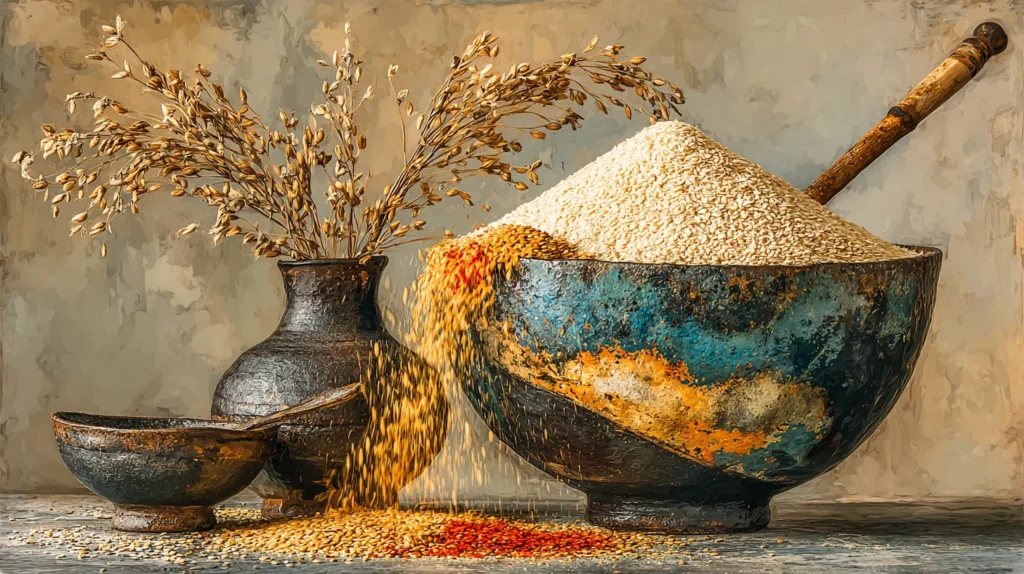
That auxiliary ingredient is rice bran.
SAKE HUNDRED’s flagship sake, “Byakko,” is celebrated for its extreme polishing ratio of 18%. Because 82% of the grain is polished away, processing 1.85 kilograms of raw rice yields approximately 1.5 kilograms of rice bran. Normally, this byproduct is excluded from sake brewing to prevent any distortion of flavor; it is typically discarded or repurposed for other industries.
Shirataki Sake Brewery, however, introduced this rice bran during the fourth stage of brewing. This act of upcycling transforms what was once set aside into a source of refined sweetness. The name itself reflects this symbiotic relationship: “Ni” as a counterpart to “Byaku,” bringing forth another “ko”—or light.
Four-Stage Brewing with White Koji: Integrating Shochu Traditions
Another paradigm shift lies in the micro-biological artistry of the koji. Sake is traditionally crafted with yellow koji. NiKo, however, intentionally incorporates white koji—predominantly used in shochu production—during the crucial fourth stage of brewing. White koji generates an abundance of citric acid, imparting a lively, citrus-like brightness that contrasts beautifully with the lactic acid-driven acidity of conventional sake.
While NiKo possesses a distinct sweetness, with a sake meter value of minus 18, its acidity level of 1.7 provides an elegant structure to the palate. Furthermore, through an ultra-low-temperature fermentation process, the naturally occurring carbon dioxide is gently trapped within the liquid, offering a delicate effervescence. SAKE HUNDRED’s official tasting notes evoke nuances of Japanese pear, strawberry smoothie, white flowers, and raw almond.
Judged by Substance, Not the Label
What NiKo demonstrates is that the designation of “futsū-shu” does not define the character or quality of a sake. The very same liquid won Gold in the Junmai-shu 51–65% category at Kura Master, while securing a Trophy as a futsū-shu at the IWC. While technical classifications vary by competition, the underlying craftsmanship has remained universally recognized across every panel.
To Bangkok
Characterized by a mindful, approachable design with an alcohol content of 13.4% and a gentle sparkle, NiKo is quietly stepping onto the global stage. In 2025, an exclusive gathering introducing the brewery was held at a premium hotel in Bangkok. How this bottle—veiled behind the humble term “futsū-shu”—will continue to unfold in the city is a narrative that may softly reshape how the modern enthusiast perceives the stories behind sake. (Mr. Bacchus)
This article is intended solely to explore the brewing philosophy and cultural heritage of Shirataki Sake Brewery (the producer of NIKO) and the SAKE HUNDRED brand, and does not aim to promote or encourage the consumption of alcohol. / บทความนี้จัดทำขึ้นเพื่อนำเสนอข้อมูลเกี่ยวกับปรัชญาการผลิตและมรดกทางวัฒนธรรมของโรงสาเก Shirataki (ผู้ผลิต NIKO) และแบรนด์ SAKE HUNDRED เท่านั้น มิได้มีเจตนาเพื่อส่งเสริมหรือโฆษณาเครื่องดื่มแอลกอฮอล์ สำหรับผู้มีอายุ 20 ปีขึ้นไป โปรดดื่มอย่างรับผิดชอบ
Discover the culture behind every bottle
We share brewery stories, tasting notes and the craft of koji & fermentation — for educational and cultural purposes only.
เราถ่ายทอดเรื่องราวจากผู้ผลิต บันทึกรสชาติ และศาสตร์แห่งโคจิและการหมัก — เพื่อการศึกษาและวัฒนธรรมเท่านั้น
Follow on Instagram FacebookRelated Articles
“The Philosophy of Bespoke” / “SAKE HUNDRED, What Sets SAKE HUNDRED Apart from Ordinary Sake” / “Why the World Chooses IWC Winners: What the IWC Reveals About Award-Winning Sake Today” / “Sorn, Bangkok’s newly crowned Michelin three-star marvel”
Related Product(s)
SAKE HUNDRED SHINSEI / SAKE HUNDRED GENGA / SAKE HUNDRED AMAIRO / SAKE HUNDRED HAKUSO / SAKE HUNDRED SHIRIN / SAKE HUNDRED RAIHI / NIKO / BYAKKO BESPOKE / BYAKKO