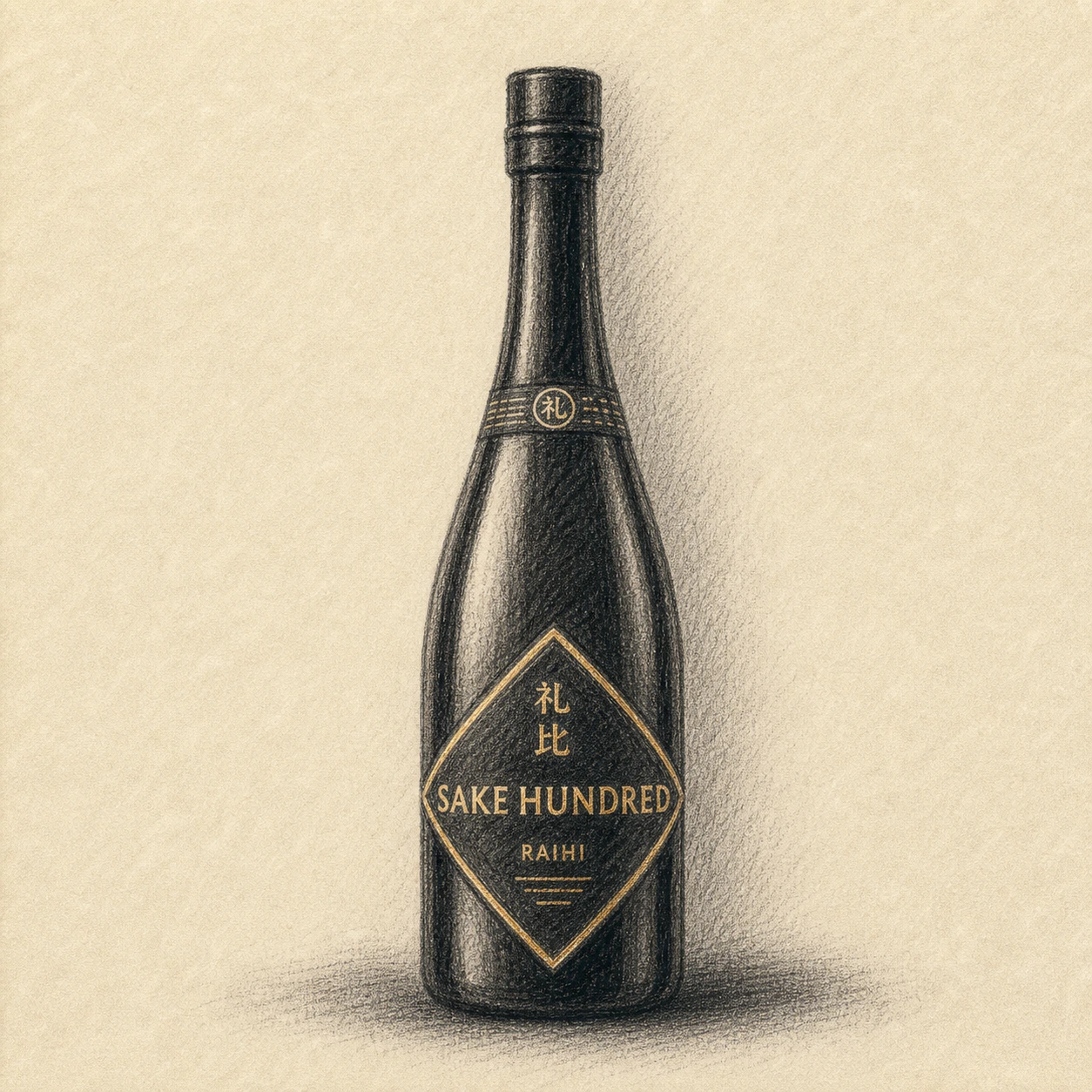
SAKE HUNDRED RAIHI
A sake brewed in 2010, given over to the stillness of ice-temperature storage and time in French oak — a bottling that has grown into maturity’s depth while keeping its freshness intact.

Maturation that keeps time moving, without losing its brightness
RAIHI is an aged sake brewed in 2010 and raised for years at ice temperature. An environment of around -5 °C guides its change slowly, holding both maturity’s depth and freshness at once.
Part of that time is spent inside medium-roast French oak casks, with the exponential brewing method adding further thickness. Cold storage, cask and brewing method together trace a quiet density beneath the sake’s pale colour.
Ripe apple, raisin, a quiet oak finish
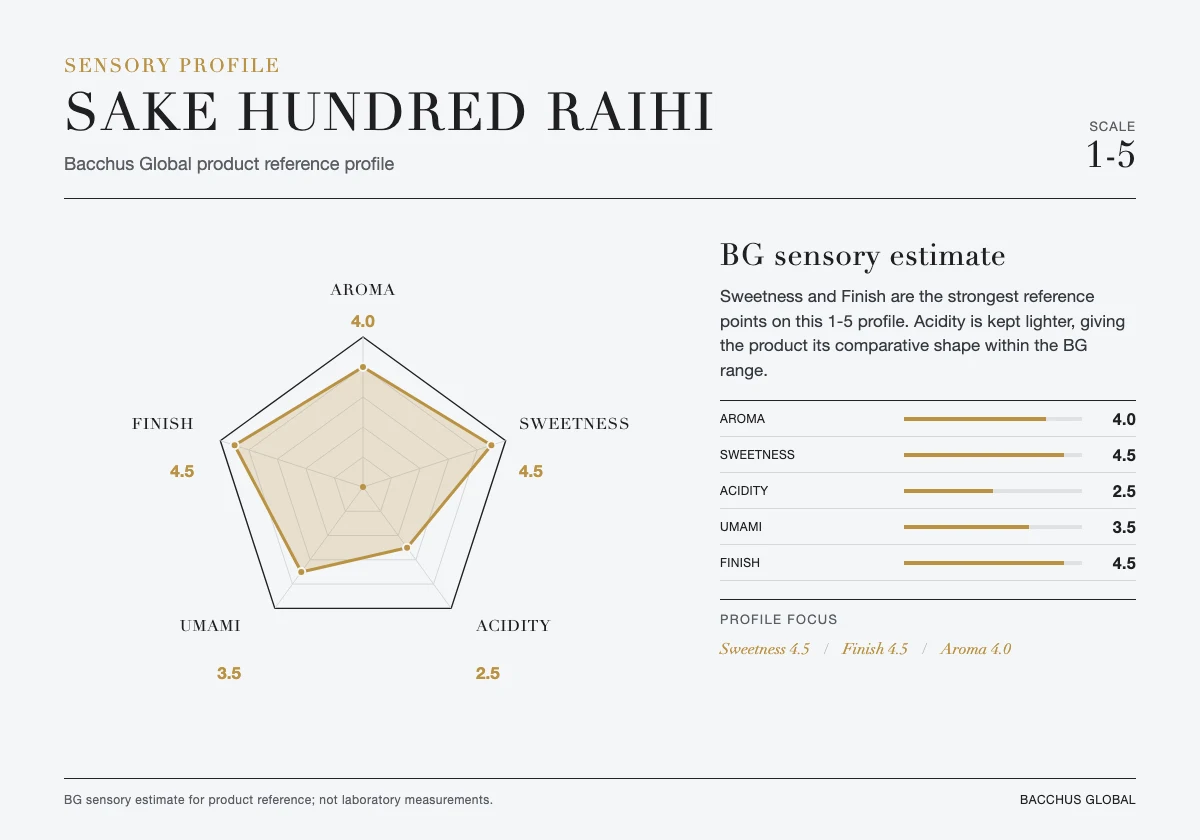
Ripe apple, dried raisin and osmanthus blossom lead the nose. With air, notes of vanilla, butter, and roasted walnut and almond layer in.
The texture is soft, with a round sweetness held up by supple acidity. Rice umami and a faint minerality linger, and the finish is long and calm.
Vanilla, walnut and a round sweetness stay woven together long into the finish.
Gunma, Kawaba — with Nagai Shuzo
RAIHI is brewed by Nagai Shuzo, founded in 1886 in Kawaba, Gunma Prefecture. Sixth-generation brewer-owner Norikichi Nagai began researching maturation in 1995, and after years of trial arrived at the possibility held by ice-temperature storage around -5 °C.
RAIHI is sake brewed in 2010 and watched over ever since within that environment. The brewery’s accumulated years of research are themselves what give the sake its clarity and depth.
Verified international recognition
Listed only where the official Kura Master record matches this exact product name. Other labels and variants are excluded.
A dish to sit alongside its concentrated sweetness and quiet oak
The brand’s own stated affinities are three: dried fruit (raisin, blackberry), financier, and baked cheesecake. What follows are four further directions read from the aroma and taste structure that can be confirmed. Two threads run through them. The vanilla and roasted-nut character from the French oak sits in the same direction as the toasted notes of baked sweets and dried fruit. And the round, concentrated sweetness, set against salty or fatty ingredients, creates an interesting contrast.
Food-pairing literature records that the vanilla and roasted notes carried by cask wood readily resonate with the toasted character of baked sweets and dried fruit. Concentrated sweetness set against salty or fatty ingredients is described as creating an appealing contrast, with a long acidity keeping the pairing light. Against lightly seasoned main dishes, the sweetness and oak character can come forward too strongly, so the directions above centre on desserts and richer ingredients.
Related products
Compare a closely related expression, a contrasting bottle and a reference from the same range.
Related reading
SAKE HUNDRED: Three Distinct Expressions Named Category Champions at the Oriental Sake Awards 2026
Interested in listing SAKE HUNDRED RAIHI at your restaurant or retail venue? Our team can provide information on availability, storage requirements and trade terms.