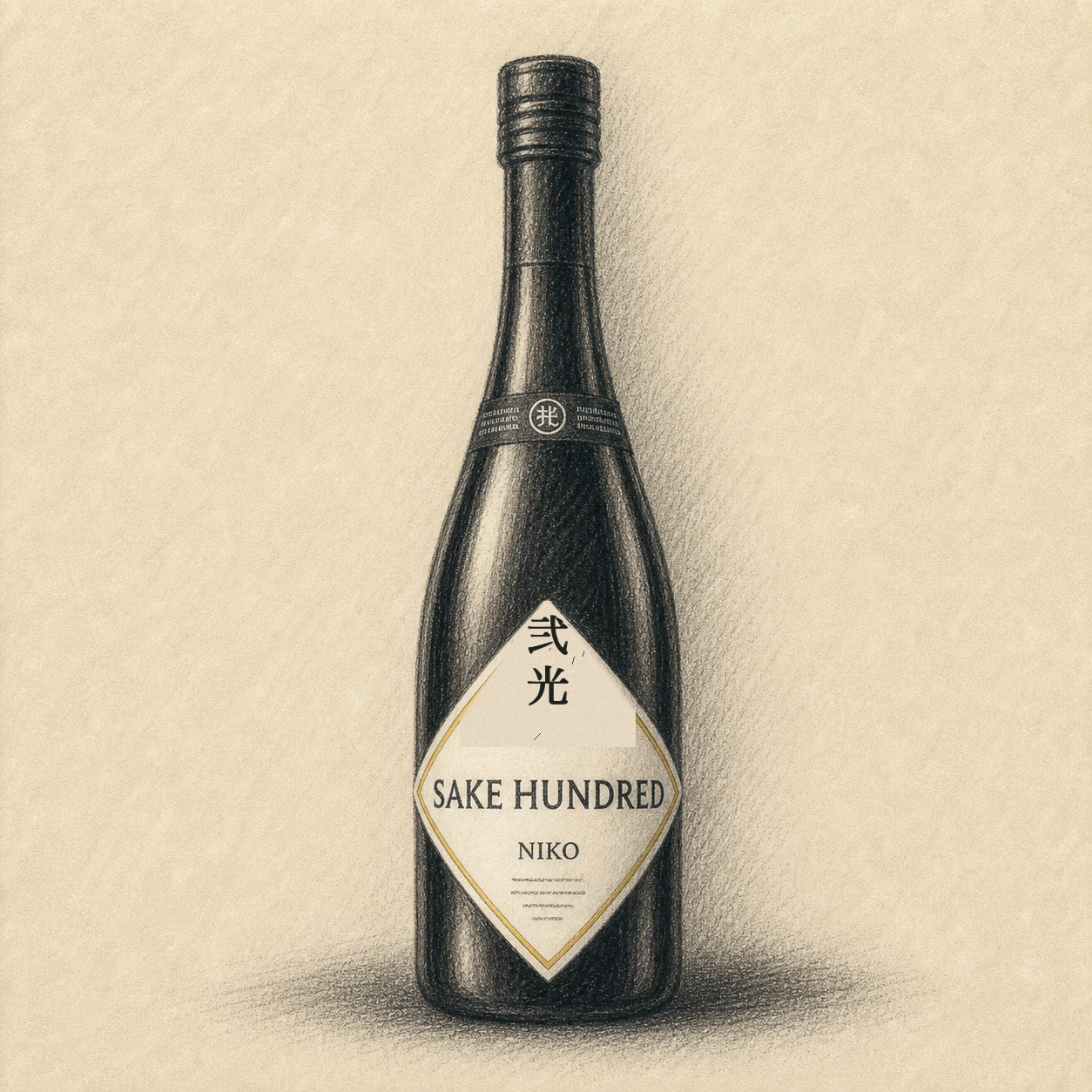
SAKE HUNDRED NIKO
Yellow koji and white koji, layered with rice bran born from another sake’s polishing — a sake that traces a new shape of sweetness and acidity, built on an idea of circulation.
Thailand · Product information
Product information from Bacchus Global Co., Ltd., based in Bangkok, Thailand. About Bacchus Global

Two lights joined — a design of circulation
NIKO is a sake brewed mainly from Niigata-grown Gohyakumangoku rice, using both yellow koji and white koji side by side. Yellow koji goes into the standard three-stage brewing process, and white koji is added in a fourth stage, layering bright acidity into a light frame.
The fourth stage also draws on rice bran left over from polishing Yamagata-grown Dewasansan rice. The idea of tying different strands of brewing knowledge together, opening the rice toward a new expression, is carried in the name “NIKO” — two lights.
The story behind this bottle
A conversation with the brewery at its centre. About six minutes.
Pear and white blossom, a faint effervescence
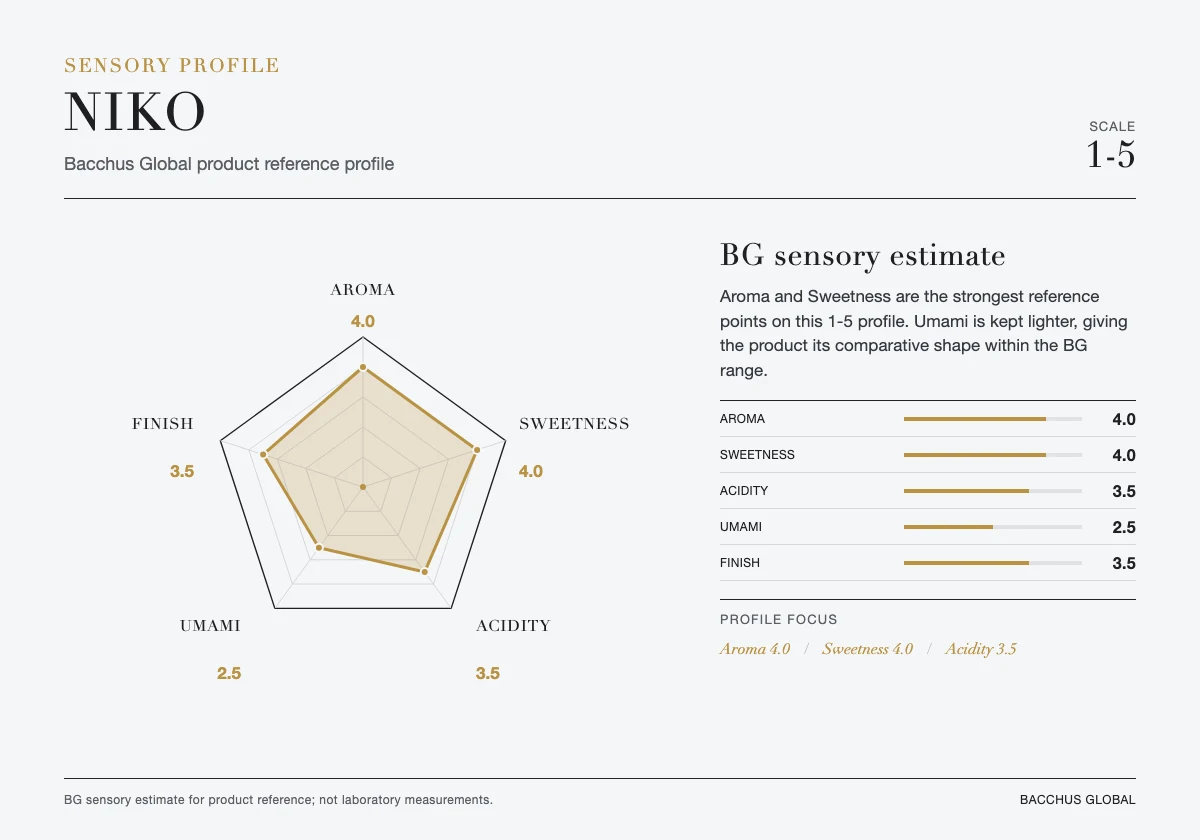
Pear, strawberry and white blossom lead the nose, with delicate notes of almond and greenery. With air, a creamy nuance slowly comes forward.
The texture is round, carrying the gentle acidity of white koji and a faint effervescence. Rice umami, a light salinity and a mineral-like bitterness shape the finish.
That faint effervescence and its mineral edge stay lively through to the last trace of umami.
Niigata, Yuzawa — with Shirataki Shuzo
NIKO is brewed by Shirataki Shuzo, founded in 1855 in Yuzawa, Niigata Prefecture. Working with the soft water that comes from snowmelt off the Tanigawa mountain range, the brewery has refined a clean, light style of sake.
NIKO layers yellow koji, white koji and rice bran onto the clear-cut frame of Gohyakumangoku rice. The brewery’s water and skill draw that complexity together into a single, clear impression.
Verified international recognition
Listed only where the official Kura Master record matches this exact product name. Other labels and variants are excluded.
A lively sweetness and acidity, ready for the table
The brand’s own stated affinities are four: caprese, salmon rillette, karaage (Japanese fried chicken), and scallop. What follows are four further directions read from the aroma and taste structure that can be confirmed. Two threads run through them. A pronounced sweetness works to soften the heat of a spicy dish. And the clean acidity from white koji sits in the same direction as a dish’s own acidity.
Food-pairing literature records that a pronounced sweetness in a drink can soften the heat of a spicy dish, and that acidity can bridge to a dish’s own sourness. A light effervescence is described as cutting through the oil of fried food. Paired alone with a plain, delicate white fish, the pronounced sweetness can overwhelm the ingredient’s subtlety, so the directions above centre on dishes with their own acidity or aroma.
Related products
Compare a closely related expression, a contrasting bottle and a reference from the same range.
Interested in listing SAKE HUNDRED NIKO at your restaurant or retail venue? Our team can provide information on availability, storage requirements and trade terms.