
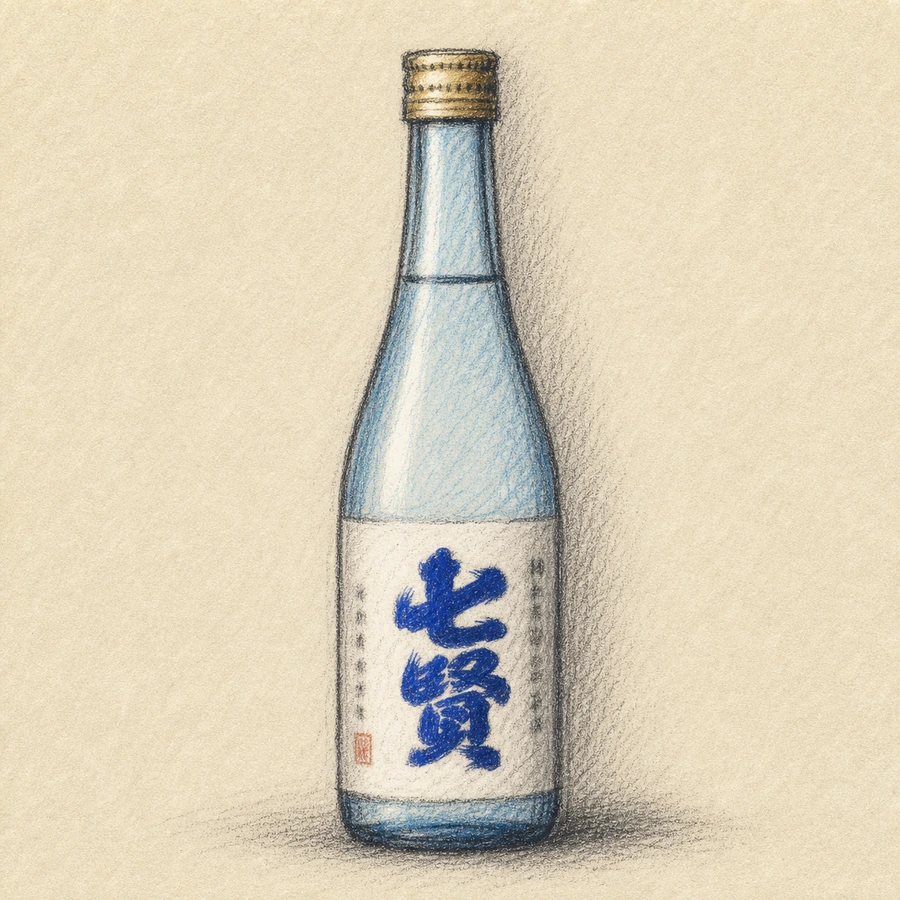
SHICHIKEN Nama Nama Junmai Nama-sake
Hitogokochi and Asahinoyume, bottled without pasteurisation to keep the freshness of Hakushu water and rice — a junmai nama-sake of clear aroma and umami, available year-round.
Thailand · Product information
Product information from Bacchus Global Co., Ltd., based in Bangkok, Thailand. About Bacchus Global
Unpasteurised freshness, all year round
This junmai nama is brewed with Hitogokochi and Asahinoyume rice, polished to 70%. It is never pasteurised, preserving the full-bodied umami distinctive of nama sake and an aroma reminiscent of freshly pressed sake.
ABV follows the brewery’s official figure of 15%. It is offered in 300ml, 720ml and 1800ml bottles and shipped year-round. This page treats it as a separate product from the brewery’s unfiltered nama genshu, released seasonally, and from its “Ichiban Shibori” (first pressing).
Green herbs and fruit, in a juicy umami
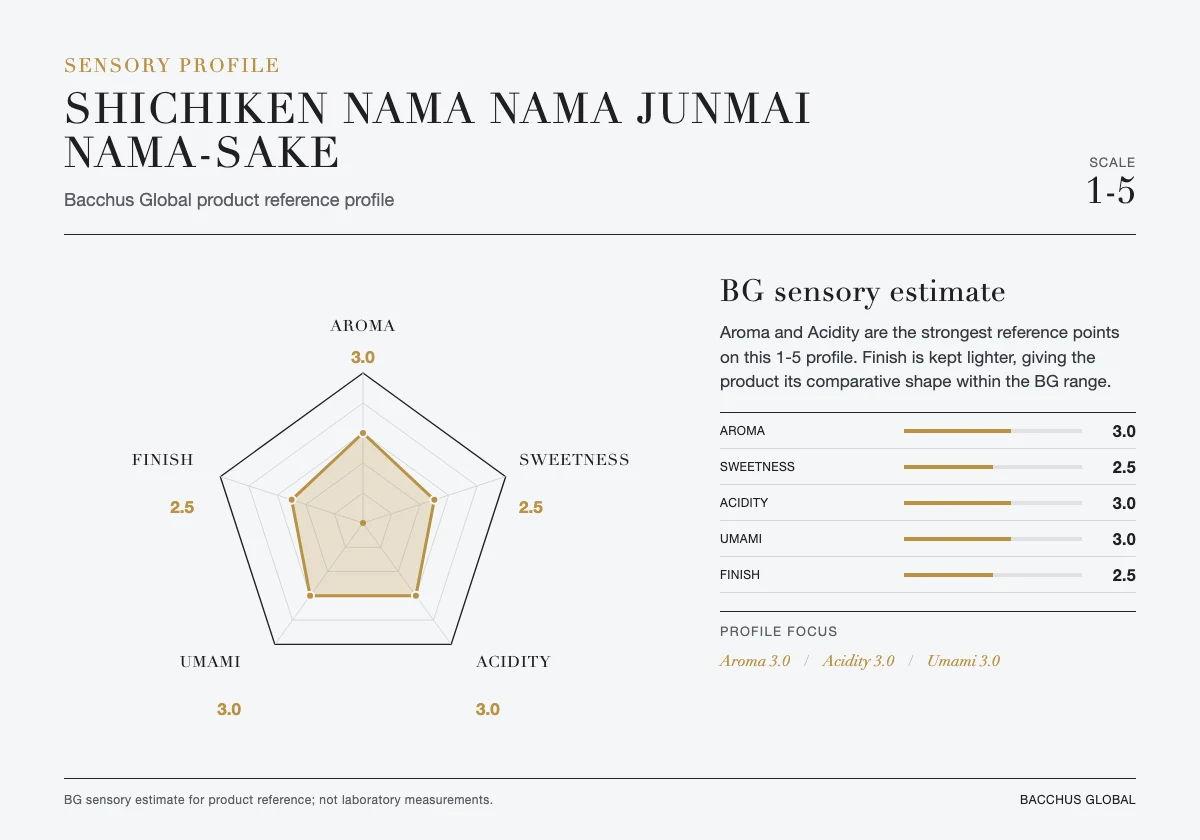
The aroma recalls chestnut, dried apple, lemongrass and rosemary, with a gentle richness suggesting lactic notes. The texture is round and juicy, and rice umami spreads through it. A pleasant acidity and a touch of bitterness keep the finish clean.
Keep refrigerated.
The water of Hakushu, and the Shichiken name carried forward
Yamanashi Meijo was founded in 1750 in Daigahara, Hakushu-cho, Hokuto City, Yamanashi Prefecture. The brewery draws its brewing water from the subsoil flow of Mount Kaikomagatake in the Southern Alps, and gentle fermentation shapes a soft, clear character in its sake.
The name “Shichiken” comes from a transom carving of the “Seven Sages of the Bamboo Grove,” presented in 1835 by the lord of Takato Castle. In 1880, the brewery’s main house served as a lodging for Emperor Meiji during his travels. Carrying forward this historic building and its water, the brewery has since broadened its range to include junmai sake, bottle-fermented sparkling sake, and spirits distilled from its own sake lees.
Question 1
Which pair of rice varieties does this page name?
- Yumeyamasui and Yamada Nishiki
- Hitogokochi and Asahinoyume
- Omachi and Kamenoo
Read the answer and explanation
Correct answer: B — Hitogokochi and Asahinoyume
The sake section names Hitogokochi and Asahinoyume.
Question 2
Which statement matches the page’s explanation of nama sake?
- It is never pasteurised
- It is aged in a cask after bottling
- It is heat-treated just before shipment
Read the answer and explanation
Correct answer: A — It is never pasteurised
The page says this sake is not pasteurised.
Question 3
Which product does this page distinguish from the unfiltered nama genshu?
- A single annual first pressing
- A spirit distilled from sake lees
- This year-round junmai nama sake
Read the answer and explanation
Correct answer: C — This year-round junmai nama sake
This is a year-round junmai nama sake, distinct from the unfiltered nama genshu and Ichiban Shibori.
Lemongrass and herbs, and the juiciness of a nama-sake
From the aromas and taste structure confirmed on the BG product page — chestnut, dried apple, lemongrass and rosemary aromas, a gentle richness suggesting lactic notes, and a round, juicy texture with a pleasant acidity and a touch of bitterness that keep the finish clean — four directions follow.
As a nama-sake with no pasteurisation, it carries a fresh lift that is distinctly its own. The directions above are a reading of the aromas and taste structure that can be confirmed.
Related products
Compare a closely related expression, a contrasting bottle and a reference from the same range.
Interested in listing SHICHIKEN Nama Nama Junmai Nama-sake at your restaurant or retail venue? Our team can provide information on availability, storage requirements and trade terms.
Related product information
- SHICHIKEN Birodo no Aji Junmai-Ginjo
- SHICHIKEN EXPRESSION Sparkling-sake 2019
- SHICHIKEN Hakushin
- SHICHIKEN Kinu no Aji Junmai-Daiginjo
- SHICHIKEN Mori no Kanade Sparkling-sake
- SHICHIKEN Onakaya Junmai-Daiginjo
- SHICHIKEN Selection Alain Ducasse Sparkling-sake
- SHICHIKEN Sora no Irodori Sparkling-sake
- SHICHIKEN Yama no Kasumi Sparkling-sake

