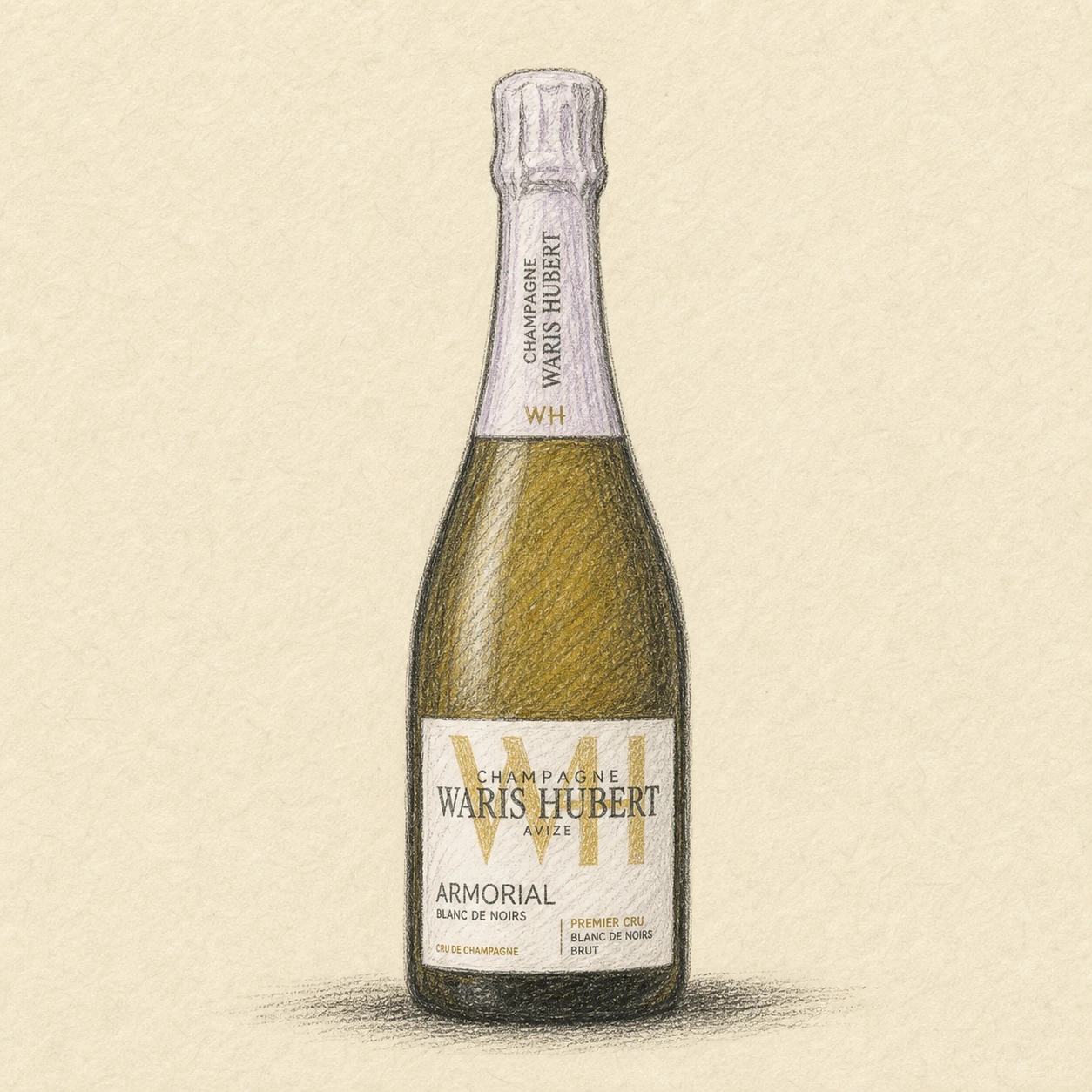
Original bottle illustration — Bacchus Global
Champagne · Blanc de Noirs
WARIS-HUBERTArmorial
Named for the heraldic emblems that define a house's identity, Armorial channels the character of Waris-Hubert through a single village south of the Côte des Blancs — where sandy, sun-warmed soils coax a fuller, fruit-driven expression from Pinot Noir.
Thailand · Product information
Product information from Bacchus Global Co., Ltd., based in Bangkok, Thailand. About Bacchus Global
- Wine type
- Blanc de Noirs Champagne, Brut
- Grape
- Pinot Noir 100%
- Appellation
- AOC Champagne
- Origin
- Barbonne-Fayel, Coteaux Sézannais, Champagne, France
- Drinking window
- —
- Recommended temperature
- 8–10°C
- Alcohol
- 12.0%
- Bottle size
- 750 ml
The Armorial Story
Named for the heraldic emblems that mark a family's identity, Armorial is Waris-Hubert's single-variety expression of Pinot Noir, standing alongside the house's Blanc de Blancs range as its counterpart in character.
It comes from Barbonne-Fayel, a single village in the Coteaux Sézannais at the southern edge of the Côte des Blancs, where the estate's Pinot Noir vines average 35 years of age.
Taste profile
In the glass
ARMORIAL
Scale1–5
BG wine structure estimate
Comparative profile within the Bacchus Global wine range.
Ripe red and orchard fruit shaped by the warm, sandy-limestone soils of Barbonne-Fayel.
Full-bodied and fruit-driven, carrying the natural ripeness of 35-year-old Pinot Noir vines with a measured, well-integrated dosage.
Pale gold in the glass, with a fine, persistent bead typical of a single-variety Pinot Noir Champagne.
Before it reaches the glass
Temperature
8–10°C
Timing
—
Glassware
A tulip-shaped Champagne glass that concentrates aroma while preserving the mousse.
Question 1
Which grape variety is used?
- 100% Pinot Noir
- 100% Chardonnay
- 100% Aligoté
Read the answer and explanation
Correct answer: A — 100% Pinot Noir
Answer: 100% Pinot Noir. The linked section gives the source detail.
Read the relevant passageQuestion 2
Which village supplies the grapes?
- Avize
- Barbonne-Fayel
- Molesme
Read the answer and explanation
Correct answer: B — Barbonne-Fayel
Answer: Barbonne-Fayel. The linked section gives the source detail.
Read the relevant passageQuestion 3
Approximately how long is bottle maturation?
- Two weeks
- Twenty years
- Two years
Read the answer and explanation
Correct answer: C — Two years
Answer: Two years. The linked section gives the source detail.
Read the relevant passageAt the table
Armorial's full-bodied Pinot Noir character suits dishes with char, smoke and richer fat, making it a versatile partner across cuisines.
From Japanese grilled dishes to Thai charcoal cooking and Western roasted fare, the wine's ripe fruit and structured palate find natural common ground with dishes built around fire and savory depth.
Japanese
- Seared duck breast
- Charcoal-grilled yakitori
- Grilled teriyaki-glazed fish
Why it worksThe wine's full-bodied Pinot Noir character and fruit depth stand up to the char and savory glaze typical of Japanese grilled dishes.
Thai
- Smoked gai yang (Thai grilled chicken)
- Charcoal-grilled pork skewers
- Grilled river prawns with nam jim
Why it worksIts ripe fruit and moderate dosage balance the smoky char and chili-forward seasoning common in Thai charcoal grilling, without being overwhelmed by the dish's intensity.
Western
- Roasted duck breast with fruit jus
- Grilled charcuterie platter
- Aged Comté or similar firm cheese
Why it worksThe wine's structure and fruit-forward profile complement richer grilled meats and firm cheeses typical of Western tables, mirroring the fuller style associated with Blanc de Noirs.
From cellar to bottle
Winemaking
Grapes are pressed and undergo a 72-hour cold settling at 4°C before fermentation, carried out mainly in stainless steel at 16°C with a portion vinified in 600-litre oak barrels; partial malolactic fermentation follows.
Product detail
The wine rests roughly two years in a temperature-controlled cellar at 11°C, then finished with a Brut dosage of 6.2 g/L, reaching 12.0% alcohol.
Barbonne-Fayel & the Coteaux Sézannais
The sandy, heat-retentive soils of this southern village create a warmer microclimate than the pure chalk of the Côte des Blancs, allowing Pinot Noir to reach full ripeness earlier and yielding a fuller style of base wine.
Official producer website→Trade information
Contact Bacchus Global for product documentation, availability and trade enquiries.
Related product information
- CHAI GARNEROT Vénus Blanc de Blancs Extra Brut 2017
- DOMAINE AMIRAULT Pet'Night Blanc Pétillant Naturel N.V.
- DOMAINE LE FAY D'HOMME X Bulles N.V.
- DOMAINE LÉON HEITZMANN MANEKINEKO Crémant d'Alsace
- WARIS HUBERT Clos de la Corneille Grand Cru 2012
- WARIS-HUBERT Albescent Grand Cru Blanc de Blanc Extra-Brut 2019
- WARIS-HUBERT Estence Premier Cru Extra-Brut 2020
- WARIS-HUBERT Lilyale