

MIZUBASHO Artist Series Dessert Sake
A dessert sake made by the kijoshu method from domestic rice, at 12% ABV.
Thailand · Product information
Product information from Bacchus Global Co., Ltd., based in Bangkok, Thailand. About Bacchus Global
A sweet kijoshu, tailored for after dinner
This is made using the kijoshu method, which replaces part of the brewing water with sake itself. It uses domestic rice, comes in at 12% ABV, and is bottled at 300 ml. Rather than foreground polishing ratio or rice variety, this Artist Series bottling is built to carry its own story as an after-dinner sake.
The label is produced in collaboration with a Japanese artist, and 5% of sales are donated to the Oze Mizubasho Project. The bottle also carries VegeProject Japan’s vegan certification — sake, art and an environmental commitment brought together in one small bottle.
How it tastes
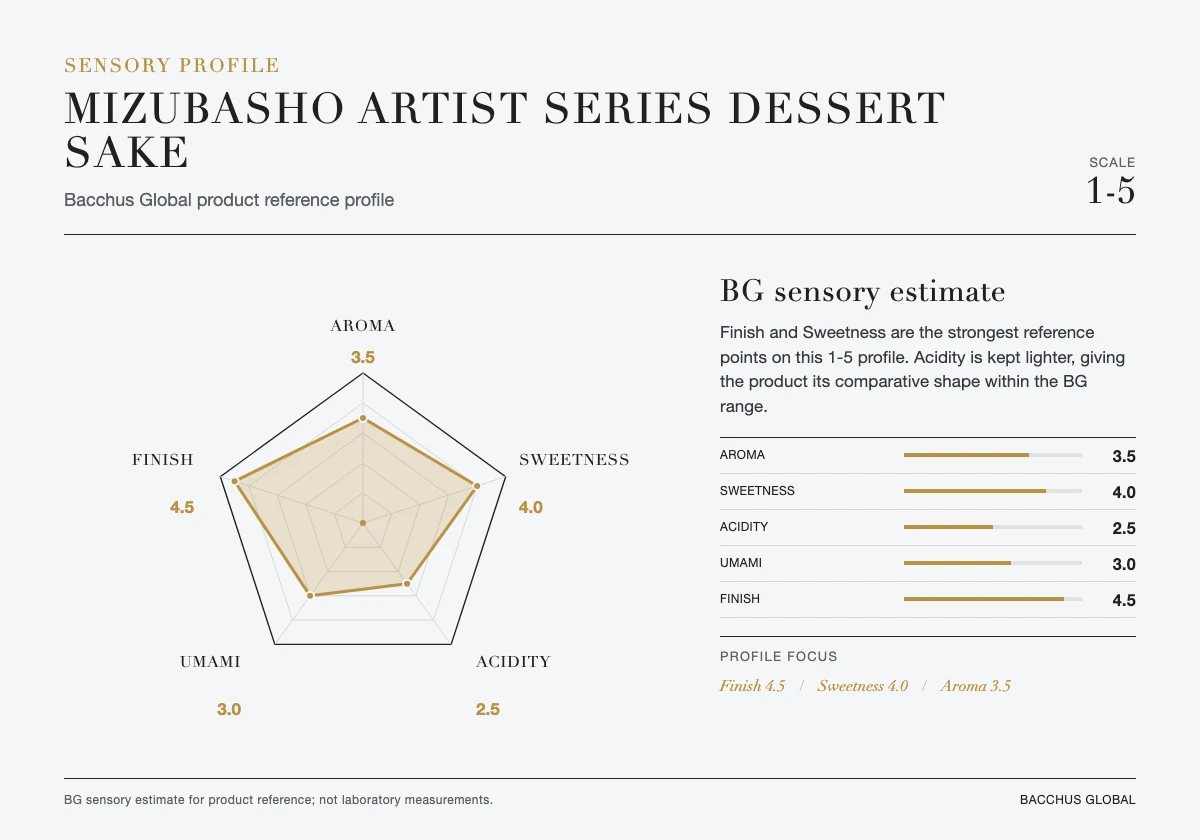
Passionfruit and apricot aromas meet an elegant, concentrated sweetness. The texture is smooth, with kijoshu’s characteristic richness unfolding slowly and its aroma and sweetness lingering well into the finish.
That concentrated sweetness stays balanced by the aroma’s lift, never turning cloying.
MIZUBASHO / TANIGAWADAKE · Nagai Sake Brewery · Gunma
Nagai Sake Brewery was founded in 1886 in Kawaba Village, Gunma Prefecture. Its story begins with first-generation brewer Shoji Nagai, who came upon the local water and built the brewery around it. The company has protected the surrounding forest that feeds its brewing water ever since, carrying forward the soft, mountain-water character it draws from.
MIZUBASHO pursues aromatic lift and range at the table, while TANIGAWADAKE offers a cleaner, everyday drinking style built around daily cooking. Both labels grow from the same Kawaba Village water, shaped into two distinct roles.
Question 1
How does the page explain the kijoshu method?
- Distil twice
- Replace part of the brewing water with sake
- Ferment a second time in the bottle
Read the answer and explanation
Correct answer: B — Replace part of the brewing water with sake
Part of the brewing water is replaced with sake.
Question 2
What can be established about the rice variety?
- Only Yamada Nishiki is used
- Only Omachi is used
- The rice is grown in Japan, but the variety is not disclosed
Read the answer and explanation
Correct answer: C — The rice is grown in Japan, but the variety is not disclosed
The page identifies rice grown in Japan without naming its variety.
Question 3
What do “passionfruit” and “apricot” denote?
- Aroma impressions
- Added juices
- The artists who designed the label
Read the answer and explanation
Correct answer: A — Aroma impressions
They are comparisons for the aroma, not an ingredient list.
Verified international recognition
Listed only where the official Kura Master record matches this exact product name. Other labels and variants are excluded.
At the table
Pair it with desserts that share its own sweetness, or with salty, full-flavoured cheese. Keep the dish no sweeter than the sake itself, and the fruit aroma stays clear.
- Citrus or fruit desserts
- Ice cream
- Chocolate
- Blue cheese
Related products
Compare a closely related expression, a contrasting bottle and a reference from the same range.
Related stories
Bacchus Global articles on Nagai Sake Brewery, MIZUBASHO, the water of Kawaba Village and the Nagai Style, and on how kijoshu is brewed.
Interested in listing MIZUBASHO Artist Series Dessert Sake at your restaurant or retail venue? Our team can provide information on availability, storage requirements and trade terms.

