
Burgundy, Through One Map
Why Are There "About 80" Different Producers Inside a Single Walled Vineyard? — Burgundy, Through One Map
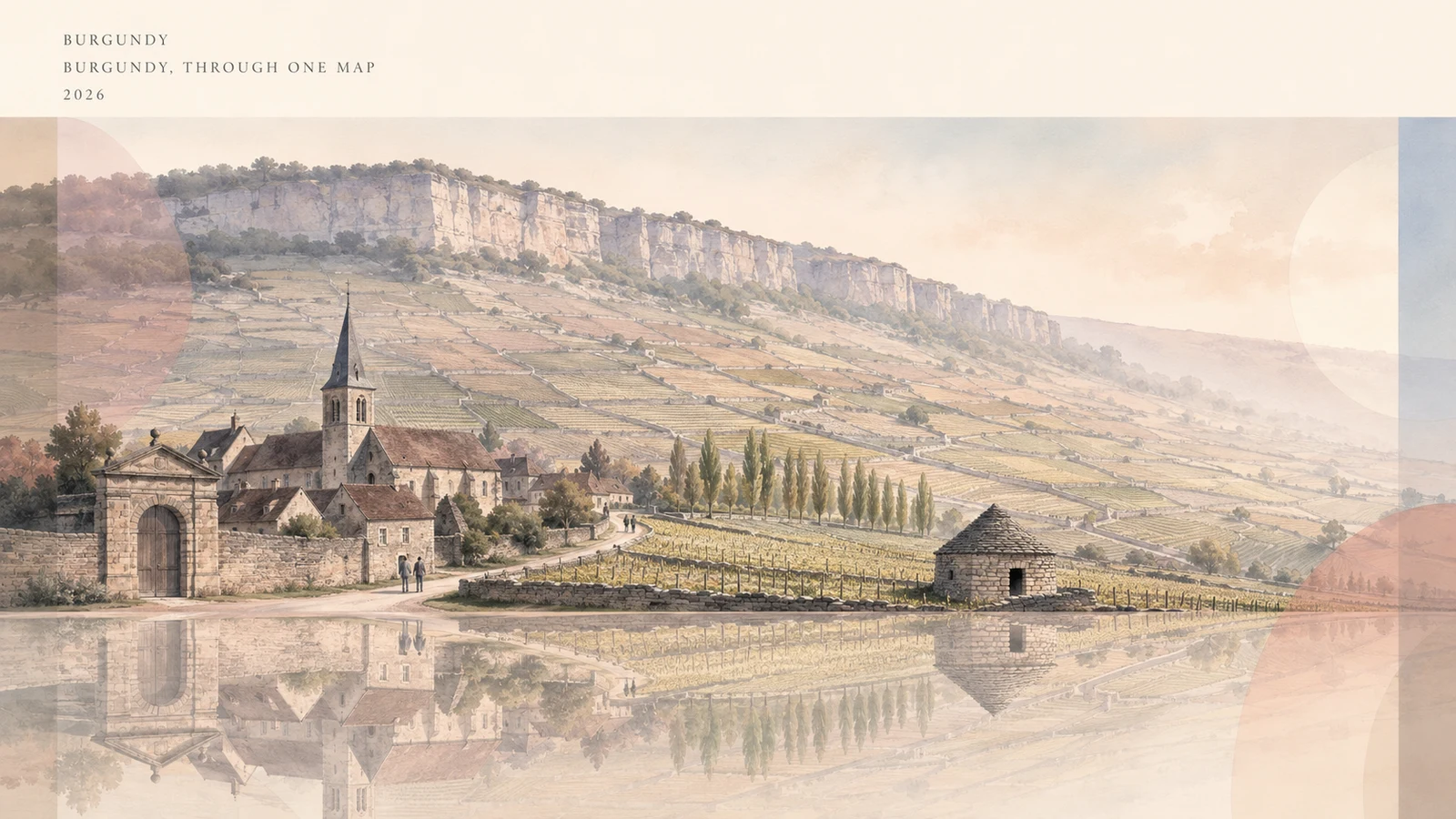
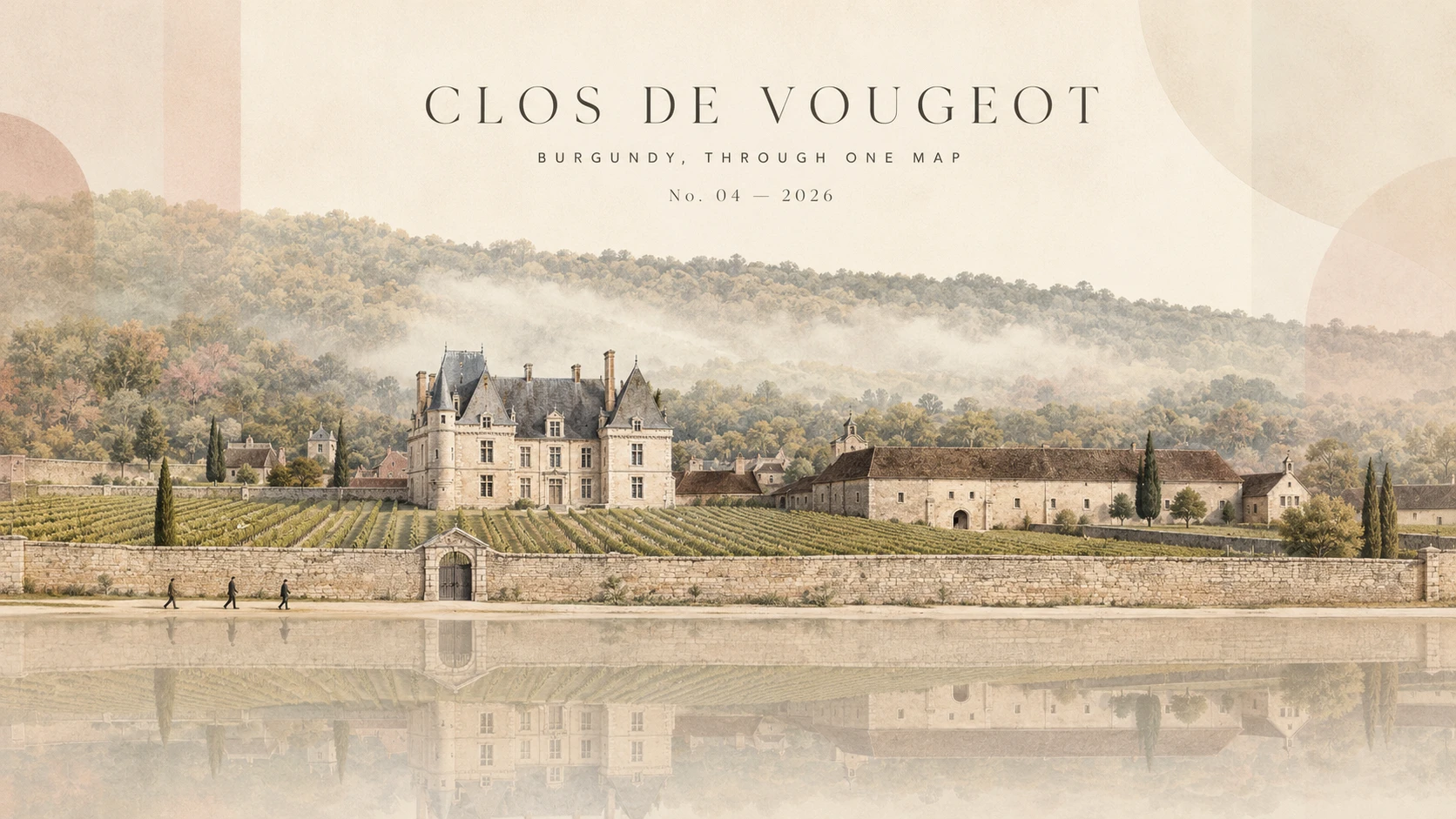
In a village in the Côte de Nuits, one encounters a single stone wall that encircles an entire vineyard. Its name is Clos de Vougeot. Its area is about 50 hectares. Seen from outside the wall, whether on a map or on the ground, it looks like a single vineyard.
But gather together the labels of the wines made from grapes grown inside this wall, and the names of the producers written on them are not one. Dozens of different wines all carry the same name, “Clos de Vougeot.” How many producers are there inside the wall? Count them, and the answer is about 80. The roughly 50 hectares of vineyard are divided among about 80 producers, each responsible for their own parcel. One wall, one vineyard, about 80 producers — why does this happen? The answer comes down to a single point: in Bordeaux and in Burgundy, the word “classification” does not point to the same thing.
| Item | Details |
|---|---|
| Region covered | Burgundy (centered on the Côte d’Or, from Chablis to the Mâconnais) |
| Unit of classification | The climat — an individually delimited vineyard parcel |
| Classification tiers | Four tiers: Regional / Village / Premier Cru / Grand Cru |
| Count by tier (BIVB data) | 33 Grand Crus / 662 climats classified as Premier Cru / 44 village appellations / 7 regional appellations |
| System & World Heritage status | The AOC (Appellation d’Origine Contrôlée) system began operating in 1936 / “The Climats, Terroirs of Burgundy” was inscribed as a UNESCO World Heritage Site on July 4, 2015 (1,247 climats counted at the time of inscription, spanning the Côte de Nuits to the Côte de Beaune) |
| One entry-point fact | Clos de Vougeot (Grand Cru) — inside a single wall, about 50 hectares shared among roughly 80 producers |
Bordeaux Classified the Producer
In 1855, ahead of the Paris World’s Fair, Bordeaux’s brokers drew up a classification. Their standard was the trading price and reputation of the time. What they lined up were “châteaux” — the very producers who made the wine. From beginning to end, the subject of the classification was the producer.
Burgundy Classified the Land
Burgundy’s classification is attached to something different. Its four-tier pyramid — Regional, Village, Premier Cru, Grand Cru — is assigned not to a producer, but to each individually delimited vineyard parcel, called a climat. The name of a Grand Cru is the name of that climat itself. So even when a parcel’s owner changes, the rank stays with the land. This system, the AOC (Appellation d’Origine Contrôlée), began operating in 1936.
About 80 People Inside the Wall
Clos de Vougeot is one of these climats. As long as the grapes are grown inside this wall, the wine may carry the name “Clos de Vougeot,” no matter which of the roughly 50 hectares of parcels they came from. About 80 people each tend their own small parcel while making wine under this same single vineyard name — and that clearly shows that the subject of the classification is the land, not the person.
There Are Still Stories on the Map Yet to Be Told
This stretch of land running from the Côte de Nuits to the Côte de Beaune, together with the 1,247 climats counted at the time, was inscribed as a UNESCO World Heritage Site on July 4, 2015. But the map does not end there. From Romanée-Conti to Chablis — on a single map, there are as many stories as there are vineyards. Below are the 12 stories that have walked across that map.
Three Facts Worth Knowing
- Clos de Vougeot is a roughly 50-hectare vineyard enclosed by a single wall. Inside it are about 80 producers, and dozens of different wines all carry the same vineyard’s name.
- Bordeaux’s 1855 classification was a list of “châteaux” — producers. Burgundy’s classification is attached to “climats” — vineyard parcels. The subject of the classification is different.
- So even when a vineyard’s owner changes, its rank stays with the land. This is why the name that takes center stage on a Burgundy label is so often not a person’s name, but a vineyard’s.
In this series
This article is the opening chapter (Episode 0) of the series “Burgundy, Through One Map.” The 12 stories of individual vineyards and producers are all published and indexed below.
Explore All 12 Stories
Chapter 1 — The Vosne-Romanée Trilogy
Chapter 2 — Legends of the Côte de Nuits
Chapter 3 — White Wine Legends of the Côte de Beaune
Chapter 4 — To the Edge of the Map
ในหมู่บ้านแห่งหนึ่งของโกต เดอ นุยส์ (Côte de Nuits) มีกำแพงหินแนวหนึ่งล้อมรอบไร่องุ่นทั้งผืนเอาไว้ ชื่อของที่นี่คือ โกล เดอ วูโฌ (Clos de Vougeot) มีเนื้อที่ราว 50 เฮกตาร์ หากมองจากภายนอกกำแพง ไม่ว่าจะบนแผนที่หรือในสถานที่จริง ก็ดูเหมือนไร่องุ่นเพียงผืนเดียว
แต่เมื่อรวบรวมฉลากของไวน์ที่ทำจากองุ่นซึ่งปลูกอยู่ภายในกำแพงนี้มาดู ชื่อผู้ผลิตที่ปรากฏบนฉลากกลับไม่ได้มีเพียงชื่อเดียว ไวน์หลายสิบชนิดต่างใช้ชื่อ “Clos de Vougeot” ร่วมกัน ภายในกำแพงนี้มีผู้ผลิตอยู่กี่ราย เมื่อนับดูแล้วคือราว 80 ราย ไร่องุ่นเนื้อที่ราว 50 เฮกตาร์ถูกแบ่งกันดูแลโดยผู้ผลิตราว 80 ราย แต่ละรายรับผิดชอบแปลงของตนเอง กำแพงเดียว ไร่องุ่นผืนเดียว ผู้ผลิตราว 80 ราย — เหตุใดจึงเกิดเรื่องเช่นนี้ขึ้นได้ คำตอบอยู่ที่จุดเดียว นั่นคือคำว่า “การจัดอันดับ” ในบอร์โดซ์กับในบูร์กอญนั้น ไม่ได้หมายถึงสิ่งเดียวกัน
| รายการ | รายละเอียด |
|---|---|
| พื้นที่ครอบคลุม | แคว้นบูร์กอญ (Bourgogne) โดยมีโกตดอร์ (Côte d’Or) เป็นศูนย์กลาง ครอบคลุมตั้งแต่ชาบลี (Chablis) ถึงมาโกแนส์ (Mâconnais) |
| หน่วยของการจัดอันดับ | climat — แปลงไร่องุ่นที่ถูกขีดเส้นแบ่งไว้เป็นรายแปลง |
| ลำดับชั้นการจัดอันดับ | 4 ระดับ ได้แก่ Régionale (ระดับภูมิภาค) / Village (ระดับหมู่บ้าน) / Premier Cru / Grand Cru |
| จำนวนแต่ละระดับ (ข้อมูลจาก BIVB) | Grand Cru 33 แห่ง / climat ที่จัดเป็น Premier Cru 662 แปลง / Village AOC 44 แห่ง / Régionale AOC 7 แห่ง |
| ระบบและสถานะมรดกโลก | ระบบ AOC (Appellation d’Origine Contrôlée) เริ่มดำเนินการตั้งแต่ปี 1936 / “Climats du vignoble de Bourgogne” ได้รับการขึ้นทะเบียนเป็นมรดกโลกโดย UNESCO เมื่อวันที่ 4 กรกฎาคม 2015 (ณ ขณะขึ้นทะเบียนนับได้ 1,247 climats ครอบคลุมตั้งแต่โกต เดอ นุยส์ถึงโกต เดอ โบน) |
| ข้อเท็จจริงหนึ่งข้อที่เป็นจุดเริ่มต้น | โกล เดอ วูโฌ (Clos de Vougeot, Grand Cru) — ภายในกำแพงเดียว เนื้อที่ราว 50 เฮกตาร์ถูกแบ่งกันดูแลโดยผู้ผลิตราว 80 ราย |
บอร์โดซ์จัดอันดับผู้ผลิต
ในปี 1855 ก่อนงานนิทรรศการโลกที่ปารีส บรรดานายหน้าค้าไวน์แห่งบอร์โดซ์ได้จัดทำการจัดอันดับขึ้น โดยใช้เกณฑ์ราคาซื้อขายและชื่อเสียงในเวลานั้น สิ่งที่พวกเขานำมาเรียงลำดับคือ “ชาโต” (château) ซึ่งหมายถึงตัวผู้ผลิตไวน์เอง ตั้งแต่ต้นจนจบ สิ่งที่การจัดอันดับนี้ยึดเป็นหลักคือตัวผู้ผลิต
บูร์กอญจัดอันดับผืนดิน
การจัดอันดับของบูร์กอญผูกอยู่กับสิ่งที่ต่างออกไป โครงสร้างพีระมิด 4 ระดับ — Régionale, Village, Premier Cru, Grand Cru — ไม่ได้ถูกกำหนดให้กับผู้ผลิต แต่ถูกกำหนดให้กับแปลงไร่องุ่นแต่ละแปลงที่เรียกว่า climat ชื่อของ Grand Cru แต่ละแห่งก็คือชื่อของ climat นั้นเอง ดังนั้นแม้เจ้าของแปลงจะเปลี่ยนไป ระดับชั้นก็ยังคงอยู่กับผืนดินนั้นต่อไป ระบบนี้ — AOC หรือ Appellation d’Origine Contrôlée — เริ่มดำเนินการมาตั้งแต่ปี 1936
ผู้ผลิตราว 80 รายภายในกำแพง
โกล เดอ วูโฌก็คือหนึ่งใน climat เหล่านี้ ตราบใดที่องุ่นเติบโตอยู่ภายในกำแพงนี้ ไวน์ก็สามารถใช้ชื่อ “Clos de Vougeot” ได้ ไม่ว่าองุ่นนั้นจะมาจากแปลงใดในเนื้อที่ราว 50 เฮกตาร์ก็ตาม ผู้ผลิตราว 80 รายต่างดูแลแปลงเล็ก ๆ ของตนเอง พร้อมกับผลิตไวน์ภายใต้ชื่อไร่องุ่นเดียวกันนี้ — สิ่งนี้แสดงให้เห็นอย่างชัดเจนว่าสิ่งที่การจัดอันดับยึดเป็นหลักคือผืนดิน ไม่ใช่ตัวบุคคล
บนแผนที่ยังมีเรื่องราวอีกมากที่ยังไม่ถูกเล่า
ผืนดินต่อเนื่องแห่งนี้ตั้งแต่โกต เดอ นุยส์ไปจนถึงโกต เดอ โบน พร้อมกับ 1,247 climats ที่นับได้ ณ ขณะนั้น ได้รับการขึ้นทะเบียนเป็นมรดกโลกโดย UNESCO เมื่อวันที่ 4 กรกฎาคม 2015 แต่แผนที่ไม่ได้จบอยู่เพียงเท่านั้น จากโรมาเน-กงติ (Romanée-Conti) ไปจนถึงชาบลี (Chablis) — บนแผนที่เพียงหนึ่งแผ่น มีเรื่องราวมากเท่ากับจำนวนไร่องุ่น ด้านล่างนี้คือ 12 เรื่องราวที่ได้เดินทางผ่านแผนที่แผ่นนั้นมาแล้ว
3 เรื่องที่รู้แล้วเล่าต่อได้
- โกล เดอ วูโฌ คือไร่องุ่นเนื้อที่ราว 50 เฮกตาร์ที่ล้อมรอบด้วยกำแพงเพียงแนวเดียว ภายในมีผู้ผลิตราว 80 ราย และไวน์หลายสิบชนิดต่างใช้ชื่อไร่องุ่นเดียวกันนี้ร่วมกัน
- การจัดอันดับปี 1855 ของบอร์โดซ์คือรายชื่อของ “ชาโต” ซึ่งหมายถึงผู้ผลิต ส่วนการจัดอันดับของบูร์กอญผูกอยู่กับ “climat” ซึ่งหมายถึงแปลงไร่องุ่น สิ่งที่การจัดอันดับยึดเป็นหลักนั้นต่างกัน
- ดังนั้น แม้เจ้าของไร่องุ่นจะเปลี่ยนไป ระดับชั้นก็ยังคงอยู่กับผืนดิน นี่คือเหตุผลที่ชื่อซึ่งเป็นตัวเอกบนฉลากไวน์ของบูร์กอญ มักไม่ใช่ชื่อคน แต่เป็นชื่อไร่องุ่น
ลิงก์ในชุดเรื่อง
บทความนี้เป็นตอนเปิด (Episode 0) ของซีรีส์ “Burgundy, Through One Map” เรื่องราวของไร่องุ่นและผู้ผลิตแต่ละราย ทั้ง 12 ตอน เผยแพร่ครบแล้วและรวบรวมไว้ในดัชนีด้านล่างนี้
สำรวจเรื่องราวทั้ง 12 ตอน
บทที่ 1 — ไตรภาคโวน-โรมาเน
บทที่ 2 — ตำนานแห่งโกต เดอ นุยส์
บทที่ 3 — ตำนานไวน์ขาวแห่งโกต เดอ โบน
บทที่ 4 — สู่ปลายแผนที่
コート・ド・ニュイのある村で、一枚の石壁がぐるりと一つの畑を取り囲んでいる光景に出会う。名はクロ・ド・ヴージョ。広さは約50ヘクタール。壁の外から眺めれば、地図の上でも現地でも、一つの畑にしか見えない。
だが、この壁の内側で育ったブドウから造られたワインのラベルを集めてみると、そこに記された造り手の名前は一つではない。同じ「クロ・ド・ヴージョ」を名乗るワインが、何十種類も存在する。壁の中に、一体何人の造り手がいるのか。数えると、約80人。約50ヘクタールの畑を、約80人がそれぞれの区画として受け持っている。一枚の壁の中に、一つの畑、約80人の造り手—なぜ、こんなことが起こるのか。答えは、ボルドーとブルゴーニュとで「格付け」という言葉が指すものが、そもそも違う、という一点にある。
| 項目 | 内容 |
|---|---|
| 対象地域 | ブルゴーニュ地方(コート・ドールを中心に、シャブリからマコネまで) |
| 格付けの単位 | クリマ(climat)—線引きされた一つひとつの畑の区画 |
| 格付けの階層 | 地方名/村名/プルミエ・クリュ/グラン・クリュの4層 |
| 階層ごとの数(BIVB調べ) | グラン・クリュ33/プルミエ・クリュに指定されたクリマ662/村名アペラシオン44/地方名アペラシオン7 |
| 制度・世界遺産 | AOC(原産地呼称統制)は1936年運用開始/「ブルゴーニュのブドウ畑のクリマ」は2015年7月4日にユネスコ世界遺産登録(登録時点でクリマ1,247・コート・ド・ニュイ〜コート・ド・ボーヌ) |
| 入口となる1事実 | クロ・ド・ヴージョ(グラン・クリュ)—一枚の壁の中、約50ヘクタールを約80人の造り手が分け合う |
ボルドーは、造り手を格付けした
1855年、パリ万博に向けて、ボルドーの仲買人たちが格付けを作った。基準にしたのは、当時の取引価格と評判。並んだのは「シャトー」—ワインを造る生産者そのものの名前だ。格付けの主語は、最初から最後まで造り手だった。
ブルゴーニュは、土地を格付けした
ブルゴーニュの格付けは、違う場所に付いている。地方名・村名・プルミエ・クリュ・グラン・クリュという4層のピラミッドは、造り手にではなく、クリマと呼ばれる一つひとつの畑の区画に割り当てられる。グラン・クリュの名前は、その畑=クリマの名前そのものだ。だから、畑の持ち主が入れ替わっても、格は畑に残り続ける。この原産地呼称統制(AOC)という制度が動き出したのは1936年のことだった。
壁の中の約80人
クロ・ド・ヴージョも、このクリマの一つだ。ブドウがこの壁の内側で育っている限り、約50ヘクタールのどの区画で採れたものであっても、そのワインは「クロ・ド・ヴージョ」を名乗ってよい。約80人がそれぞれ小さな区画を受け持ちながら、同じ一つの畑名の下でワインを造っている—それが、格付けの主語が人ではなく土地であることを、はっきりと物語っている。
地図の上には、まだ語られていない物語がある
コート・ド・ニュイからコート・ド・ボーヌにかけてのこのひとつながりの土地は、2015年7月4日、登録時点で数えられた1,247のクリマとともにユネスコの世界遺産に登録された。だが、地図はそこで終わらない。ロマネ・コンティからシャブリまで—一枚の地図の上には、畑の数だけ物語がある。以下に、その地図の上を歩いた12の物語を並べた。
知っておくと語れる3つ
- クロ・ド・ヴージョは、一枚の壁に囲まれた約50ヘクタールの畑だ。 その中に約80人の造り手がいて、同じ畑の名前を何十種類ものワインが名乗っている。
- ボルドーの1855年格付けは「シャトー」—造り手—の一覧だった。ブルゴーニュの格付けは「クリマ」—畑の区画—に付いている。 格付けの主語が違う。
- だから、畑の持ち主が変わっても、格は畑に残り続ける。 ブルゴーニュのラベルの主役が、しばしば人の名前ではなく畑の名前である理由はここにある。
シリーズ内リンク
→ ボルドー・シャトー物語「一枚の表」(1855年格付けと五大シャトー)へ
※本記事はシリーズ「一枚の地図でわかる ブルゴーニュ」の入口(第0話)です。個別の畑・造り手の12の物語は、下の索引からすべて読める形で公開しています。