
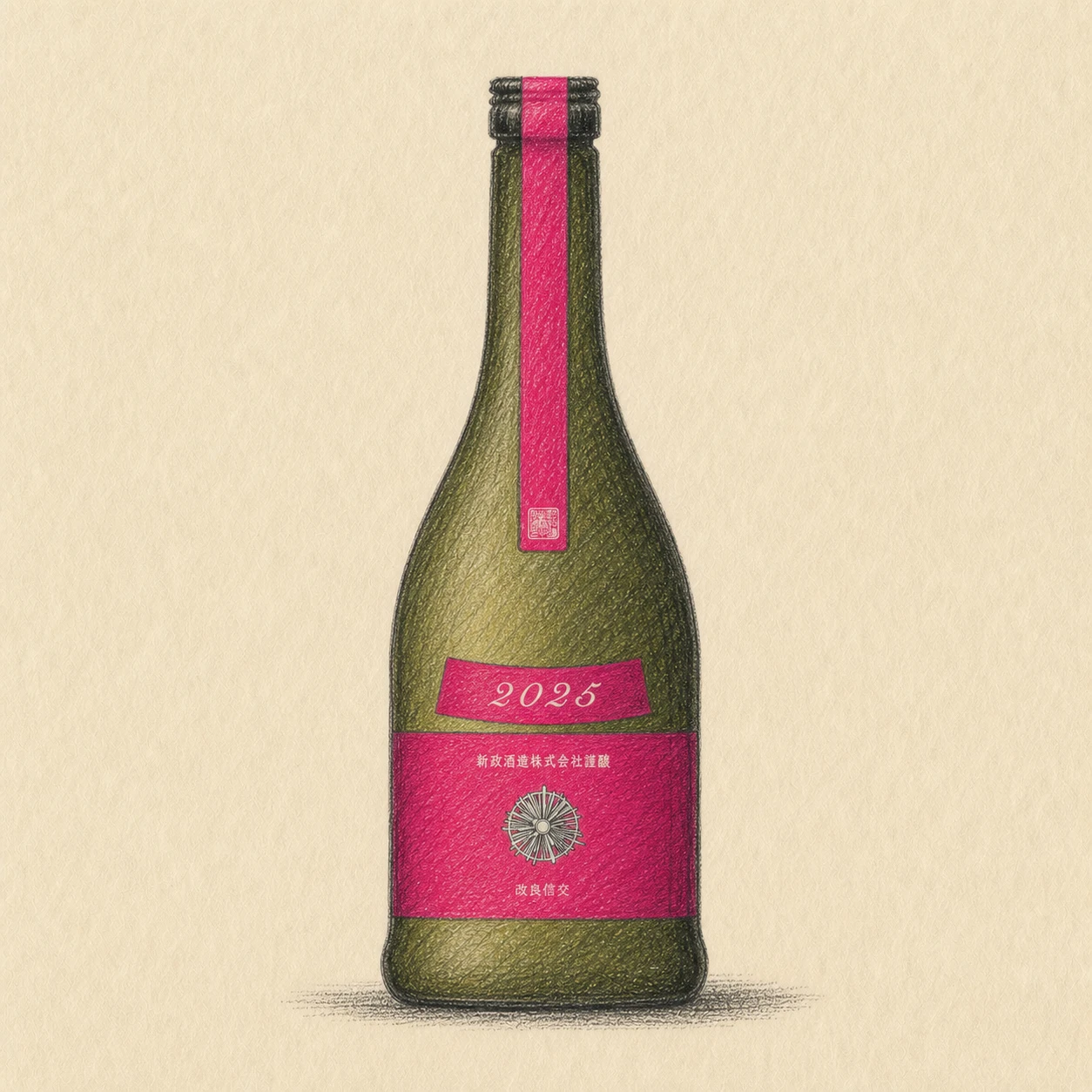
ARAMASA COSMOS
Kairyo Shinko: strawberry, pomegranate and peach, with floral and citrus detail.
Thailand · Product information
Product information from Bacchus Global Co., Ltd., based in Bangkok, Thailand. About Bacchus Global
Kairyo Shinko and the character of 2025
Kairyo Shinko was developed in Akita in 1959. Descended from Shinko No. 190, it is a sibling of Miyama Nishiki in lineage. The brewery contrasts Miyama Nishiki’s firm structure with Kairyo Shinko’s smooth, graceful character.
COSMOS uses Akita-grown Kairyo Shinko polished to 60%, brewed by kimoto with Association No. 6 in cedar vats, at 13% ABV without dilution. It belongs to the pasteurised Colors line, designed with three to five years or more of maturation in mind. The 2025 vintage is an unblended, single-lot bottling, described as youthful and firm, naturally balanced, and brighter in acidity.
Specifications and tasting notes shown here describe the 2025 vintage. If the supplied lot differs, its bottle label takes precedence.
The story behind this bottle
A conversation about two rices counted as siblings by lineage, whose flavours could not be more different. About six minutes.
Question 1
Which rice variety does “The sake” name for COSMOS?
- Kairyo Shinko
- Rikuu 132
- Kame-no-O
Read the answer and explanation
Correct answer: A — Kairyo Shinko
This page names Kairyo Shinko for COSMOS. Rikuu 132 belongs to EARTH and Kame-no-O to ASH.
Question 2
How does this page contrast Kairyo Shinko with Miyama Nishiki?
- They are one rice variety with the same character
- They are considered siblings in lineage, while the brewery describes different characters
- Both are fruit juices added to this sake
Read the answer and explanation
Correct answer: B — They are considered siblings in lineage, while the brewery describes different characters
The page calls them siblings in lineage but contrasts a firm structure with Kairyo Shinko’s smooth, graceful character. It does not state a more specific shared-parent claim.
Question 3
Which question does the podcast leave without asserting a reason?
- Why fruit juice is added to this sake
- Why the distillery moved location
- Why Kairyo Shinko had once faded from attention
Read the answer and explanation
Correct answer: C — Why Kairyo Shinko had once faded from attention
The audio follows the brewery’s question about Kairyo Shinko but does not invent a reason for its earlier obscurity.
How it tastes
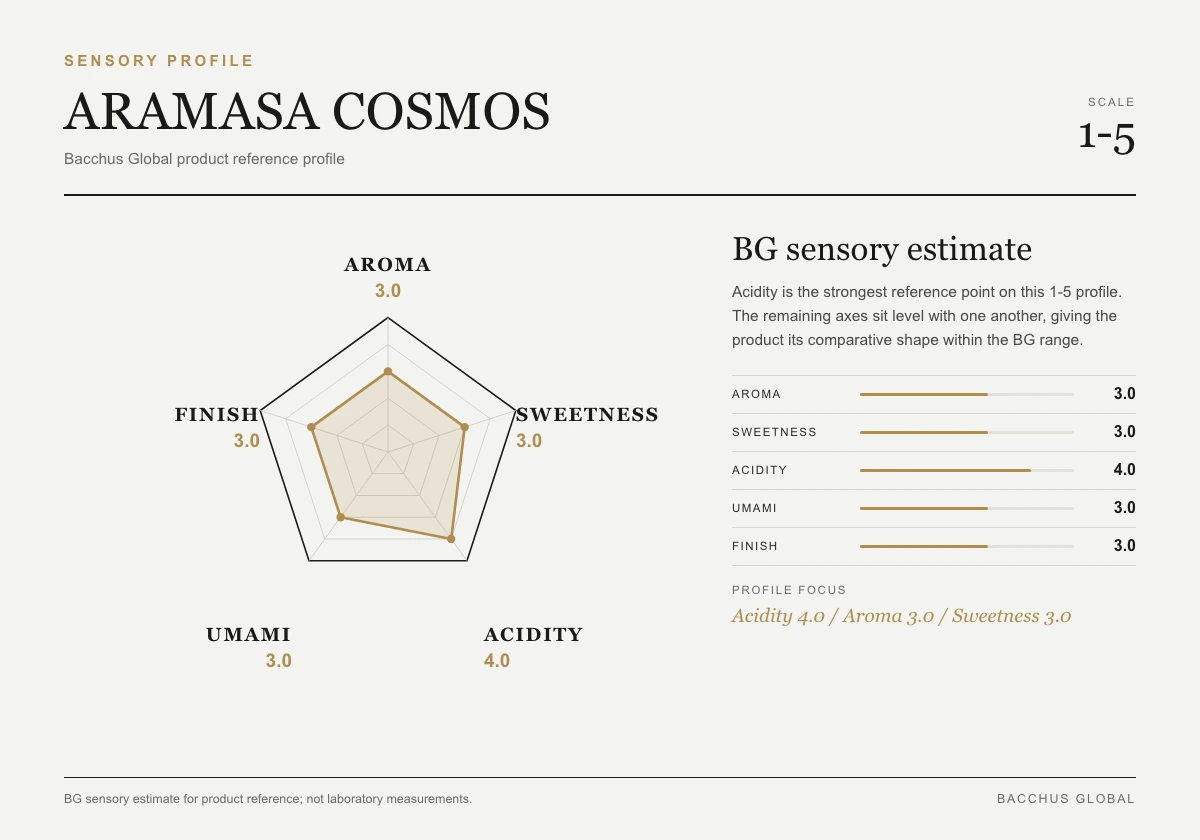
The 2025 aroma profile includes strawberries with green stems, ripe pomegranate and peach nectar, with spring-flower notes recalling jasmine and daphne, and an accent of orange zest.
Soft sweetness, gentle umami and juicy acidity are balanced by citrus-pith astringency through the middle. The finish is described as smooth and lingering.
The chart is a Bacchus Global reference estimate, not brewery analytical data.
Akita rice, kimoto and cedar vats
Aramasa was founded in Akita in 1852. Association No. 6 yeast was isolated from its fermenting mash in 1930. Akita-grown rice, kimoto and cedar vats underpin its brewing. The Colors and PRIVATE LAB products presented here use No. 6; ASTRAL PLATEAU ferments without added yeast.
The brewery returned to cedar-vat brewing in 2013 and began passing on cooperage skills in 2016. It established its own cooperage in 2024 and completed the transition to Akita-cedar brewing vessels. The brewery uses 50 Akita-cedar vats.
Colors is the pasteurised core line expressing differences between rice varieties. PRIVATE LAB explores four styles: kijoshu, high-acidity sake, low-alcohol sparkling sake and sake made with minimally polished rice. ASTRAL PLATEAU shares three foundations: a single rice variety, new cedar vats and fermentation without added yeast.
At the table
What follows is not a brewery recommendation but a reference set built by Bacchus Global from the acidity, sweetness, umami and finish of the sake.
- Scallop
- Prawn and white fish
- Salt-and-citrus sushi
- Fresh cheese
Related products
Three routes: a close style, a contrasting expression, and an ARAMASA reference point.
Related stories
Related Bacchus Global editorial content; no new external source is quoted here.
Interested in listing ARAMASA COSMOS at your restaurant? Our team can provide information on availability, storage requirements and trade terms.

