
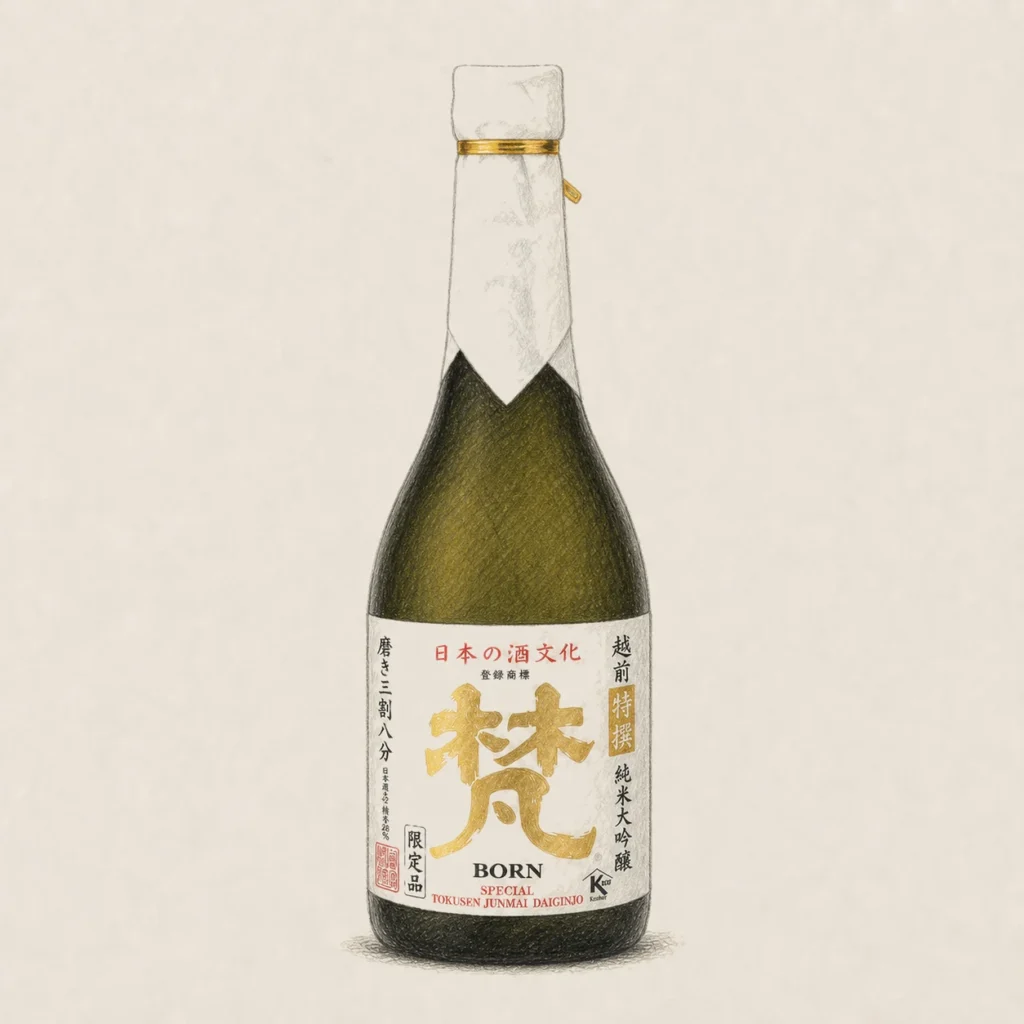
BORN Tokusen Junmai-Daiginjo
Polished to 38%, with grapefruit aromas, a smooth texture and a mineral finish.
Thailand · Product information
Product information from Bacchus Global Co., Ltd., based in Bangkok, Thailand. About Bacchus Global

Yamada Nishiki, polished to 38%
BORN Tokusen Junmai-Daiginjo is a junmai daiginjo made with contract-grown Yamada Nishiki from Hyogo’s Special A districts, with a rice-polishing ratio of 38%. The producer describes a blend of sake matured at or below 0°C for up to one to two years.
Grapefruit aromas, a smooth and layered structure

Aromas of grapefruit, flowers, chestnut and vanilla accompany a smooth mouthfeel and moderate umami. The clarity from high-milled rice carries through to a refined, precise finish.
Sabae, Fukui — since 1860
Kato Kichibee Shoten was established in Sabae, Fukui, in 1860. The brewery has produced junmai styles exclusively since 2003 and matures its sake below 0 °C before release. BORN’s identity is built around rice, water, time and a clean, layered house style.
Question 1
What does “38%” describe for this product?
- Alcohol content
- The polishing ratio of Yamada Nishiki
- The proportion of the blend
Read the answer and explanation
Correct answer: B — The polishing ratio of Yamada Nishiki
The page gives 38% as the rice-polishing ratio of Yamada Nishiki. Alcohol content and blend composition are different items.
Question 2
How does the page describe the sake used for the blend?
- Matured at or below 0°C for up to one to two years
- At room temperature for 38 years
- Bottled immediately without maturation
Read the answer and explanation
Correct answer: A — Matured at or below 0°C for up to one to two years
The producer describes a blend of sake matured at or below 0°C for up to one to two years. It does not guarantee one exact age for the finished product.
Question 3
Which fruit does “Taste profile” use to describe a bright aroma?
- Mango
- Ume
- Grapefruit
Read the answer and explanation
Correct answer: C — Grapefruit
The page describes an aroma reminiscent of grapefruit. This is not a statement that fruit juice was added.
Verified international recognition
International results are compiled from Kato Kichibee Shoten’s official award archive and grouped by competition. Existing exact-label IWC and Japanese competition records are retained. Different products and specifications are excluded.
Dishes that let the ingredient lead, with a gentle richness
The smooth texture and quiet depth show a natural affinity with dishes that let the ingredient’s own character lead, with butter, cheese and olive oil dishes as candidates too.
- White fish dishes
- Steamed dishes
- Butter-based dishes
- Soft cheese
Related products
Three routes: a close style, a contrasting expression, and a BORN reference point.
Related stories
Only directly related Bacchus Global articles are linked.
Interested in listing BORN Tokusen Junmai-Daiginjo at your restaurant or retail venue? Our team can provide information on availability, storage requirements and trade terms.

