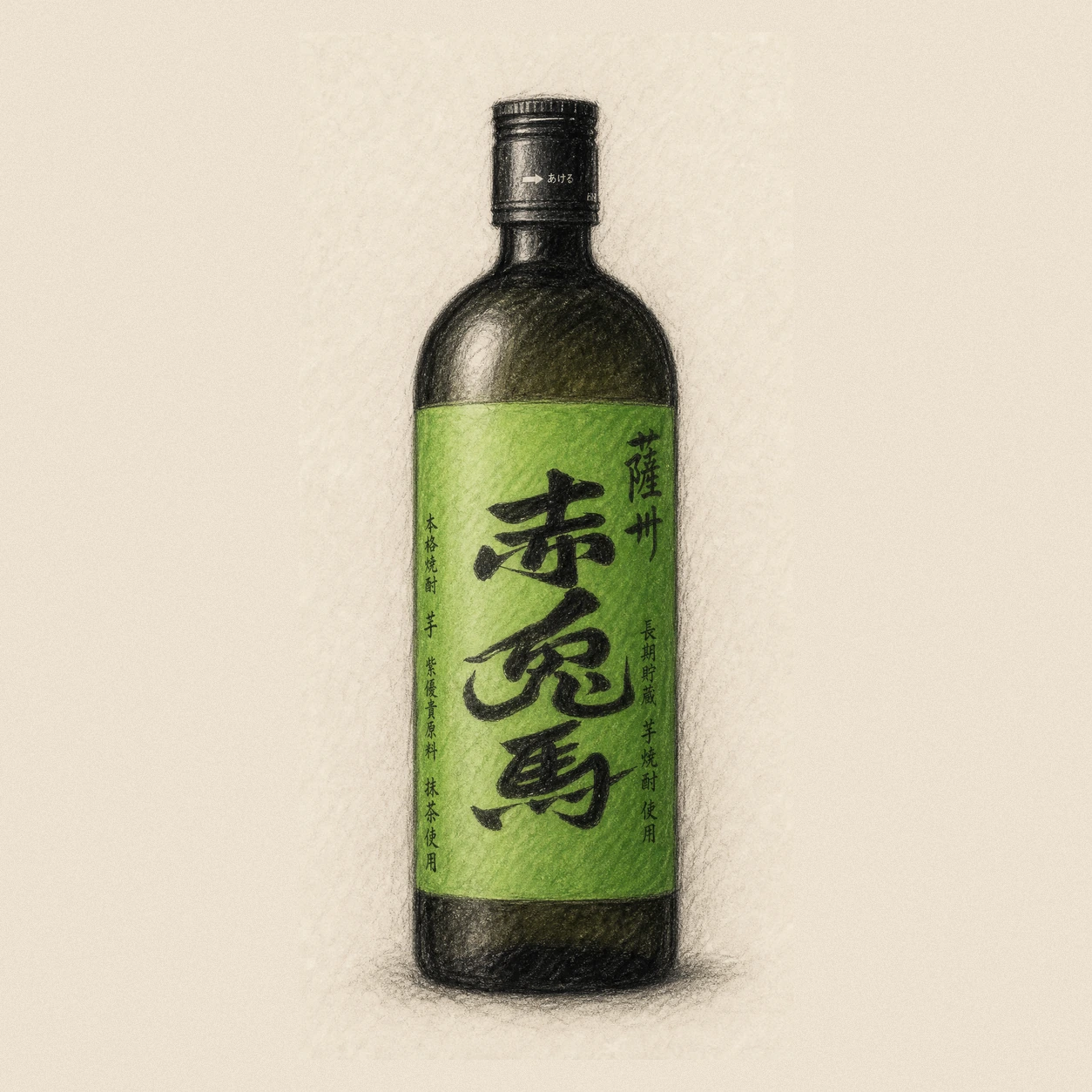
SEKITOBA Macha
Kagoshima matcha and green tea enter during fermentation, before distillation. Two differently distilled spirits are then blended: sweet-potato depth carries into matcha’s gentle bitterness and the fresh line of sencha, while the product remains legally classified as honkaku imo shochu.
Integrated in fermentation, not mixed in at the end
Kagoshima matcha and green tea are added during fermentation. They pass through distillation as part of the production design, distinguishing this product from a liqueur or a finished spirit simply flavoured with tea after the fact.
Depth and freshness composed separately
The final expression blends two spirits with different roles. Atmospheric distillation preserves breadth and sweet-potato depth; low-temperature distillation carries a lighter, more lifted tea character. Their meeting creates the product’s progression rather than a single uniform note.
Sweet potato, gentle matcha bitterness, fresh sencha
The sequence begins with the soft sweetness and savoury depth of imo shochu, moves through matcha’s measured bitterness, and closes with a fresh green-tea line. Tea is present as structure and transition, not as a sweetened flavour cue.
Tea placed inside the structure of shochu
Introduced in 2025, SEKITOBA MATCHA treats tea as part of fermentation and distillation rather than as a surface flavour. That production choice allows the character of Kagoshima tea to remain connected to the body of honkaku imo shochu.
Three stages: sweetness, bitterness, freshness
What is recorded above is a soft sweet-potato sweetness moving into a gentle matcha bitterness, closing on a clean, sencha-like freshness. Tea appears not as a sweet flavour but as a structure that carries the taste through its stages. What follows are four directions that follow those three stages. They are not pairings the distillery states officially.
This pairing rationale draws on the following reference book: Logical pairing theory records bitterness and astringency as a suppressing effect on fat — one that works only when balanced against umami and richness, which mirrors the three-stage structure of this bottle.
Three houses for tradition, innovation and continuity
Hamada Shuzo was founded in 1868 in Ichikikushikino, Kagoshima. Its three-house structure assigns distinct roles to Denbee-gura, Denzouin-gura and Kanayama-gura, allowing historical methods, modern development and long-term continuity to remain visible within one producer.
For current-lot specifications, availability, storage requirements and trade terms, please contact Bacchus Global.