Blog
The Virtue of Time
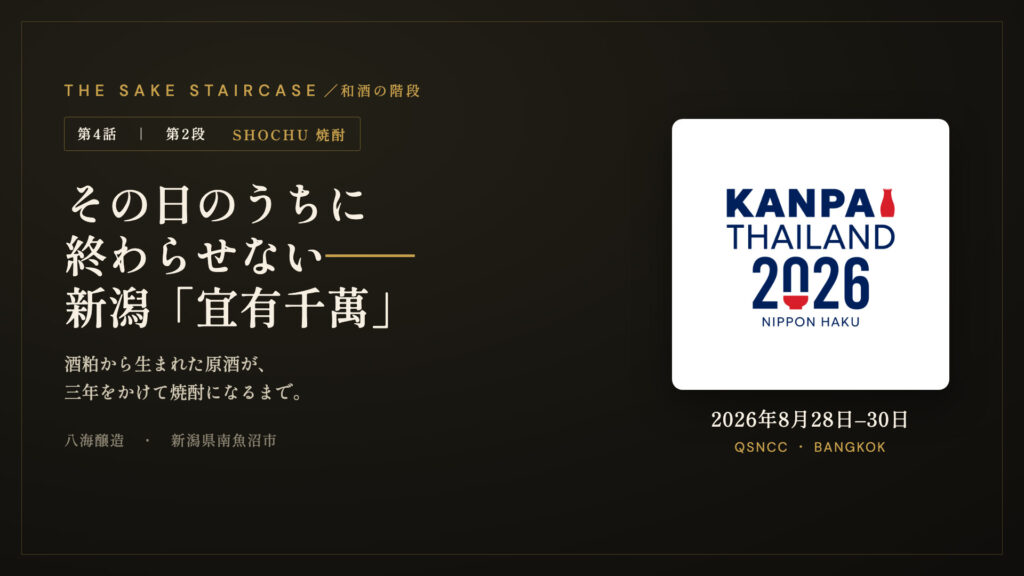
The Virtue of Time: How Niigata’s “Yoroshiku Senman Arubeshi” Transforms Fresh Sake Lees
The Sake Staircase, Episode 4 | Step Two: Shochu (Part 2)
After sake is pressed, something soft and white always remains in the pressing vat: sake lees, or sake kasu. When these lees are distilled, the result is known as kasutori shochu, a traditional spirit distilled from sake lees.
Many producers distill freshly pressed lees as quickly as possible and bottle the spirit while it is still young. But Hakkaisan Brewery, located in Minamiuonuma, Niigata, takes a different path. Even after distillation is complete, the spirit continues to mature for more than three years. This is the story of Hakkaisan Honkaku Kasutori Shochu “Yoroshiku Senman Arubeshi.”
In Episode 3, we followed Hamada Syuzou’s Daiyame from Kagoshima to see how sake and shochu diverge from the same starting point: koji. But there is another path on this staircase, one that transforms a byproduct of sake brewing itself into an entirely new spirit through patience and time.
A Heritage Born in the Snow
Founded in 1922 in the snow-covered region of Minamiuonuma, Hakkaisan Brewery uses exceptionally soft spring water known as “Raidensama no Shimizu,” which flows from the foothills of sacred Mount Hakkai. Today, production is divided among three facilities: the Kowa Brewery, the Second Kowa Brewery, and the Fukazawahara Distillery.
Although the brewery obtained its shochu distilling license in the 1980s, it resisted rushing a product to market. After more than twenty years of research and development, it built the dedicated Fukazawahara Distillery in 2005. Three years later, in May 2008, Yoroshiku Senman Arubeshi was finally introduced.
The Meticulous Craft of Ageless Spirit
Only fresh sake lees from premium-grade sake, specifically Honjozo or higher, is used as the raw material. Roughly five kilograms of lees are required to produce a single 720 ml bottle. The spirit is vacuum-distilled at approximately 40–50°C, a gentle process that suppresses harsh flavors while carefully preserving the elegant ginjo aromas remaining in the lees.
Up to this point, the process resembles that of many other kasutori shochu. What makes Yoroshiku Senman Arubeshi unique is what happens afterward.
While Hakkaisan’s rice shochu “Yoroshiku Senman Arubeshi” is aged for two years, this sake-lees expression rests for an additional year, maturing for more than three years in total. It is time spent not in haste, but in quietly softening the sharp edges of youth.
The name “Yoroshiku Senman Arubeshi” (宜有千萬) comes from an ancient Chinese auspicious phrase expressing the wish that one may receive immeasurable blessings. It is read “Yoroshiku Senman Arubeshi.” The names share the same pronunciation but are written differently; the rice shochu uses additional hiragana.
This meticulous approach has earned recognition both in Japan and abroad. At the Tokyo Whisky & Spirits Competition, the spirit received a Gold Award in 2021, the Highest Gold Award in 2022, and another Gold Award in 2023, achieving three consecutive years of Gold or higher and earning a place in the competition’s Hall of Fame. It also won both the Platinum Award and the Judges’ Award at Kura Master in France in 2022.
The world of shochu offers many different paths from the same starting point: koji. Sake lees, created after starch is converted into sugar by koji and then fermented by yeast during sake brewing, can be seen as a lingering memory of the rice itself. Yoroshiku Senman Arubeshi distills that memory once more, then reshapes it through the quiet passage of three years.
An Encounter with the Craft in Bangkok
Many Japanese producers of traditional spirits gathered in Bangkok for KANPAI THAILAND 2026, held from August 28 to 30 at QSNCC (Queen Sirikit National Convention Center). The event brought together makers of sake, shochu, umeshu, and craft gin, and Hakkaisan Brewery was listed among the participating producers.
For those wishing to experience firsthand the relationship between koji and fermentation that lies behind Yoroshiku Senman Arubeshi, KOUJI ALCHEMIST by Salon du Japonisant offers a sensory and thoughtful introduction. Those interested in exploring the stories of Japan’s breweries at a more leisurely pace can visit Salon du Japonisant, while Nadaya Saketen, a traditional specialist liquor retailer, provides the opportunity to discover carefully curated selections backed by professional expertise.
The event has concluded.
Next time, we continue with Step Two, climbing one more step on the staircase of shochu.
This article is intended solely to explore the distillation techniques and cultural heritage of Hakkaisan Brewery and the Yoroshiku Senman brand, and does not aim to promote or encourage the consumption or purchase of alcohol. The list of participating producers and products at KANPAI THAILAND 2026 was subject to change before the event. For those aged 20 and over; please drink responsibly.
บทความนี้จัดทำขึ้นเพื่อนำเสนอข้อมูลเกี่ยวกับเทคนิคการกลั่นและมรดกทางวัฒนธรรมของ Hakkaisan Brewery และแบรนด์ Yoroshiku Senman เท่านั้น มิได้มีเจตนาเพื่อส่งเสริมหรือโฆษณาการบริโภคหรือการซื้อเครื่องดื่มแอลกอฮอล์ ก่อนวันงาน รายชื่อผู้ผลิตและผลิตภัณฑ์ที่ร่วมงาน KANPAI THAILAND 2026 ยังอาจเปลี่ยนแปลงได้ สำหรับผู้มีอายุ 20 ปีขึ้นไป โปรดดื่มอย่างมีความรับผิดชอบ
Discover the culture behind every bottle
We share brewery stories, tasting notes and the craft of koji & fermentation | for educational and cultural purposes only.
เราถ่ายทอดเรื่องราวจากผู้ผลิต บันทึกรสชาติ และศาสตร์แห่งโคจิและการหมัก | เพื่อการศึกษาและวัฒนธรรมเท่านั้น
Related Articles
““Daiyame,” the Kagoshima Spirit Whose Name Means “Healing the Day’s Fatigue” ” / “The Brewery That Gave Up Its Name” / “A Sake Named by a Poet|Tamba’s “Kotsuzumi,” the First Step into Japanese Sake” / “Map of Washu | The Five Steps at a Glance” / “May you be blessed with ten millionfold good fortune”
Related Product(s)
HAKKAISAN Kasu-tori Shochu Yoroshiku Senman Arubeshi / HAKKAISAN Rice Shochu Yoroshiku Senman Arubeshi / HAKKAISAN Fubaika Rice Shochu aged in Oak Barrel