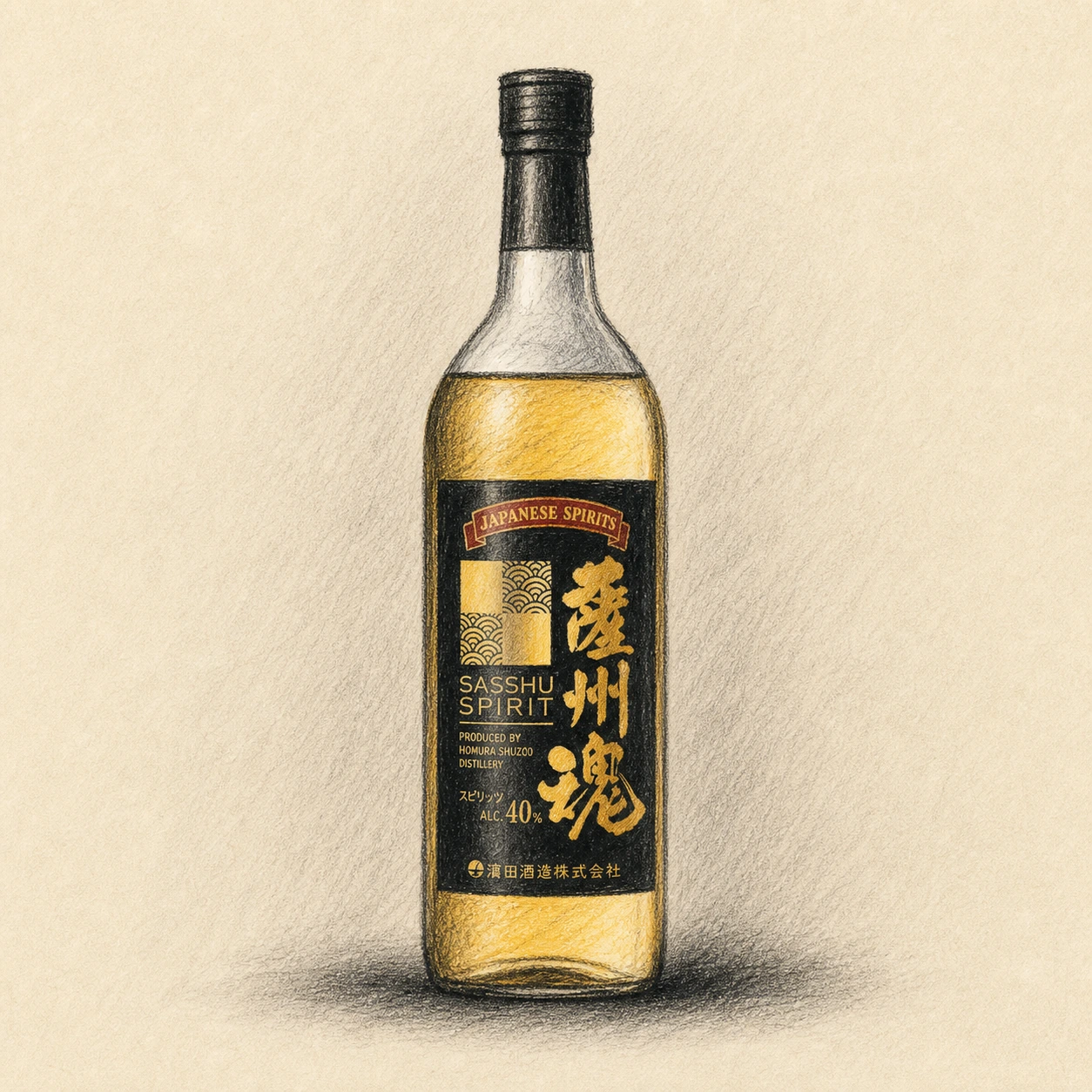
SASSHU SPIRIT
White-koji barley shochu provides the foundation; white-oak casks provide colour, vanilla and a broader frame. Bottled at 40% and legally classified as a spirit rather than shochu, SASSHU DAMASHII preserves the cask expression without disguising its category.
Thailand · Product information
Product information from Bacchus Global Co., Ltd., based in Bangkok, Thailand. About Bacchus Global
Sensory profile
Satsuma in body, spirit in name
“Sasshu” is an older name associated with Kagoshima; “damashii” means soul or spirit. The name gathers the product’s two sides into one phrase: a Japanese barley-shochu foundation and the influence of Western-style white-oak maturation.
Why the label says spirit, not shochu
Japanese regulations limit the colour permitted in shochu. SASSHU DAMASHII keeps the amber hue and oak-derived character of maturation and is therefore classified as a spirit. The distinction is stated directly because “shochu” would be legally and technically inaccurate for this bottle.
Vanilla, barley and koji-derived savoury depth
White-oak maturation brings vanilla and wood notes to a barley base made with white koji. Roasted grain, concentrated savoury depth and a long finish are supported by the 40% structure.
Question 1
What is the base liquor?
- Honkaku barley shochu
- Junmai ginjo
- Grape wine
Read the answer and explanation
Correct answer: A — Honkaku barley shochu
A barley shochu made with white koji is the foundation.
Question 2
Which material is related to the flavors reminiscent of vanilla and wood?
- White oak
- Purple sweet potato
- Yuzu juice
Read the answer and explanation
Correct answer: A — White oak
The page states that white oak is used.
Question 3
What is the labeled category of the finished product?
- Honkaku shochu
- Spirits
- Seishu (sake)
Read the answer and explanation
Correct answer: B — Spirits
The finished product is labeled as spirits, which is a separate matter from the category of the base shochu.
Following the grain’s depth and the vanilla
What is recorded above is a vanilla and wood nuance from the white oak cask, joined by a roasted barley aroma and koji umami from the white-koji base. It moves from a grain-driven depth into a long finish. What follows are four directions that follow that depth and roasted aroma. They are not pairings the distillery states officially.
Award historys for this product
Awards are presented as competition records for this specific product only; they do not guarantee individual preference or quality.
Three houses for tradition, innovation and continuity
Hamada Shuzo was founded in 1868 in Ichikikushikino, Kagoshima. Its three-house structure assigns distinct roles to Denbee-gura, Denzouin-gura and Kanayama-gura, allowing historical methods, modern development and long-term continuity to remain visible within one producer.
For current-lot specifications, availability, storage requirements and trade terms, please contact Bacchus Global.