

TAMAGAWA Junmai Yamahai Non-filter Nama-Genshu
Thick rice umami and bold acidity define TAMAGAWA’s “Red Label.”
Thailand · Product information
Product information from Bacchus Global Co., Ltd., based in Bangkok, Thailand. About Bacchus Global

No added yeast — the power drawn out by yamahai
Known affectionately as the “Red Label,” TAMAGAWA Junmai Yamahai Non-filter Nama-Genshu is unfiltered, unpasteurised and undiluted. It is made from 100% Tajima-grown Kitanishiki rice, polished to 66%; no yeast is added, and the yamahai method draws out the wild yeast naturally present in the brewery.
With no dilution or pasteurisation, ABV runs relatively high — 18–20.9%, depending on the brewing year. Keep refrigerated.
How it tastes
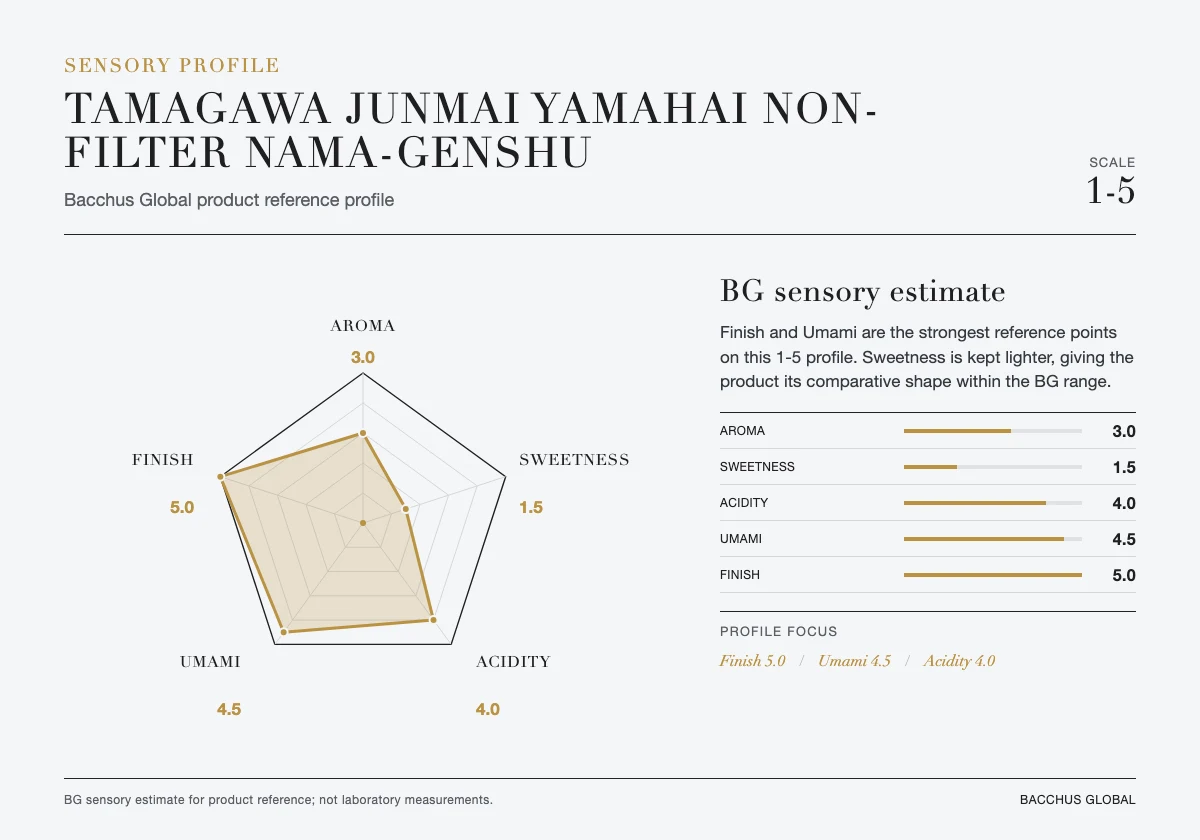
The aroma suggests steamed rice, lactic notes and nuts. The texture carries the thickness typical of genshu, with rice umami and bold acidity spreading at once, and a finish that leaves a toasty, savoury note.
Keep refrigerated. The rice umami and bold acidity carry evenly through to the toasty finish.
TAMAGAWA · Kinoshita Brewery · Kyoto
Kinoshita Brewery was founded in 1842 in Kumihama, Kyotango, Kyoto. The name TAMAGAWA comes from the Kawakamidani River that flows near the brewery.
Toji Philip Harper earned his Nanbu Toji certification in 2001 and joined Kinoshita Brewery in 2007. Working with traditional methods such as yamahai, no added yeast and aged styles, he values how the sake’s expression changes with temperature and time.
Question 1
Which rice is used?
- Tajima-grown Kita Nishiki
- Yamanashi-grown Yumesansui
- Hyogo-grown Yamada Nishiki
Read the answer and explanation
Correct answer: A — Tajima-grown Kita Nishiki
Answer: Tajima-grown Kita Nishiki. The linked section gives the source detail.
Question 2
How is yeast handled in the brewing?
- Wine yeast is added
- No yeast is added
- Only lactic acid bacteria are added
Read the answer and explanation
Correct answer: B — No yeast is added
Answer: No yeast is added. The linked section gives the source detail.
Question 3
Which processes are omitted for this unfiltered, unpasteurised, undiluted sake?
- Rice polishing
- Fermentation
- Filtration, pasteurisation and dilution
Read the answer and explanation
Correct answer: C — Filtration, pasteurisation and dilution
Answer: Filtration, pasteurisation and dilution. The linked section gives the source detail.
At the table
The genshu’s thick umami and bold acidity pair with grilled meats, aged ingredients and rich broths — matching the dish’s own richness keeps that intensity from feeling one-note.
- Seasonal seafood
- Vegetable dishes
- Lightly seasoned poultry
- Cheese
Related products
Compare a closely related expression, a contrasting bottle and a reference from the same range.
Related stories
Interested in listing TAMAGAWA Junmai Yamahai Non-filter Nama-Genshu at your restaurant or retail venue? Our team can provide information on availability, storage requirements and trade terms.

