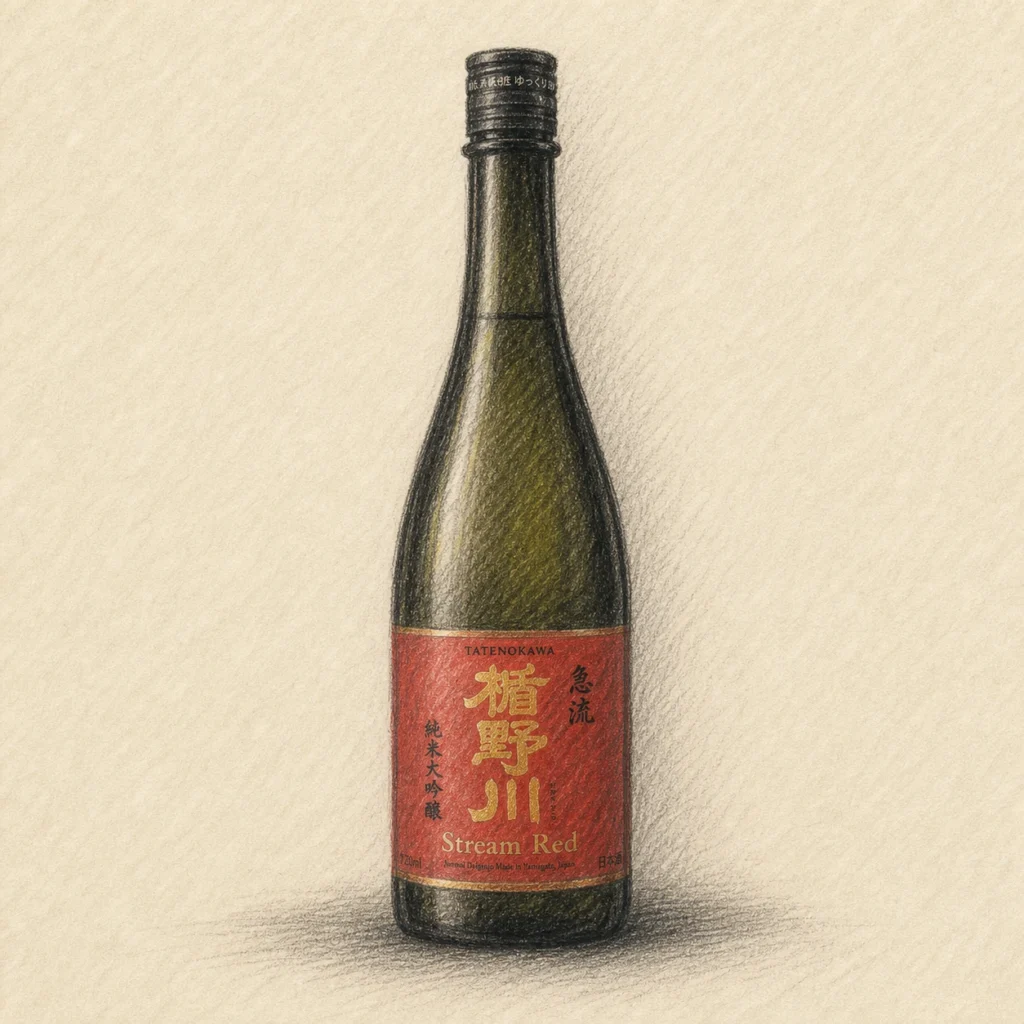
TATENOKAWA Stream Red
Yamagata Dewa Sansan polished to 33%, built low in amino acids to strip weight from the umami — ripe fruit and a sharp cut, drawn with the clarity of fast water.
Thailand · Product information
Product information from Bacchus Global Co., Ltd., based in Bangkok, Thailand. About Bacchus Global

Paring back umami’s weight, sharpening aroma and cut
A Junmai-Daiginjo made with Yamagata contract-grown Dewa Sansan rice, polished to 33%. Rather than layering the rice’s umami thickly, a low-amino-acid design steers it toward clarity and cut.
While retaining Dewa Sansan’s softness, careful removal of the surface proteins and lipids brings out ripe-fruit aromatics, a silky texture and well-defined acidity. True to the name Kyuryu (“Rapid Stream”), the taste never stagnates — it flows vividly.
Ripe fruit, a silky texture, a vivid cut
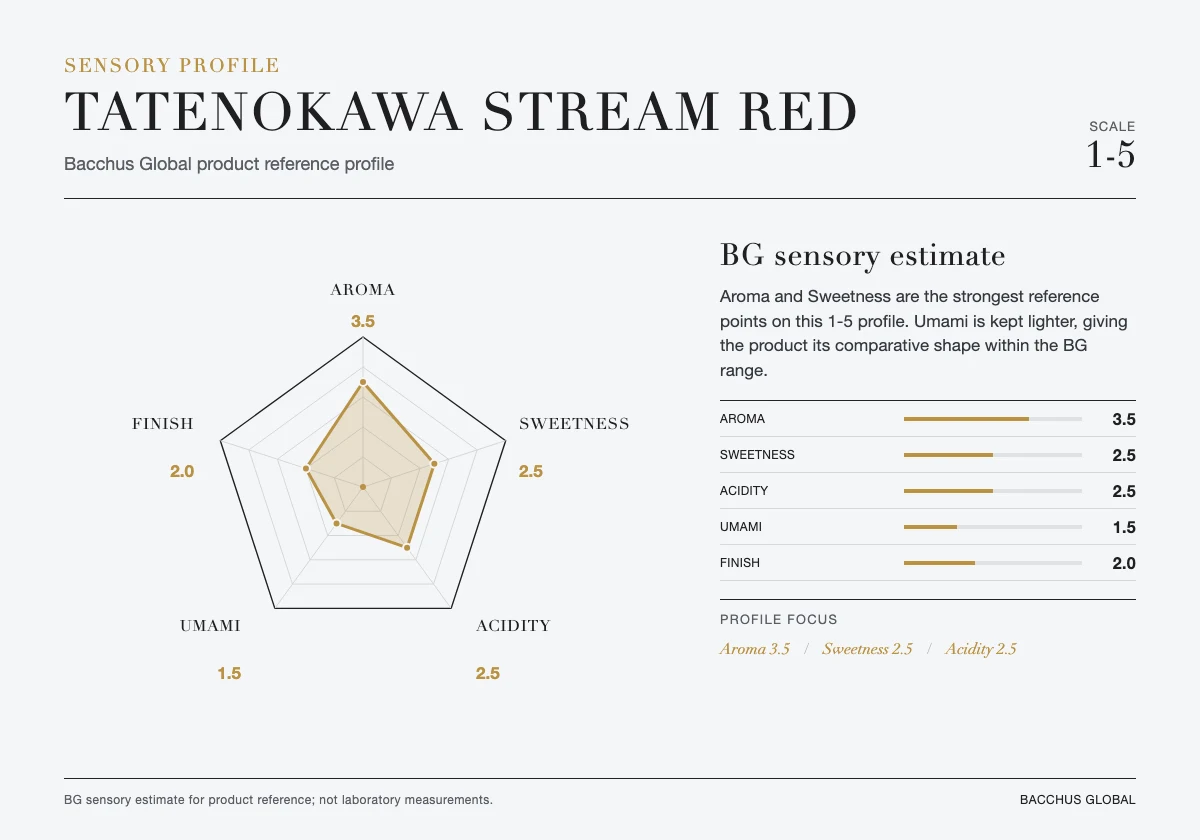
A gentle, generous fruit aroma of green apple, pear, white peach and melon. The texture is silky, with fresh acidity quickly tightening the rice’s gentle sweetness. Without leaving any heaviness, and with a faint bitterness, the aftertaste cuts sharp and clean.
That sharp, clean cut is the last impression it leaves.
Founded 1832, designing sake quality from the milling stage
Tatenokawa Sake Brewery was founded in 1832 in Sakata, Yamagata Prefecture. In 2010 it became Yamagata’s first brewery to convert its entire production to Junmai-Daiginjo, designing the rice’s character and the finished sake as one, through contract-grown rice, in-house milling and small-batch brewing.
Kyuryu puts its milling technique to work not just for obvious floral showiness, but for lightness and cut. Rather than polishing the rice’s presence away entirely, it leaves it behind as a clean, defined structure — a modern Junmai-Daiginjo for Tatenokawa.
A low amino-acid content that cuts clean with acidity
The brewery has not stated an official food pairing for this sake. Here we set out four directions drawn from its confirmed structure: a 33% rice-polishing ratio and a restrained amino-acid content that together produce a clear acidity and a sharp, clean finish. This is not a sake that leans on umami to sit alongside a dish — it cuts through fat with acidity and connects through aroma.
Food-pairing literature notes that the fat in cooked or aged dairy tends to connect well with fruit aroma — a direction that echoes this sake’s own ripe-fruit character.
Related products
Compare a closely related expression, a contrasting bottle and a reference from the same range.
Interested in listing TATENOKAWA Stream Red at your restaurant or retail venue? Our team can provide information on availability, storage requirements and trade terms.