Blog
The Spectrum of Junmai Daiginjo: Tatenokawa at 8%, 33%, and 50%
KANPAI Makers’ Choices No.08
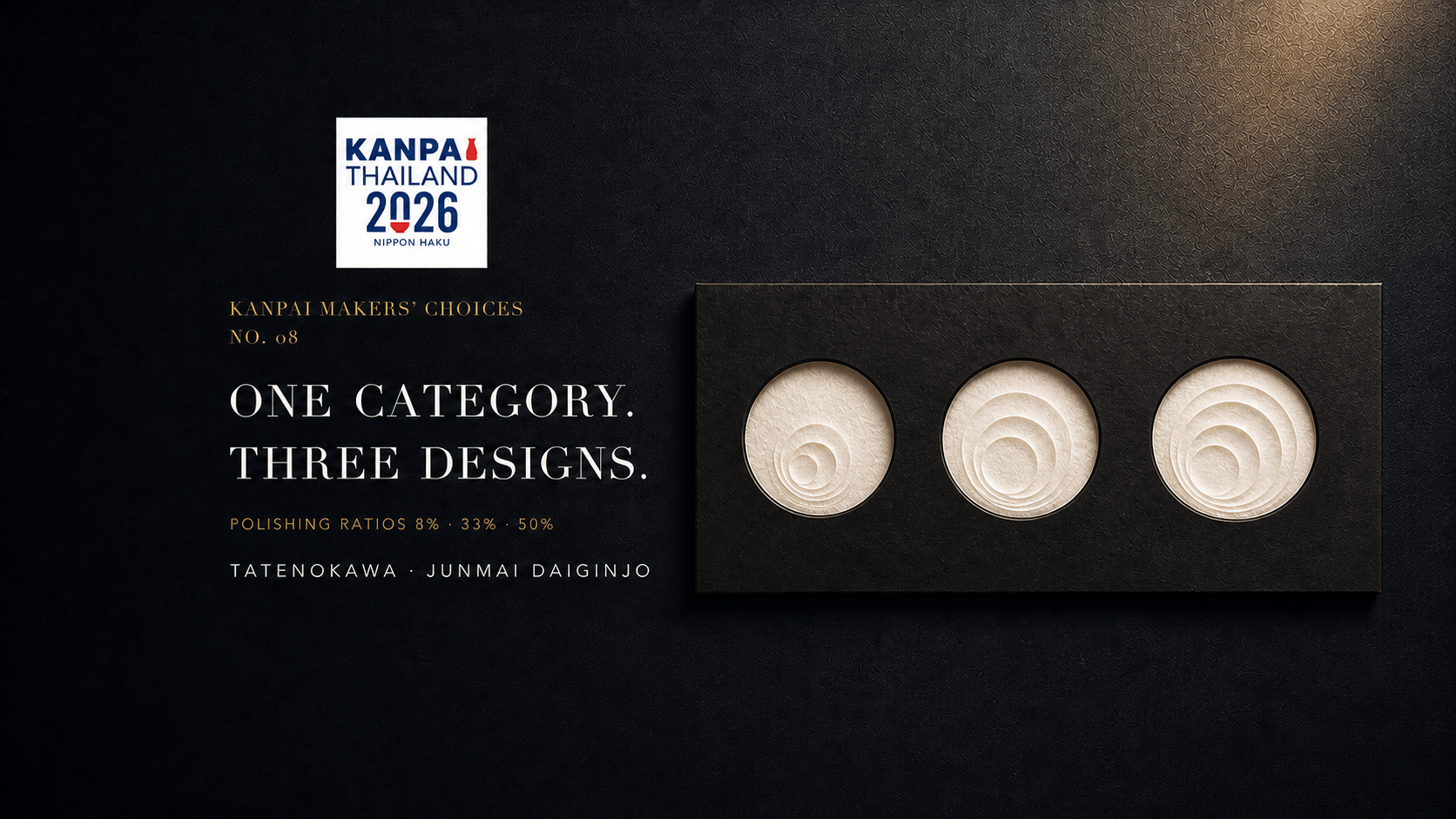
The same brewery, committed entirely to a single category: Junmai Daiginjo. Yet its rice polishing ratios are deliberately split across three distinct marks|8%, 33%, and 50%.
At KANPAI Thailand 2026, Tatenokawa Shuzo presents three notable labels: “Tatenokawa Junmai Daiginjo Kyokugen,” “Tatenokawa Stream Red Junmai Daiginjo,” and “Tatenokawa Seiryu Junmai Daiginjo.” While all three share the same official classification, they are far from simple iterations differentiated merely by name. Each bottle reflects deliberate choices in rice variety, polishing ratio, and alcohol content. For Kyokugen, the craft extends even further into micro-batch brewing and moromi temperature control calibrated in increments of 0.1°C.
What matters here is not which percentage claims supremacy, but the brewery’s conscious decision to dedicate itself to one classification without reducing it to a single formula.
Junmai Daiginjo Does Not Mean One Flavor
Under the National Tax Agency’s Standards for Manufacturing Methods and Quality Indication for Sake, Junmai Daiginjo is made from rice and rice koji, has a rice-polishing ratio of 50% or less, and uses koji rice for at least 15% of the rice. It must also use the ginjo-zukuri method, with particularly good characteristic flavor, color, and luster. The polishing ratio simply indicates the percentage of the grain remaining after the outer layers are removed.
These standards set the technical boundary for the designation, not a hierarchy declaring an 8% polishing ratio inherently superior to 33% or 50%, nor do they suggest that sakes sharing a category taste alike.
Since 2010, Tatenokawa Shuzo has taken the rare step of brewing exclusively Junmai Daiginjo. The brewery attributes this focus to two core principles: absolute clarity of purpose and an unwavering commitment to quality. Yet narrowing its focus to one category has not led to uniformity. Instead, it has unlocked a surprising range of expressions.
Seiryu: Dewasansan at 50% as a Baseline
“Seiryu” is brewed exclusively from Yamagata’s native Dewasansan rice, polished to 50%, with an alcohol content of 14%. Considered a cornerstone of Tatenokawa’s core lineup, Seiryu is often described by the brewery as its signature calling card.
While 50% represents the maximum allowable polishing ratio for Junmai Daiginjo, the figure alone does not define the character of the sake. By utilizing Dewasansan grown by local contract farmers and brewing with disciplined precision, Seiryu embodies the pure fundamentals of the craft.
As both a calling card and a reference point for the brand, Seiryu serves as an ideal baseline for understanding the distinct philosophies behind each of the three bottles. Its design includes not only a 50% polishing ratio but also an alcohol content of 14%.
Stream Red: Dewasansan at 33%
“Stream Red” also utilizes Dewasansan rice, but pushes the polishing ratio down to 33%, with an alcohol content of 15%. Compared with Seiryu, 17 percentage points less of the original grain remains after polishing.
Tatenokawa’s official development story questions the industry view that a polishing ratio of 35% is one benchmark, and positions 33% as an entry into the world of highly polished sake. Since both Seiryu and Stream Red use Dewasansan, they can be viewed as two designs that use the same rice variety at different polishing ratios.
However, this 17-percentage-point difference alone cannot be identified as the sole cause of differences in aroma or flavor. Many production conditions are involved, including rice-growing conditions, fermentation management, and adjustments to the sake’s character. What public information confirms is that Dewasansan of the same variety is used at different polishing ratios of 50% and 33%.
Kyokugen: Yamada Nishiki at 8% and Micro-Temperature Control
“Kyokugen” reaches a remarkable polishing ratio of 8%, leaving just 8% of the original grain. This represents a 42 percentage point difference from Seiryu and 25 percentage points from Stream Red.
Kyokugen uses Yamada Nishiki rice from Hyogo Prefecture. According to official information, it is polished to 8% over approximately 40 days, brewed in small batches, and the moromi temperature is managed in 0.1°C increments.
The 8% figure draws attention, but focusing on that number alone can obscure the approximately 40 days of polishing, small-batch brewing, and 0.1°C temperature management. Kyokugen is shaped not only by the 8% of rice that remains after polishing, but also by the conditions under which it is made into sake.
Multiplying Possibilities Within a Single Category
Even within the singular designation of Junmai Daiginjo, differences between expressions remain profound. Seiryu showcases local Dewasansan at 50%; Stream Red takes that same grain to 33%; and Kyokugen applies ultra-precision to Hyogo Yamada Nishiki at 8%.
These three bottles do not form a linear staircase where 8% sits at the top as the sole definition of quality. Instead, Seiryu establishes the baseline, Stream Red demonstrates the influence of ratio on identical rice, and Kyokugen expands the paradigm through grain selection and rigorous micro-control. Each numerical figure gains meaning only when understood alongside the precise craftsmanship behind it.
Record No. 08: Expanding Potential Within Precision
The KANPAI Makers’ Choices series avoids ranking technical figures into a rigid hierarchy of superiority. Across earlier records, the series has documented conscious brewing decisions: setting specific polishing and aging conditions, committing to year-round brewing, capturing only the prized nakagumi press, preparing sweet potatoes meticulously before secondary fermentation, separating polishing ratios for koji and kakemai, incorporating tea during fermentation, omitting activated charcoal filtration, and selecting alternative base spirits for umeshu.
For Record No. 08, the choice documented at Tatenokawa Shuzo is clear: specializing exclusively in Junmai Daiginjo without ever limiting the category to a single formula.
8%, 33%, and 50% are numbers measured on the same scale, yet they do not represent a ladder of quality. Viewed through the lens of the craftsmanship behind them, these figures reveal that even within a focused discipline, the room for exploration, nuance, and mastery remains virtually limitless.
This article is intended solely to provide factual and cultural information about Tatenokawa Brewery and its 2026 KANPAI Thailand lineup, including its production design. It does not aim to promote or encourage the purchase or consumption of alcohol. It is intended for readers aged 20 and over.
บทความนี้จัดทำขึ้นเพื่อให้ข้อมูลเชิงข้อเท็จจริงและวัฒนธรรมเกี่ยวกับ Tatenokawa Brewery และผลิตภัณฑ์ที่นำเสนอในงาน KANPAI Thailand 2026 รวมถึงแนวคิดด้านการผลิตเท่านั้น มิได้มีเจตนาเพื่อส่งเสริมการซื้อหรือการบริโภคเครื่องดื่มแอลกอฮอล์ บทความนี้จัดทำขึ้นสำหรับผู้อ่านอายุ 20 ปีขึ้นไป
Related Products
TATENOKAWA Extreme Ultra 8 Kyokugen / TATENOKAWA Stream Red / TATENOKAWA Stream Seiryu
Related Reading
No.07: Not Defining Umeshu by a Single Formula / Polishing Away 92% of the Rice, Leaving Just 8% / Mastering the Art of 33% / The Truth of the Everyday Pour
No.09: Five Years, Two Vessels
How special designations relate to rice polishing
When 50% Rice Polishing Is Not Junmai Daiginjo
Discover the culture behind every bottle
We share brewery stories, tasting notes and the craft of koji & fermentation | for educational and cultural purposes only.
เราถ่ายทอดเรื่องราวจากผู้ผลิต บันทึกรสชาติ และศาสตร์แห่งโคจิและการหมัก | เพื่อการศึกษาและวัฒนธรรมเท่านั้น
Follow on Instagram Facebook