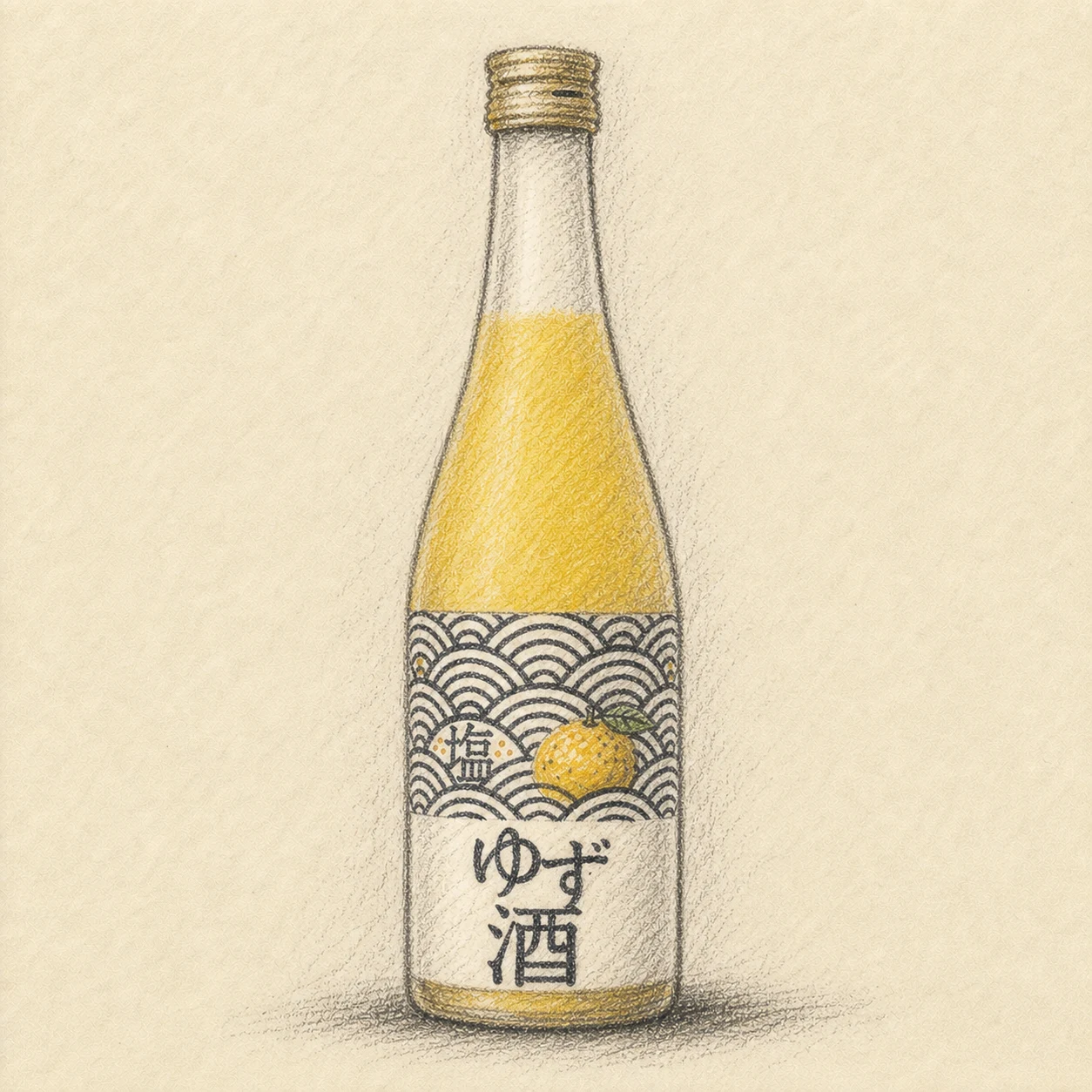
SHIO YUZU / CITRUS
Japanese yuzu and junmai sake meet a measured touch of Umi no Sei sea salt from Izu Oshima. The salt rounds the acidity, lifts savoury depth and cuts the sweet finish cleanly.
Junmai-based yuzu liqueur with sea salt
Defining the profile with yuzu, junmai and sea salt
Japanese yuzu and fructose are blended into house-brewed junmai sake, followed by traditional Umi no Sei sea salt from Izu Oshima. The salt is used as a balance point, not as a dominant flavour.
Junmai sake beneath the yuzu
Rice-derived amino acids give the citrus acidity a rounded, substantial frame.
Umi no Sei for a cleaner line
Minerality softens the edge of the acid, heightens the sense of fruit and cuts away a sticky sweet finish.
Savoury dimension rather than overt saltiness
Yuzu aroma, the softness of junmai and marine minerality appear in sequence, creating a precise finish suited to the table.
The story behind this bottle
A conversation tracing one bottle through 220 years of brewing. About six minutes.
Vivid yuzu, rounded acidity and a mineral finish

Freshly pressed citrus aroma leads into bright fructose sweetness and acidity. Sea-salt minerality then gathers the palate into a rounder shape, leaving gentle peel bitterness and a clean saline edge.
Yuzu aroma and umami-edged salinity lighting up the table
The food affinities for SHIO YUZU are not combinations officially presented by the producer, but a reading drawn from the characteristics recorded on this page. Built around the aroma of Japanese yuzu, the rice-derived amino acids that support its umami, and the salinity of Umi no Sei sea salt, they are organised into four directions — distinct from its sibling SHIO UME, this reading centres on citrus aroma and fermentation-derived umami rather than stone-fruit acidity.
These suggestions are a hypothesis built on structural cues drawn from food-pairing theory — shared-aroma synergy, umami synergy, and salt contrasting with and lifting umami — and are not an official recommendation from the producer.
Kitajima Shuzo, established in Shiga in 1805
Kitajima Shuzo was founded in Konan, Shiga, in 1805. It works with local water and house-brewed junmai sake across both sake and fruit liqueurs.
Related yuzushu
Only directly relevant products and Bacchus Global stories are shown.
Contact Bacchus Global for product documentation and trade information.