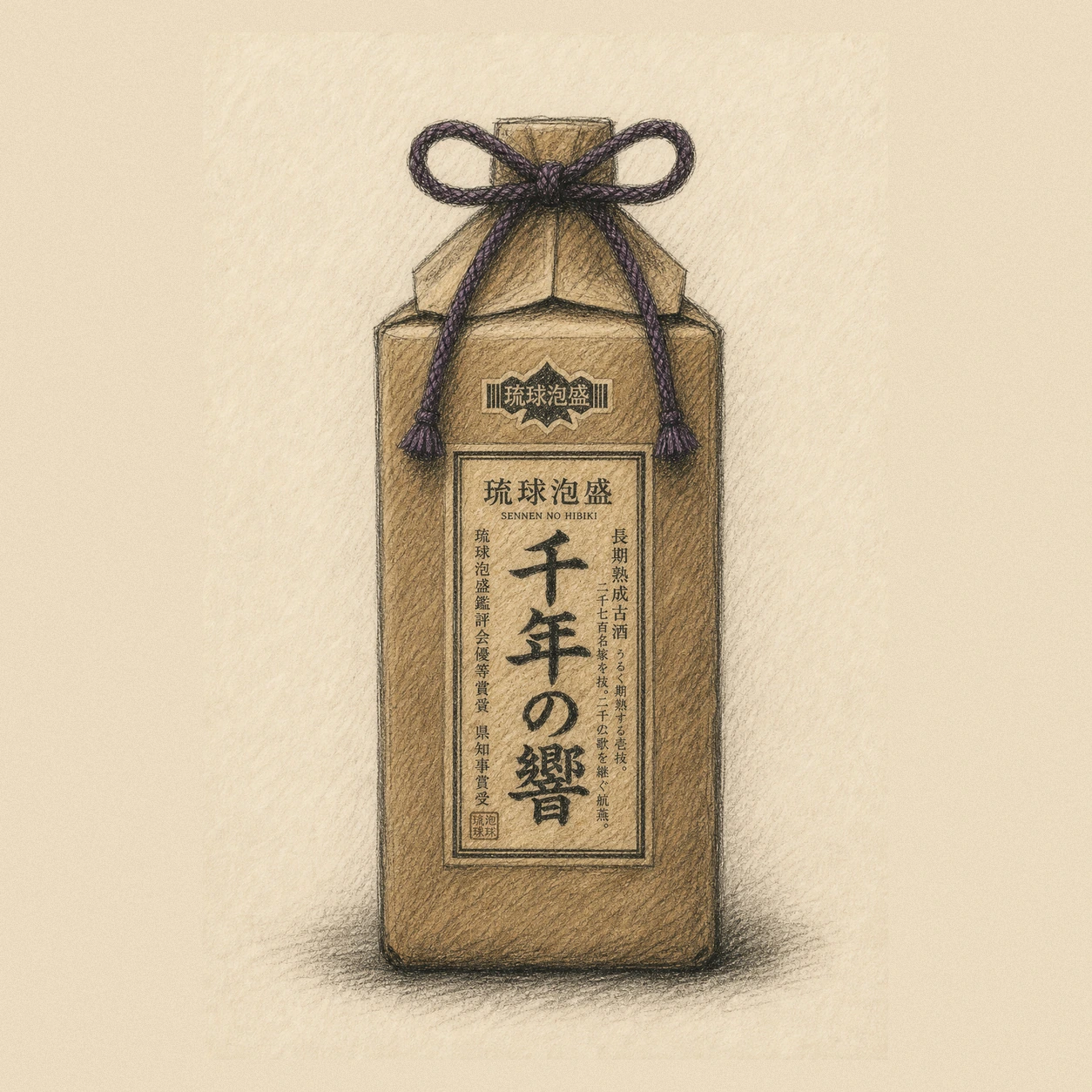
SENNEN NO HIBIKI
Thai rice travels to Okinawa, becomes awamori through black koji and atmospheric distillation, and returns to Thailand with a different history. SENNEN NO HIBIKI is a series, not a single specification: oak-cask and seven-year Namban-jar expressions must be read separately.
Thailand · Product information
Product information from Bacchus Global Co., Ltd., based in Bangkok, Thailand. About Bacchus Global
Thai rice, Okinawa, then Thailand
This awamori series begins with Thai rice. At Nakijin it meets black koji and atmospheric single distillation, then matures in oak casks or, for the jar-aged expressions, for seven years in Namban earthenware jars.
Do not flatten five distinct releases
SENNEN NO HIBIKI includes oak-cask 25% and 43% expressions, Namban-jar seven-year 25% and 43% expressions, and a limited Madeira-cask finish. Awards are attached to the relevant series or individual expression.
Award record
The award record shown is specific to this product; it does not guarantee individual preference or quality.
Question 1
Where is the rice from?
- Thailand
- Akita
- Amami
Read the answer and explanation
Correct answer: A — Thailand
The awamori series begins with Thai rice.
Question 2
Which koji does the page name?
- White koji
- Black koji
- Yellow koji
Read the answer and explanation
Correct answer: B — Black koji
The page identifies black koji in the awamori-making process.
Question 3
Which statement correctly reads the different expressions?
- All have the same jar and alcohol content
- Every bottle spends seven years in a jar
- Oak-cask and Namban-jar expressions differ, with 25% and 43% versions
Read the answer and explanation
Correct answer: C — Oak-cask and Namban-jar expressions differ, with 25% and 43% versions
This is a series, so one maturation period or vessel should not be assigned to every bottle.
Two vessels, two weights: oak barrel and clay jar
These are not pairings the maker has presented, but readings drawn from the confirmed production facts on record. This page carries no specific description of aroma or taste, so the four directions below are built only from what can be confirmed: aging in an oak barrel or a traditional clay jar (nanban-game), Thai rice as the raw material, and the 25%/43% specifications.
This pairing rationale draws on the following reference books: Because this page carries no specific description of aroma or taste, the above is built only from confirmed production facts — the aging vessel, the Thai rice raw material, and the ABV specifications. Matching a long-aged spirit to a slow-simmered dish of similar weight follows the “matching weight” principle in ロジカルペアリング (Logical Pairing), and matching aged or fermented dishes to jar-aged spirits follows the “layered aroma” discussion of fermented foods in フードペアリングの科学 (The Science of Food Pairing).
Nakijin, Okinawa — Nakijin Distillery
Nakijin Distillery was founded in 1948 near the ruins of Nakijin Castle in northern Okinawa. SENNEN NO HIBIKI is a mature awamori series made from Thai rice and black koji, then given either oak-cask time or a seven-year rest in Namban earthenware jars according to the expression.
For current-lot specifications, availability, storage requirements and trade terms, please contact Bacchus Global.