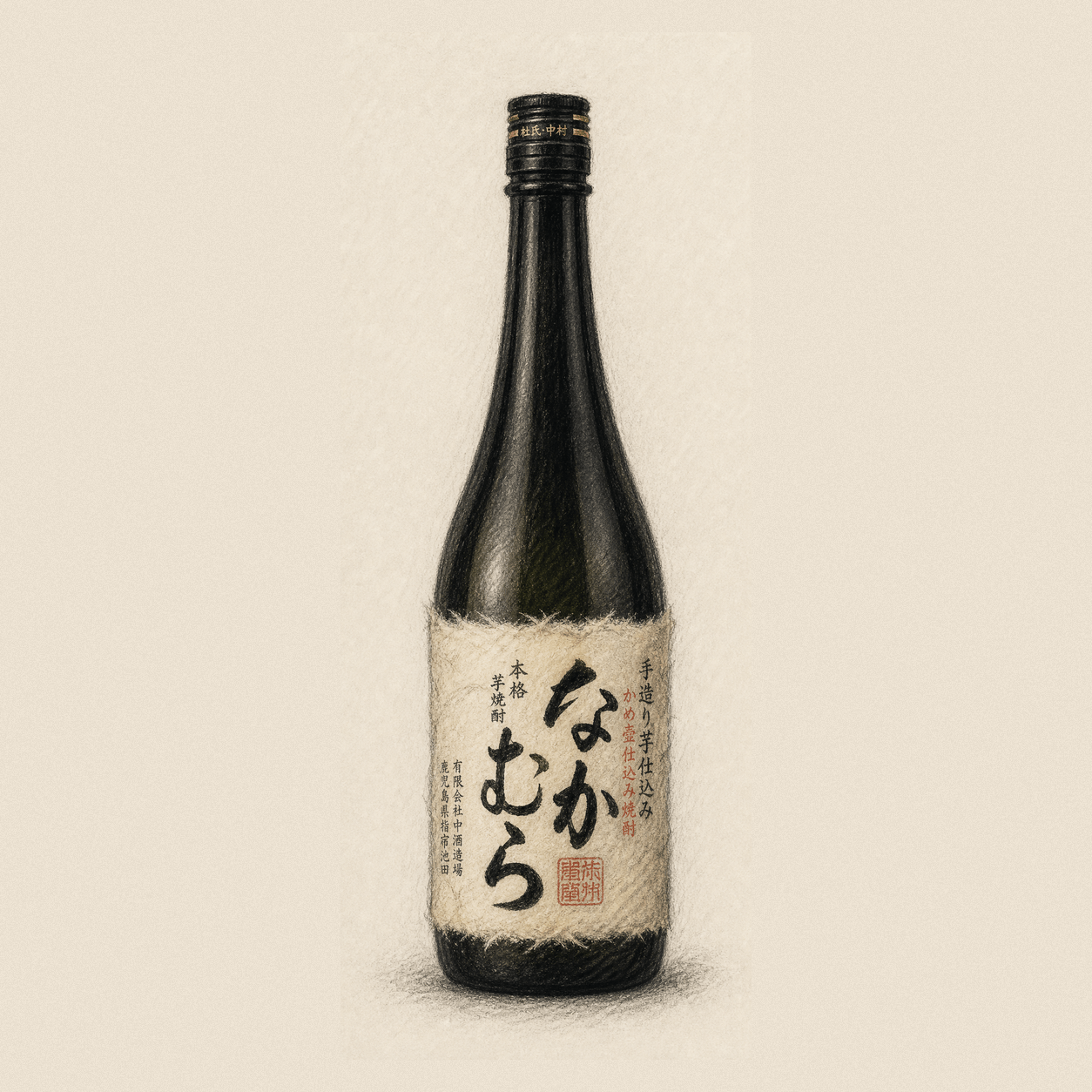
NAKAMURA
A sweet-potato shochu shaped by the slow work of a stone koji room. Wooden trays, rice koji and clay pots are not an image here; they are the physical rhythm that gives NAKAMURA its composed, grounded character.
Koji is made by hand
Nakamura Shuzojo uses a stone-built koji room and wooden trays for its koji making. The work is deliberately small in scale: the maker watches heat and humidity through the material itself rather than turning the process into a mechanical routine. This approach begins long before distillation and sets the pace for the finished spirit.
A local line through the making
Koganesengan sweet potato meets Hinohikari rice grown in Kirishima for the koji. After atmospheric distillation, the spirit rests in traditional clay pots. The result is a shochu with depth but without spectacle—its sense of place comes from a sequence of materials kept close to the house.
Kirishima, Kagoshima — Nakamura Shuzojo
Nakamura Shuzojo was founded in 1888 in Kirishima, Kagoshima. The house works under a family principle of keeping the brewery small, continuing a hand-led approach centred on koji, earthenware and the local water source.
Koji follows its condition, not a machine
Nakamura Shuzojo makes its koji in a stone-built koji room using wooden koji trays. Instead of forcing the process to follow machine settings, the makers work in response to the condition of the rice and koji.
The family principle, “Do not make the brewery bigger,” has been carried forward since the brewery was founded in 1888. It is a commitment to keeping the work within the makers’ sight and hands, rather than competing on scale.
A sake-brewer’s view brought to sweet-potato shochu
The sixth-generation toji, Shinya Nakamura, studied brewing at Tokyo University of Agriculture and trained at Hatsumago, a sake brewery in Yamagata. He brought a sake-brewer’s attention to rice koji and fermentation into the making of sweet-potato shochu.
Sweetness and texture shift with temperature
The producer describes the spirit as sweet and gently roasted when warmed, and silky and smooth when served chilled. Atmospheric distillation and rest in traditional clay pots give the regular expression depth without losing composure.
The regular expression is 25% ABV and is listed in 720 ml and 1,800 ml formats. Try it neat, on the rocks, with water or warm water to see how temperature and dilution shift its profile.
How temperature changes the way it sits with food
The pairings below are not a combination presented officially by the brewery, but a reading drawn from the aroma and texture characteristics recorded on this page.
This pairing rationale draws on the following reference books: The official description that this shochu turns “sweet and toasty when warmed, smooth when chilled” lines up with the idea in Logical Pairing that temperature changes how the five basic tastes and aroma are perceived. The book notes that umami and sweetness become easier to sense when warmed, while texture shifts in softness with temperature — Nakamura’s temperature design can be read as following that same principle when paired with food. Sushi and Washoku Pairing Rules also notes that distilled spirits carry almost no iron and are unlikely to bring out fishy notes in seafood, which is one more reason it sits well with delicate seafood dishes.
For current-lot specifications, availability, storage requirements and trade terms, please contact Bacchus Global.