Drink
Black Koji, White Koji, Yellow Koji
Three molds that paint entirely different landscapes within shochu
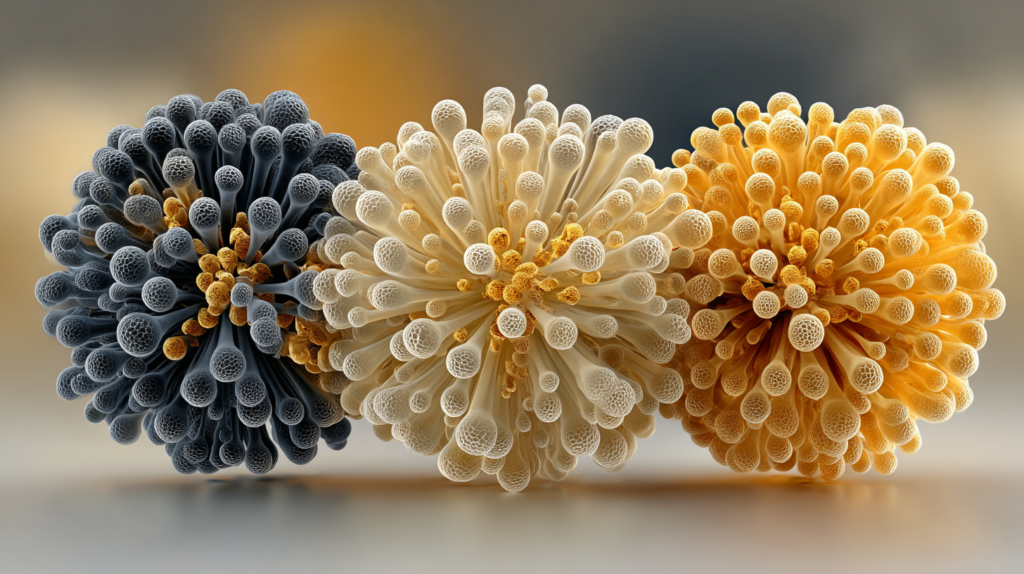
Just as wine is spoken of in terms of grape varieties like Pinot Noir or Cabernet Sauvignon, there are three names that should come first when approaching shochu: black koji, white koji, and yellow koji. In scientific terms, they are Aspergillus luchuensis, Aspergillus luchuensis mut. kawachii, and Aspergillus oryzae. These three distinct microorganisms create completely different expressions within the single category of “shochu.”
Why shochu needs koji
Grapes, as long as yeast is present on their skins, can convert sugar directly into alcohol. But rice, sweet potatoes, and barley are not sugar; they are dense with starch. Yeast alone cannot work with starch in that form.
This is where koji mold comes in. When it propagates over grains, it produces enzymes called amylases, which break starch down into sugar. Only then can yeast convert it into alcohol. Both sake and shochu are built on this two-step process. As Jeremy Umansky and others explain in Koji Alchemy, koji is a microorganism that simultaneously generates enzymes responsible for sweetness, umami, and aroma. Choosing which koji to use is not a minor technical detail; it is a foundational design decision that defines the very structure of the spirit.
Black koji: A powerful guardian from the south
Black koji originally evolved for awamori production in the Ryukyu Islands. In a subtropical climate of heat and humidity, it produces large amounts of citric acid, keeping the mash acidic and resistant to spoilage. Awamori has been made in Okinawa for over 500 years in part because of this mold’s defensive strength.
In the early 20th century, a Kagoshima researcher named Genichiro Kawachi introduced black koji to mainland shochu production. Until then, southern Kyushu distillers relied on yellow koji from sake brewing and struggled with spoilage in the summer. The adoption of black koji marked a turning point in the technological history of shochu, stabilizing the entire industry.
A modern example is Hamada Shuzo’s DAIYAME 40. By combining carefully aged “aroma-matured” sweet potatoes with vacuum distillation, it produces vibrant fruit notes reminiscent of lychee and muscat grapes. This expression demonstrates how black koji can also yield bright, aromatic profiles.
White koji: A gentle mutation born from black
White koji emerged as a natural mutation of black koji. In 1924, within Kawachi’s koji room, white spores were discovered mixed among the black ones. Though a variant of the same species, it differed not only in color but also in the character it imparted to the spirit. From the postwar era to today, white koji has become the dominant strain in authentic shochu production in southern Kyushu.
Nakamura Shuzojo’s “Nakamura” exemplifies the potential of white koji through a style reminiscent of sake brewing. Using one of the few remaining stone-built koji rooms in Kyushu, they still practice futa-koji, a labor-intensive method where koji is cultivated in individual wooden trays. Even within white koji, expression varies: Moriizo Shuzo’s “Gokujō Moriizo,” aged over long periods, achieves a silky, rounded mouthfeel. It is one answer to what happens when the gentle nature of white koji meets the dimension of time.
Yellow koji: Elegance crossing over from sake
Yellow koji is the most widely used mold in Japan, underpinning sake, miso, and soy sauce. Because it does not produce large amounts of citric acid, temperature control is more difficult, and it largely disappeared from southern Kyushu shochu production after the war.
Yet in recent years, some distilleries have deliberately chosen to revive it. A leading example is Hakkaisan Brewery’s rice shochu “Yoroshiku Senman Arubeshi.” Using yellow koji and sake yeast familiar to sake brewers, along with a three-stage fermentation process, vacuum distillation, and over two years of aging, it effectively transplants the grammar of sake brewing into rice shochu. The result is a spirit with a fragrant, ginjo-like aromatic profile. It stands as an elegant act of crossing boundaries, reinterpreting the traditional constraints of shochu production.
Opening three doors at the table in Bangkok
In Bangkok, the presence of shochu is quietly growing in Japanese restaurants and fine dining settings. Simply adding the words “black koji,” “white koji,” or “yellow koji” after a label gives the drink a new sense of dimension. Variables like sweet potato variety, rice strain, distillation method, and aging are gently unified by that initial choice of koji.
To speak the language of shochu is to reconnect, at the table, with the wisdom of Japan’s fermentation culture, a body of knowledge woven over 500 years. These three types of koji are the small, three-colored doors placed at its entrance. (Mr.Bacchus)
This article is intended solely to explore the distillation techniques and cultural heritage of Japanese shochu producers including Hamada Shuzo (DAIYAME), Nakamura Shuzojo (Nakamura), Mori-Izo Shuzo (Mori-Izo), and Hakkaisan Brewery (Yoroshiku Senman Arubeshi), and the role of the three koji molds in shochu craftsmanship.
Discover the culture behind every bottle
We share brewery stories, tasting notes and the craft of koji & fermentation | for educational and cultural purposes only.
เราถ่ายทอดเรื่องราวจากผู้ผลิต บันทึกรสชาติ และศาสตร์แห่งโคจิและการหมัก | เพื่อการศึกษาและวัฒนธรรมเท่านั้น
Follow on Instagram FacebookRelated Articles
“The Invisible Spirit” / “The True Vernacular of the Land” / “A Parallel Spirit” / “Sushi and the Choice of Shochu” / “The Architecture of Aroma”
Related Product(s)
HAKKAISAN Rice Shochu Yoroshiku Senman Arubeshi / GOKUJO MORIIZO / NAKAMURA / DAIYAME 40