Blog
Five Years, Two Vessels: Oyama Yume Kobo’s “Yumehibiki”
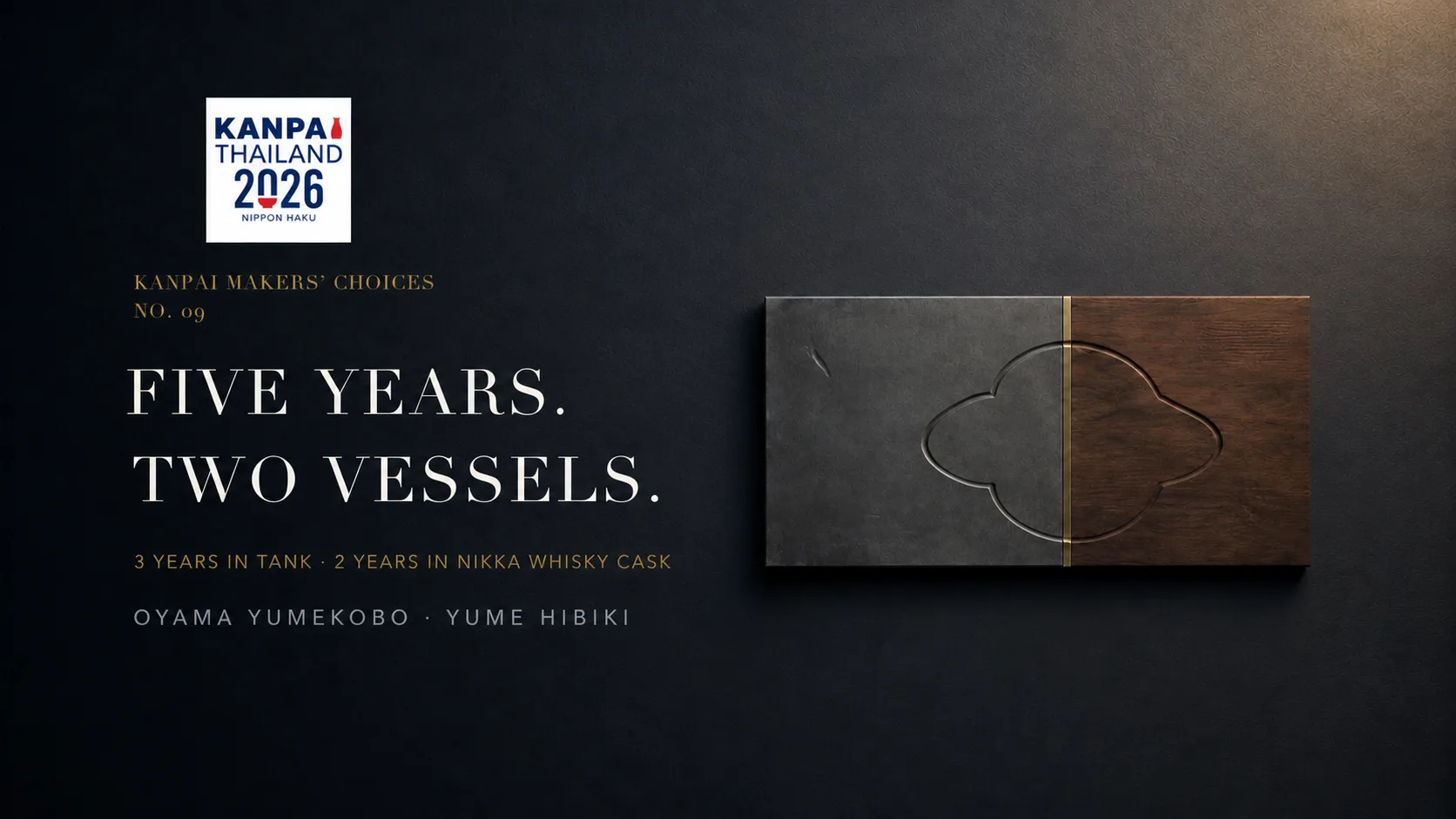
KANPAI Makers’ Choices No.09
When you hear “aged for five years,” you might picture a single liqueur resting quietly in the same vessel for the entire period. But Oyama Yume Kobo’s “Yumehibiki Nikka Barrel-Aged Umeshu | 5-Year Aged” does not spend all five years in one place.
The process is divided intentionally: umeshu made from local Oushuku plums first ages for three years in stainless steel tanks, before being transferred to oak barrels previously used for Nikka Whisky for an additional two years. Behind the simple designation of “five years” lies a 3+2-year timeline, defined by a deliberate change of vessel along the way.
At KANPAI Thailand 2026, Oyama Yume Kobo will also present “Rose Umeshu Yumehibiki Premium” and “Nanko Ume no Kodawari Umeshu | 3-Year Aged.” For No. 09, however, the focus rests on this five-year-aged expression and the artisan’s choice to transition between vessels midway through maturation.
From a Plum-Growing Community to a Dedicated Craft Distillery
In 1961, the town of Oyama in Hita, Oita Prefecture, launched a pioneering agricultural movement under the memorable slogan, “Plant plums and chestnuts, and go to Hawaii.” Today, according to the City of Hita, Oyama’s orchards remain home to approximately 9,000 plum trees.
This regional initiative was never solely about harvesting fruit. As documented by Japan’s Ministry of Agriculture, Forestry and Fisheries, the goal was to cultivate lasting value within the community by processing locally grown produce into refined goods.
Oyama Yume Kobo was established in 1998, later opening Bungo Oyama Hibiki no Sato in 2002 as a public-private venture in Hita City. Its modern umeshu facility, Umeshu Gura Oyama, was developed in close collaboration with Nikka Whisky.
Only plums cultivated by local farmers in Oyama are used. Harvested in the cool of the morning, the fruit is steeped that very afternoon. Long before the years of aging begin, this time-sensitive ritual ensures that the raw natural character of the harvest is captured at its peak.
No Barrel Aging for the First Three Years
Yumehibiki is made with Oushuku plums grown in Oyama Town. Oushuku is a variety that bears large fruit and is also featured on Hita City’s page introducing Oyama Town.
According to the maker’s official product information, the umeshu made from Oushuku plums is first aged for three years. Published product information says this initial three-year period takes place in tanks, so the full five years are not spent in barrels.
By the time it is transferred to a barrel, the umeshu has already been aged for three years. The sequence confirmed by public information is: age the umeshu for three years, then transfer it to an oak barrel.
Public information does not explain why the first period was set at three years or what criteria were used. What can be confirmed is the transfer of three-year-aged umeshu to the next vessel.
After Three Years, the Umeshu Moves to Whisky Barrels
After three years of aging, the umeshu is transferred to oak barrels used for making whisky.
The product name shown at KANPAI Thailand 2026 includes “Nikka Cask,” and published product information says it is stored for a further two years in Nikka Whisky barrels.
The producer’s official product information confirms the process of transferring the three-year-aged umeshu to oak barrels for further storage. However, public information does not say which distillery used each barrel, what kind of whisky it previously held, or how each barrel was managed. We cannot describe every change resulting from two years of barrel aging through speculation. What has been made public is the process: umeshu aged for three years is moved to oak barrels used in whisky-making and kept there for a further two years.
Reading “Five Years” as Two Distinct Epochs
Three years plus two years equals five. Yet for this bottle, “five years” is not a single uninterrupted passage of time.
For the first three years, the Oushuku umeshu matures in quiet tanks. For the remaining two, it breathes within whisky barrels. What shifts is not merely the age of the liquid, but the very vessel with which it interacts.
This two-stage approach is not presented as superior to traditional single-vessel aging; art cannot be easily ranked. Rather, it highlights a conscious design choice: introducing a structural shift halfway through the journey.
To read the bottle simply as “five years” is to miss the transition. To read it as “3 + 2 years” brings the maker’s intent into sharp focus.
No. 09 Records the Choice to Change Vessels Midway
The KANPAI Makers’ Choices series has so far recorded decisions about rice-polishing ratios and aging conditions; four-season brewing and the selection of nakagumi; handling sweet potatoes before the second-stage mash; and using different rice-polishing ratios for koji rice and kake rice.
Other topics have included using tea from the fermentation stage and blending two sake styles after distillation, choosing not to use activated charcoal for adjustment, changing the base sake used for umeshu, and placing multiple designs within a single Junmai Daiginjo. In No. 09, the choice recorded for Oyama Yume Kobo is not to age the full five years in one vessel.
According to the brewery, plums harvested in Oyama in the morning are steeped that same day. This product is umeshu made with Oushuku plums, aged for three years and then transferred to whisky barrels for a further two. Looking only at the number “five years” can hide the vessel change in the middle. Reading the “3 years + 2 years” breakdown alongside the process makes clear that Yumehibiki’s five years are not spent in one vessel; they are two stages linked by a change of vessel.
This article is intended solely to provide factual and cultural information about Oyama Yume Kobo and YUME HIBIKI 5 years old in Nikka Whisky Cask, including its maturation design. It does not aim to promote or encourage the purchase or consumption of alcohol. It is intended for readers aged 20 and over.
บทความนี้จัดทำขึ้นเพื่อให้ข้อมูลเชิงข้อเท็จจริงและวัฒนธรรมเกี่ยวกับ Oyama Yume Kobo และ YUME HIBIKI 5 years old in Nikka Whisky Cask รวมถึงแนวคิดด้านการบ่มเท่านั้น มิได้มีเจตนาเพื่อส่งเสริมการซื้อหรือการบริโภคเครื่องดื่มแอลกอฮอล์ บทความนี้จัดทำขึ้นสำหรับผู้อ่านอายุ 20 ปีขึ้นไป
Related Products
YUME HIBIKI 5 years old in Nikka Whisky Cask / ROSE UME LIQUEUR YUME HIBIKI Premium
Related Reading
No.08: The Spectrum of Junmai Daiginjo / No.07: Not Defining Umeshu by a Single Formula / KANPAI THAILAND 2026: All Episodes
No.10: 13% ABV and Still Genshu
Discover the culture behind every bottle
We share brewery stories, tasting notes and the craft of koji & fermentation | for educational and cultural purposes only.
เราถ่ายทอดเรื่องราวจากผู้ผลิต บันทึกรสชาติ และศาสตร์แห่งโคจิและการหมัก | เพื่อการศึกษาและวัฒนธรรมเท่านั้น
Follow on Instagram Facebook