KAGURA
Striking Water, Reviving a Brewery
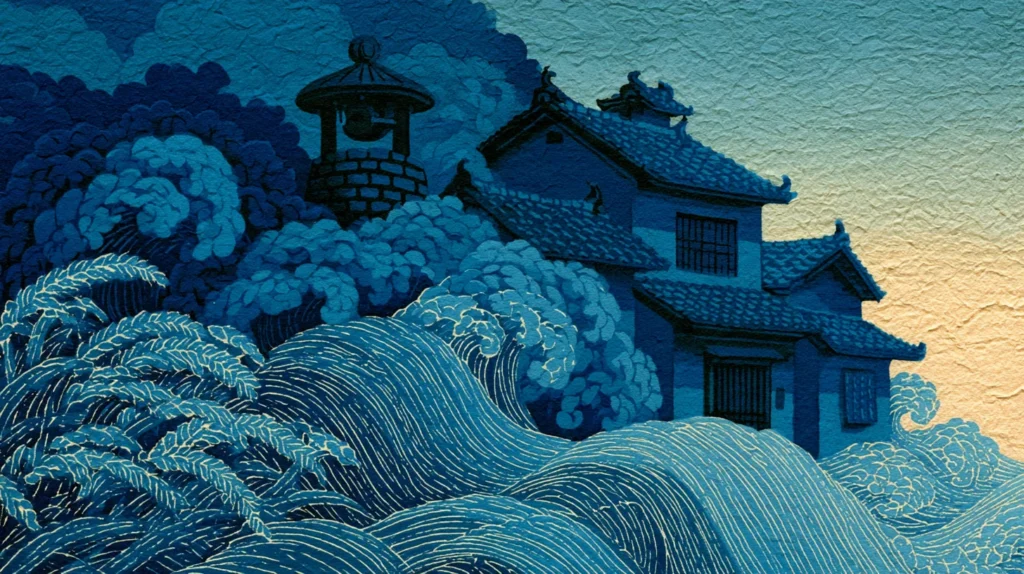
Striking Water, Reviving a Brewery: Kyoto’s Matsui Shuzo and Its 300-Year Legacy in “KAGURA Junmai Midnight Blue”
Every ten meters they drilled, Matsui Shuzo’s fourteenth-generation head, Yatsuho Matsui, tested the water they brought up. He continued until they reached a depth of fifty meters, where he finally rediscovered the same underground water vein once used for brewing sake. It was 2009. Founded in 1726 and later relocated to central Kyoto, the brewery had, until shortly before then, been unable to make sake for many years.
A Brewery Falls Silent
The story of Matsui Shuzo begins in Kasumi, Tajima|now part of Kami Town in Hyogo Prefecture. The family ran both a sake-brewing business and a trading enterprise using kitamaebune cargo ships. At the time, its sake was sold under the name “Fuji Chitose.”
The brewery was eventually moved to central Kyoto. During the Hamaguri Gate Rebellion in the final years of the Tokugawa shogunate, it was destroyed in a major fire. Then, during the Taisho era, the expansion of Kyoto’s streetcar lines forced another move, this time to the area that is now Sakyo Ward.
After surviving fire and repeated relocations, the brewery was finally driven into silence in the late Showa period. Railway construction, including subway development, altered the quality of the well water essential to brewing. Combined with declining demand, this forced Matsui Shuzo to suspend sake production. The family preserved only its brewing license and remained inactive for several decades.
On the Ground Floor of an Apartment Building
The revived brewery now occupies the ground floor of an apartment building along Kyoto’s Kamo River. It is a compact urban brewery of only about 132 square meters. All brewing takes place in temperature-controlled thermal tanks, allowing year-round production regardless of the season.
Annual output is modest, at approximately 300 koku, and fermentation temperatures are controlled in increments of 0.1 degrees Celsius. The brewery uses exceptionally soft water, with a hardness of about 35 mg/L, drawn from the same water system as the Kyoto Imperial Palace and Shimogamo Shrine. Matsui Shuzo calls it “sensui,” or “cleansing water.” With this water restored, the brewery was able to begin making sake once again.
Today, the brewery is led by its fifteenth-generation head, Jiemon Matsui. While studying at Keio University Law School, he was reportedly told by his father, “There are others who can become lawyers, but you are the only one who can make Matsui Shuzo’s sake.”
After training under a Noto toji, or master brewer, he now works in the brewery as toji himself. Around 60 percent of the electricity used in production is supplied by solar power. In 2026, Matsui Shuzo celebrates its 300th anniversary.
The Choice Not to Polish Too Much
“KAGURA Junmai Midnight Blue” is an unfiltered, undiluted junmai namazake produced by Matsui Shuzo. It is made entirely from Iwai, a sake rice grown in Kyoto Prefecture.
The rice is polished to 65 percent of its original size|far less extensively than rice used for daiginjo sake. Rather than polishing away every trace of richness or complexity, the sake is designed to preserve the distinctive character of Iwai rice. Iwai dissolves readily into the moromi mash, and its unique qualities are said to diminish when it is polished too heavily.
A seamless union of grain and water, bound by the shared terroir of Kyoto.
After approximately thirty-five days of slow, low-temperature fermentation, the undiluted sake is bottled as it is. The Kagura label bears five crests, said to represent the harmony of five tastes: sweetness, acidity, dryness, bitterness, and astringency. Because of its deep lapis-blue bottle, the sake is also known overseas as “Midnight Blue.”
Sake production at this brewery once came to a halt. Yet after rediscovering its water source, the brewery came back to life. Today, the water that once slipped away flows into each bottle of KAGURA Junmai Midnight Blue, meticulously filled to honor a revived legacy.
Matsui Shuzo’s 300-year story, carried from Tajima to central Kyoto, is still being written.
This article is intended solely to explore the brewing philosophy and cultural heritage of Matsui Sake Brewery and the “KAGURA Junmai Midnight Blue” brand, and does not aim to promote or encourage the consumption of alcohol. / บทความนี้จัดทำขึ้นเพื่อนำเสนอข้อมูลเกี่ยวกับปรัชญาการผลิตและมรดกทางวัฒนธรรมของโรงสาเก Matsui และแบรนด์ “KAGURA Junmai Midnight Blue” เท่านั้น มิได้มีเจตนาเพื่อส่งเสริมหรือโฆษณาเครื่องดื่มแอลกอฮอล์ สำหรับผู้มีอายุ 20 ปีขึ้นไป โปรดดื่มอย่างรับผิดชอบ
Discover the culture behind every bottle
We share brewery stories, tasting notes and the craft of koji & fermentation | for educational and cultural purposes only.
เราถ่ายทอดเรื่องราวจากผู้ผลิต บันทึกรสชาติ และศาสตร์แห่งโคจิและการหมัก | เพื่อการศึกษาและวัฒนธรรมเท่านั้น
Related Articles
“In the Heart of Kyoto Stands a 300-Year-Old Sake Brewery” / “What “water” brings to sake #SAKE HUNDRED” / “Matsuo Taisha shrine, Kyoto ~ God of Sake” / “TAMAGAWA Sake: Tradition Reinvented by Toji Philip Harper”
Related Product(s)
KAGURA Junmai Midnight Blue Non-filter Nama-Genshu / KAGURA Junmai-Daiginjo White Non-filter Genshu / KAGURA Junmai Clear Non-filter Nama-Genshu / KAGURA Umeshu Cup with Whole Ume Fruit