
Drink
“Nakadori” Is Not a Quality Grade: Where Arabashiri, Nakadori, and Seme Emerge During Pressing
Sake labels sometimes feature terms such as arabashiri, nakadori, and seme. In explanations intended for general audiences, it is not uncommon to see these three terms presented as though they represent a hierarchy of quality.
However, a closer look at the glossary published by the Japan Sake and Shochu Makers Association (JSS) reveals a somewhat different picture. Rather than indicating levels of quality, these terms describe the sequence in which sake emerges during pressing and the differences in pressure applied at each stage.
Inside the Pressing Vat, Sake Emerges in Sequence
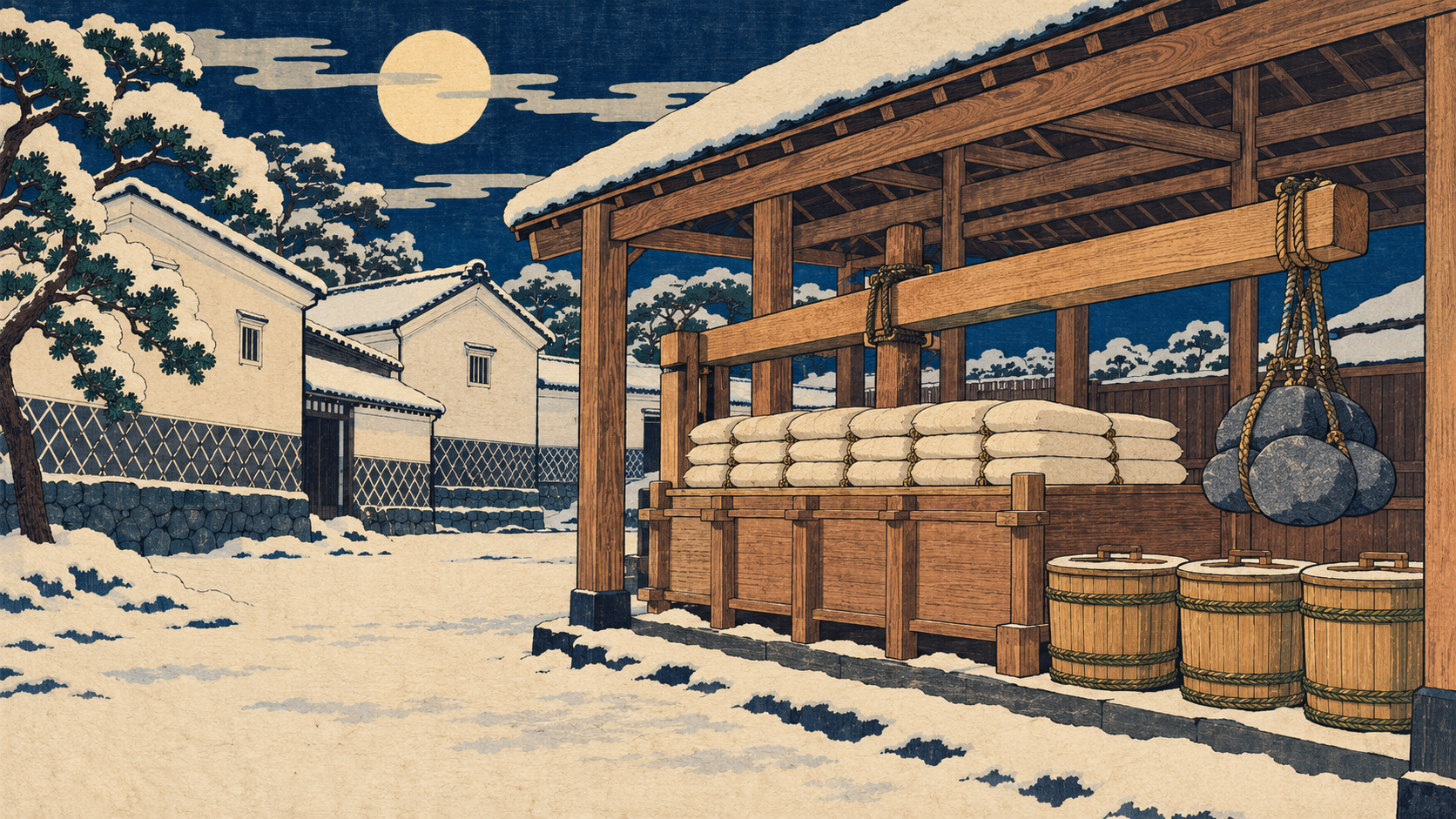
The process of separating fermented moromi (sake mash) into clear liquid sake and solid lees is called jōsō (上槽), or sake pressing. The association’s glossary describes the traditional pressing process using a fune (槽), a rectangular pressing vat, approximately as follows.
First, the moromi is poured into sake bags holding roughly 5 to 9 liters each, which are then arranged and stacked inside the pressing vat. The first liquid to emerge while the bags are being stacked is a cloudy sake known as arabashiri (荒走り, “rough run”). For about three hours after stacking is complete, clear sake flows out naturally under the sheer weight of the bags themselves. As the stack begins to settle, a pressing lid known as an oshibuta (押蓋) and heavy wooden beams are placed on top, and pressure is applied. The following day, the sake bags are rearranged and pressed once more. This final stage is called semebune (責槽), and the sake obtained from it is known as seme (責め).
The association refers to the sake released after arabashiri but before seme as nakadare (中垂れ). In other words, the three stages are arabashiri, the cloudy sake released while the bags are being stacked; nakadare, the sake released through the weight of the bags and the initial pressing; and seme, the sake obtained by rearranging and pressing the bags again the following day. These names therefore represent distinctions in timing and applied force, rather than rankings of quality.
The terms nakadori (中取り) and nakagumi (中汲み), commonly seen on commercial sake labels, are used to describe this middle portion of the run. However, even the association’s glossary does not establish a uniform definition of precisely where this middle fraction begins and ends.
Arabashiri Is Not Always Bottled Separately
Regarding arabashiri, Kyoto-based sake producer Gekkeikan explains that it is the first sake to flow out naturally under the weight of the mash itself. Freshly pressed sake still contains dissolved carbon dioxide and appears slightly cloudy due to suspended fine particles known as ori (澱), or lees sediment.
Meanwhile, Hyogo-based Hakutsuru Sake Brewing notes that this initial cloudy run may be collected separately in a small vessel to allow the sediment to settle, or it may be returned to the mash to be pressed again. Arabashiri, therefore, is not necessarily bottled and sold as a standalone product. Whether to isolate it or return it for re-pressing is a decision left to each brewery.
General explanations of seme also frequently make categorical claims that it has “a higher alcohol content” or “more off-flavors.” However, among the documentation examined from sake brewing associations and individual breweries, no numerical comparisons of the chemical composition of these three pressing fractions were found. What can be stated with certainty from primary sources is limited to the order in which the sake emerges and the differences in pressure applied during pressing.
With Machine Pressing, the Boundaries Vary by Brewery
The association’s glossary also notes that automatic mash filter presses have become widespread in modern brewing. Because the three traditional terms originated in a manual process involving cloth bags and a pressing vat, how those distinctions are mapped onto modern machine pressing varies from one brewery to another.
Fumigiku Sake Brewery in Toyama Prefecture explains that its “Haneya” brand is made using only nakagumi (nakadori), which it defines as the middle portion of the sake collected in a receiving tank during pressing. Here, nakagumi is framed not in terms of time elapsed inside a traditional pressing vat, but as the “middle portion” of the liquid volume accumulated in the tank. This illustrates how the exact range indicated by the same term can shift depending on a brewery’s equipment and production philosophy.
Although Fumigiku notes that its labor-intensive methods limit its ability to scale up production, it maintains a policy of using only the middle fraction of the pressing for the Haneya brand. Both “HANEYA Tsubasa Junmai-Daiginjo Nama” and “HANEYA Kirabi Junmai-Ginjo Nama-Genshu” are crafted under this policy.
What Happens After the Middle Fraction Is Selected?
Selecting the middle portion of the pressing is not the final step in sake production; how the sake is handled afterward also diverges from brewery to brewery.
Kato Kichibee Shoten in Fukui Prefecture describes its “BORN Junmai-Daiginjo Non-filter Nama-Genshu” as a nakadori junmai daiginjo sake. Brewed with Yamada Nishiki rice polished to 50% of its original weight, the sake undergoes no filtration, water dilution, or pasteurization, and is sub-zero aged at −10°C.
Yamachu Honke Brewery in Aichi Prefecture, meanwhile, explains that its “GIKYO Yorokobi” is a blend crafted from the nakagumi fraction of junmai ginjo sake made with rice polished to 40% of its original weight. The sake is aged at low temperatures for at least three years, after which batches from multiple brewing vintages are blended together.
Although both breweries select the “middle” cut, their approaches to finishing the sake are entirely different. Some breweries release the selected fraction as nama genshu, unpasteurized and undiluted sake that remains close to its freshly pressed state. Others age their sake across several years and marry different vintages to create the final product. The word nakadori on a label is therefore just one piece of information indicating which part of the pressing was used; to understand the sake as a whole, it must be read alongside other details, including maturation and pasteurization.
What These Names Really Tell Us Is When the Sake Was Pressed
Arabashiri, nakadare, and seme are terms rooted in a traditional pressing workflow that unfolds across more than a single day: stacking sake bags inside a vat, applying pressure, and rearranging the bags for a final pressing the next day. Yet each brewery decides which portions to isolate and bottle, where to draw the boundaries of what it calls nakadori or nakagumi, and how to finish the resulting sake. Rather than assuming a quality ranking based on a single word printed on a label, looking at how the brewery itself defines and explains that term offers a much clearer guide to what is inside the bottle.
This article is intended solely to explore the brewing techniques and cultural heritage of sake pressing, with reference to Fumigiku Sake Brewery (HANEYA), Kato Kichibee Shoten (BORN) and Yamachu Honke Brewery (GIKYO), and does not aim to promote or encourage the consumption of alcohol.
บทความนี้จัดทำขึ้นเพื่อนำเสนอข้อมูลเกี่ยวกับเทคนิคการผลิตและมรดกทางวัฒนธรรมของขั้นตอนการคั้นสาเก โดยอ้างอิงถึง Fumigiku Sake Brewery (HANEYA), Kato Kichibee Shoten (BORN) และ Yamachu Honke Brewery (GIKYO) เท่านั้น มิได้มีเจตนาเพื่อส่งเสริมหรือโฆษณาเครื่องดื่มแอลกอฮอล์ สำหรับผู้มีอายุ 20 ปีขึ้นไป โปรดดื่มอย่างรับผิดชอบ
Discover the culture behind every bottle
We share brewery stories, tasting notes and the craft of koji & fermentation — for educational and cultural purposes only.
เราถ่ายทอดเรื่องราวจากผู้ผลิต บันทึกรสชาติ และศาสตร์แห่งโคจิและการหมัก — เพื่อการศึกษาและวัฒนธรรมเท่านั้น
Follow on Instagram Facebook
