CRAFT BEER
From Rice to Malt: How the Same Water Connects Sake and Beer— HEIWA CRAFT Pale Ale
From Rice to Malt: How the Same Water Connects Sake and Beer — HEIWA CRAFT Pale Ale
The Sake Staircase, Episode 9 | Step 5: Craft Beer
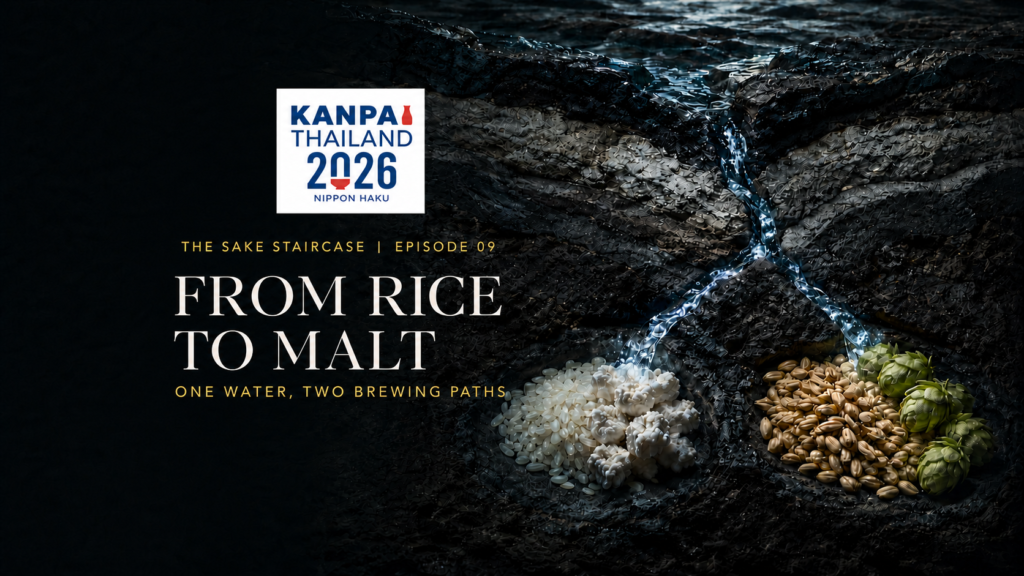
At first glance, sake and beer inhabit different worlds—one built on rice, the other on malted barley and hops, each guided by distinct brewing methods. Yet at Heiwa Shuzo in Kainan, Wakayama Prefecture, these two traditions are united by the same sacred water.
Heiwa Shuzo draws its brewing water from deep underground beneath the Kishigawa River, a body fed by the pristine mountains of Koyasan. Flowing naturally through rich subterranean layers, this water reaches the brewery’s well, serving not only as the soul of its sake but also as the foundation for HEIWA CRAFT beers.
In our previous feature (Episode 8), we explored how local botanicals and water define the sense of place in ohoro GIN Standard. Continuing with Step 5, we now turn to HEIWA CRAFT Pale Ale. While craft beer may seem distant from the sake introduced in Step 1, it reveals a profound connection to the daily craft of a sake brewery.
Sake and Beer Convert Starch into Sugar in Different Ways
In every fermented beverage, yeast turns sugar into alcohol. However, because the primary carbohydrate in both rice and malt is starch—which yeast cannot digest directly—the starch must first be converted into fermentable sugars.
In sake brewing, this transformation is driven by koji, steamed rice cultivated with koji mold. Enzymes produced by the mold break starch into sugars while yeast simultaneously ferments those sugars into alcohol within the same vessel (moromi). This harmonious double process is known as parallel multiple fermentation.
Beer follows a sequential path. During mashing, natural enzymes in the malt convert starch into fermentable sugars. Yeast then ferments the resulting wort, while hops lend their distinct aroma and balanced bitterness.
Though ingredients and techniques diverge, the fundamental principle remains constant: starch becomes sugar, and sugar becomes alcohol.
What They Share: Water and Fermentation Control
Heiwa Shuzo is celebrated for its flagship sake brand, KID, alongside its delicate Tsuru-Ume liqueurs. Yet behind both lies a shared discipline: the expertise in microbial control and fermentation management developed over decades of sake brewing now serves as the bedrock for its craft beer production.
Microbial control demands precise stewardship—fostering beneficial yeast while shielding the brew from unwanted strains. Meticulous attention to temperature, hygiene, and fermentation dynamics is essential to both sake and beer, regardless of their differences.
While sake techniques cannot be directly applied to beer, the core philosophy of fermentation control translates effortlessly. And in every batch, brewing begins with that same pristine underground water from the Kishigawa River.
One Person’s Passion Became a New Chapter for the Brewery
The story of Heiwa Shuzo’s beer production centers on Kanako Takagi. She joined the brewery in 2011 with a dedication to craft brewing, though she had not anticipated that her journey would lead to masterminding beer.
The opportunity emerged when the brewery acquired brewing equipment to explore new expressions of craft. Knowing Takagi’s passion for craft beer, the brewery entrusted her with leading the venture. Heiwa Shuzo secured its brewing licenses in 2014 and introduced HEIWA CRAFT to the world in 2016.
Takagi’s vision, combined with modern brewing equipment and the brewery’s deep knowledge of fermentation, created an inspiring new chapter alongside its traditional sake making.
Why a Classic Pale Ale Matters
Crafted purely from malt and hops, HEIWA CRAFT Pale Ale is defined by its classic pale ale style. While regulatory and labeling classifications may differ across international markets, its character remains anchored in this elemental approach.
A pale ale is distinguished by its golden clarity and balanced profile. By eschewing added spices, fruits, or auxiliary flavorings, this straightforward recipe turns full attention toward the essential components of brewing: malt, hops, and water.
This clarity makes it easier to appreciate the subtle interplay between beer and sake brewing, illustrating how both crafts stem from the same dedication to fermentation.
Connecting Step 1 and Step 5
In The Sake Staircase, Step 1 introduces sake, while Step 5 explores craft spirits and beer. Rather than a hierarchy of quality, these steps offer a framework for understanding how distinct spirits are brought to life through common principles.
HEIWA CRAFT Pale Ale bridges Step 1 and Step 5 seamlessly. Sake relies on rice and koji; beer on malt and hops. Their paths to converting starch differ, yet both are nurtured by the same Kishigawa underground water and guided by the same mastery of microbial control.
Featured as the craft beer representative for Step 5 at KANPAI THAILAND 2026—taking place at Bangkok’s QSNCC from August 28–30, 2026—HEIWA CRAFT Pale Ale shows how wisdom cultivated in sake brewing can flourish in an entirely new context.
In our final installment, we will look back across all five steps of The Sake Staircase, celebrating both the unique identity of each craft and the deep, enduring philosophy that binds them together.
This article provides factual and educational information about HEIWA CRAFT Pale Ale and Heiwa Shuzo’s brewing culture. It is not intended to advertise alcoholic beverages or encourage their purchase or consumption. For readers aged 20 and over.บทความนี้นำเสนอข้อมูลเชิงข้อเท็จจริงและความรู้เกี่ยวกับ HEIWA CRAFT Pale Ale และวัฒนธรรมการผลิตของ Heiwa Shuzo โดยไม่มีวัตถุประสงค์เพื่อโฆษณา ส่งเสริมการซื้อ หรือส่งเสริมการบริโภคเครื่องดื่มแอลกอฮอล์ เนื้อหานี้จัดทำสำหรับผู้อ่านอายุ 20 ปีขึ้นไป
Related Articles
“From the Same Water, Three Faces” / “Dissolving the Boundaries of a Sake Maker” / “Rice as a Common Language Brewed by Thailand and Japan”
Related Product(s)
HEIWA CRAFT Pale Ale / HEIWA CRAFT IPA / HEIWA CRAFT Sansho Golden Ale
Discover the culture behind every bottle
We share brewery stories, tasting notes and the craft of koji & fermentation — for educational and cultural purposes only.
เราถ่ายทอดเรื่องราวจากผู้ผลิต บันทึกรสชาติ และศาสตร์แห่งโคจิและการหมัก — เพื่อการศึกษาและวัฒนธรรมเท่านั้น