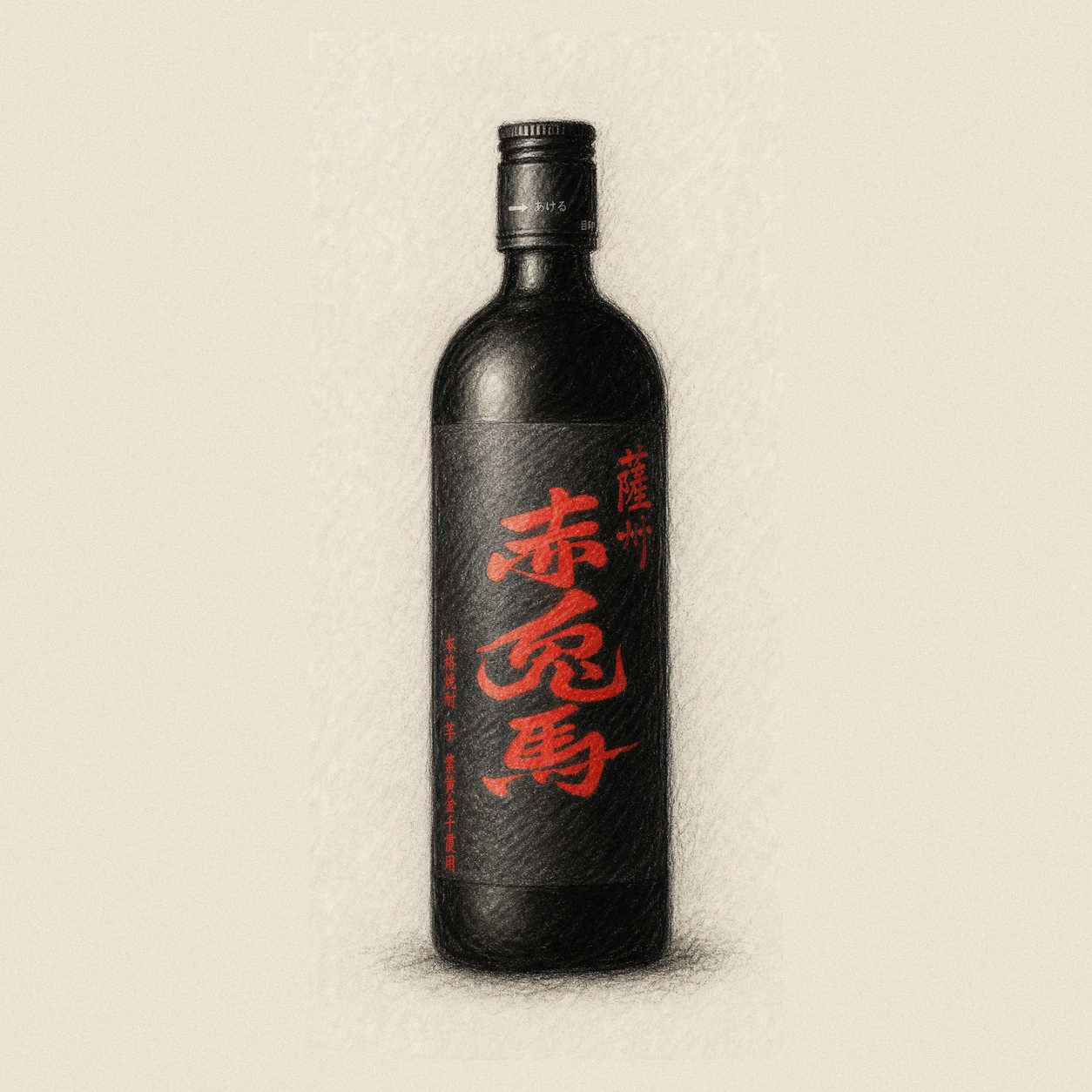
SEKITOBA
Koganesengan, white koji and atmospheric distillation give the black-label signature its depth; proprietary filtration and Mt. Kanmuri spring water bring a clear entry to that substantial core. SEKITOBA calls this balance ‘smooth yet rich.’
A legendary horse carried into a modern signature
Launched in 2001, SEKITOBA takes its name from the Red Hare of the Chinese classic Romance of the Three Kingdoms. The reference is not ornamental: the brand uses the horse’s speed and strength as a metaphor for a spirit that enters with precision and retains a firm centre.
Clear at the edge, substantial at the core
Kagoshima-grown Koganesengan is fermented with white koji and distilled under atmospheric pressure. A proprietary filtration method then refines the spirit without removing the depth that defines the black-label expression. The result is described by the brand as “smooth yet rich.”
Mt. Kanmuri water completes the texture
Spring water from Mt. Kanmuri is used in the final adjustment. The documented profile moves from white flowers and gentle fruit toward soft vanilla, sweet-potato depth and a clean finish. The water is presented as part of the texture, not as a decorative origin claim.
From a light entry to a rich finish
What is recorded above moves from white flowers and gentle fruit toward soft vanilla, sweet-potato depth and a clean finish. This spirit carries a two-stage texture: light on entry, with weight building through the finish. What follows are four directions that follow those two stages. They are not pairings the distillery states officially.
This pairing rationale draws on the following reference book: Logical pairing theory records that sweetness tempers the sting of chilli. Shochu also carries fewer taste elements than brewed drinks, so it rarely meets heavily spiced dishes head-on — a second point that supports this direction.
Award historys for this product
Awards are presented as competition records for this specific product only; they do not guarantee individual preference or quality.
Three houses for tradition, innovation and continuity
Hamada Shuzo was founded in 1868 in Ichikikushikino, Kagoshima. Its three-house structure assigns distinct roles to Denbee-gura, Denzouin-gura and Kanayama-gura, allowing historical methods, modern development and long-term continuity to remain visible within one producer.
For current-lot specifications, availability, storage requirements and trade terms, please contact Bacchus Global.