
Burgundy, Through One Map
Why Has the Vineyard Kept the Same Name Through Every Change of Owner? — Romanée-Conti
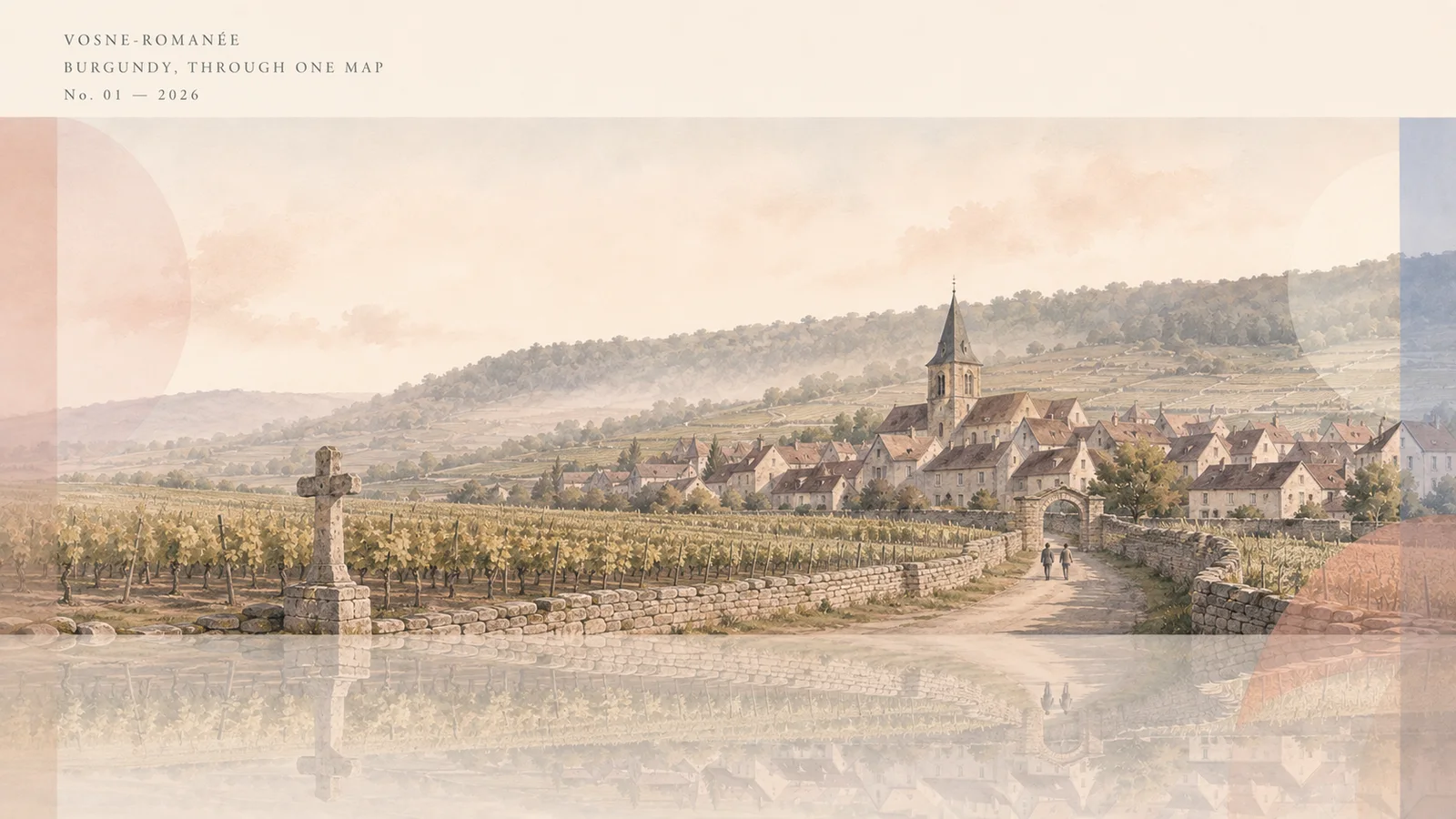
In a corner of the village of Vosne-Romanée, in the Côte de Nuits, lies a vineyard of 1.81 hectares—small enough to walk across in a few minutes. Its name is “Romanée-Conti,” simply the old name of the land, “Romanée,” joined to the name of a nobleman, “Conti.” Over more than 260 years, ownership of this vineyard has passed from a medieval abbey to a nobleman, from the nobleman to the revolutionary state, and from the state to a succession of families. And yet the name given to the vineyard has never changed.
| Item | Details |
|---|---|
| Name of the climat | Romanée-Conti |
| Commune / district | Vosne-Romanée (Côte de Nuits) |
| Classification | Grand Cru / AOC recognized September 11, 1936 |
| Form of ownership | Monopole (the entire plot is owned by a single domaine) |
| Milestone years | 13th century (the abbey holds vineyard land here) / 1760 (acquired by the Prince de Conti) / 1789–94 (confiscated and auctioned in the Revolution) / 1869 (acquired by the Duvault-Blochet family) / 1936 (AOC recognition) / late 20th century–2022 (Aubert de Villaine’s co-directorship) |
| For reference | Area approx. 1.81 hectares / grape variety 100% Pinot Noir / red wine only |
From the Abbey’s Vineyard to “La Romanée”
Records of vines planted in this area reach back to the Middle Ages. The Abbey of Saint-Vivant, founded around the 10th century by Manassès, lord of Vergy, is said to have held vineyard land in this area by the 13th century, built on land granted to it by the Duke of Burgundy in the 12th century. Tended by monks, the land remained a vineyard even after the Abbey of Saint-Vivant itself was later absorbed into the Abbey of Cluny. It was only afterward that the plot came to be called “La Romanée.” The origin of the name is not clear, but it is said to have already taken hold by the 17th century.
1760: A Nobleman Chooses This Vineyard
In 1760, “La Romanée” was put up for sale. It was acquired by a nobleman of the House of Bourbon, Louis-François de Bourbon, Prince de Conti. A story is told that the prince won the vineyard after a rivalry with Madame de Pompadour, the favorite of King Louis XV. After the acquisition, the vineyard came to be known as “Romanée-Conti.” In 1763, the prince also purchased two adjoining plots, to be used as the site for winemaking facilities.
Even the Revolution’s Confiscation Could Not Erase the Name
In 1789, following the storming of the Bastille, the confiscation of Church and noble property began. The vineyard, owned by the Prince de Conti’s family, was not spared. In February 1794, the revolutionary government carried out its first appraisal, and it is in the record of that appraisal that the name “Romanée-Conti” appears in writing for the first time. It was a twist of fate: the name of a nobleman was inscribed in the very documents of the government that was confiscating his property. In December of that year, the vineyard was put up for auction and passed to a man named Nicolas Defer de la Nouerre. It continued to change hands several times over the course of the 19th century, until, on November 25, 1869, it was acquired by Jacques-Marie Duvault-Blochet.
1869, and the Other Village a Co-Director Would Later Choose
The Duvault-Blochet family, which acquired Romanée-Conti that year, would go on to pass the domaine down through succeeding generations. In the latter half of the 20th century, Aubert de Villaine, a descendant within that family line, served as co-director of the domaine that includes this vineyard for nearly half a century, stepping down from the role in 2022. Alongside his years as co-director, Villaine also built a domaine of his own in Bouzeron, a small village in the Côte Chalonnaise. The man who had long been entrusted with this vineyard had also left his name in a quiet village of his own.
Some 800 years have passed since the monks of the Abbey of Saint-Vivant first worked this land. Ownership has passed from the abbey to a nobleman, from the nobleman to the revolutionary state, and on to a succession of families. And yet the name given to the vineyard has never changed.
Three Facts Worth Knowing
- The name “Romanée-Conti” is simply two names joined together. The old name of the land, “La Romanée,” passed down since the Middle Ages, was joined with the name of the nobleman who acquired the vineyard in 1760—Louis-François de Bourbon, Prince de Conti—to form the name used today.
- The Prince de Conti’s property was confiscated in the French Revolution, yet it was in the very process of that confiscation—an appraisal record drawn up by the revolutionary government in 1794—that the name “Romanée-Conti” was first written down. The nobleman’s name was inscribed in the paperwork of the government that was seizing his property.
- The domaine has been carried forward by the same family line since Jacques-Marie Duvault-Blochet acquired the vineyard in 1869. Aubert de Villaine, who served for decades as co-director in the latter half of the 20th century, also built a domaine of his own in the village of Bouzeron, in the Côte Chalonnaise.
In this series
ที่มุมหนึ่งของหมู่บ้านโวสน-โรมาเน (Vosne-Romanée) ในเขตโกต เดอ นุยส์ (Côte de Nuits) มีไร่องุ่นผืนเล็กขนาด 1.81 เฮกตาร์ เล็กพอที่จะเดินข้ามได้ในเวลาไม่กี่นาที ชื่อของไร่นี้คือ “โรมาเน-กงติ” (Romanée-Conti) ซึ่งเป็นเพียงการนำชื่อเดิมของผืนดิน “โรมาเน” (Romanée) มาต่อกับชื่อของขุนนางคนหนึ่ง “กงติ” (Conti) เท่านั้น ตลอดกว่า 260 ปีที่ผ่านมา เจ้าของไร่แห่งนี้เปลี่ยนมือจากอารามในยุคกลาง สู่ขุนนาง จากขุนนางสู่รัฐบาลปฏิวัติ และจากรัฐบาลปฏิวัติสู่ตระกูลต่าง ๆ สืบต่อกันมา แต่ชื่อที่ตั้งให้กับไร่แห่งนี้กลับไม่เคยเปลี่ยนแปลงเลยแม้แต่ครั้งเดียว
| รายการ | รายละเอียด |
|---|---|
| ชื่อไร่ (climat) | Romanée-Conti (โรมาเน-กงติ) |
| หมู่บ้าน/เขต | โวสน-โรมาเน (Vosne-Romanée เขตโกต เดอ นุยส์) |
| การจัดระดับ | แกรนด์ครู (Grand Cru) / ได้รับการรับรอง AOC เมื่อวันที่ 11 กันยายน 1936 |
| รูปแบบการถือครอง | โมโนโปล (Monopole) — พื้นที่ทั้งผืนเป็นของโดเมนเดียว |
| ปีสำคัญ | ศตวรรษที่ 13 (อารามครอบครองไร่องุ่นในย่านนี้) / 1760 (เจ้าชายแห่งกงติทรงได้มาซึ่งไร่) / 1789–94 (ถูกยึดและประมูลขายในช่วงปฏิวัติ) / 1869 (ตระกูลดูโว-โบลเชได้มาซึ่งไร่) / 1936 (ได้รับการรับรอง AOC) / ปลายศตวรรษที่ 20 ถึงปี 2022 (โอแบร์ เดอ วิแลนดำรงตำแหน่งผู้บริหารร่วม) |
| ข้อมูลอ้างอิง | พื้นที่ประมาณ 1.81 เฮกตาร์ / พันธุ์องุ่น ปิโนต์ นัวร์ (Pinot Noir) 100% / ผลิตเฉพาะไวน์แดง |
จากไร่องุ่นของอาราม สู่ชื่อ “ลา โรมาเน”
บันทึกการปลูกองุ่นในย่านนี้ย้อนไปได้ถึงยุคกลาง อารามแซ็ง-วีวองต์ (Saint-Vivant) ซึ่งก่อตั้งขึ้นราวศตวรรษที่ 10 โดยมานัสเซส (Manassès) เจ้าเมืองแวร์ฌี (Vergy) กล่าวกันว่าได้ครอบครองไร่องุ่นในย่านนี้แล้วตั้งแต่ศตวรรษที่ 13 บนที่ดินซึ่งดยุกแห่งบูร์กอญถวายให้ในศตวรรษที่ 12 ผืนดินนี้ซึ่งพระในอารามดูแลอยู่ ยังคงเป็นไร่องุ่นต่อมาแม้ในภายหลังอารามแซ็ง-วีวองต์เองจะถูกรวมเข้ากับอารามกลูนี (Cluny) ก็ตาม ไร่แห่งนี้เริ่มถูกเรียกว่า “ลา โรมาเน” (La Romanée) ในเวลาต่อมา ที่มาของชื่อยังไม่ชัดเจน แต่กล่าวกันว่าชื่อนี้ได้หยั่งรากมั่นคงแล้วตั้งแต่ศตวรรษที่ 17
ปี 1760 ขุนนางผู้เลือกไร่แห่งนี้
ในปี 1760 “ลา โรมาเน” ถูกนำออกขาย ผู้ที่ได้ไร่นี้ไปคือขุนนางแห่งราชวงศ์บูร์บง หลุยส์-ฟรองซัวส์ เดอ บูร์บง เจ้าชายแห่งกงติ (Louis-François de Bourbon, prince de Conti) มีเรื่องเล่าสืบต่อกันมาว่า เจ้าชายทรงได้ไร่นี้ไปหลังการแข่งขันกับมาดาม เดอ ปงปาดูร์ (Madame de Pompadour) สนมเอกของพระเจ้าหลุยส์ที่ 15 (Louis XV) หลังจากได้ไร่นี้มาแล้ว ไร่จึงเริ่มถูกเรียกว่า “โรมาเน-กงติ” ต่อมาในปี 1763 เจ้าชายยังทรงซื้อที่ดินอีก 2 แปลงที่อยู่ติดกัน เพื่อใช้เป็นที่ตั้งอาคารสำหรับการผลิตไวน์
แม้การปฏิวัติจะยึดไร่ไป แต่ชื่อก็ไม่เคยหายไป
ในปี 1789 เมื่อเหตุการณ์บุกป้อมบาสตีย์ (Bastille) จุดชนวนให้เกิดการยึดทรัพย์สินของศาสนจักรและขุนนาง ไร่แห่งนี้ซึ่งเป็นของตระกูลเจ้าชายแห่งกงติก็ไม่พ้นชะตากรรมนั้น ในเดือนกุมภาพันธ์ 1794 รัฐบาลปฏิวัติได้ทำการประเมินราคาทรัพย์สินเป็นครั้งแรก และในบันทึกการประเมินครั้งนั้นเองที่ชื่อ “โรมาเน-กงติ” ปรากฏเป็นลายลักษณ์อักษรเป็นครั้งแรก นับเป็นเรื่องบังเอิญ — ชื่อของขุนนางถูกจารึกไว้ในเอกสารของรัฐบาลฝ่ายที่ยึดทรัพย์สินของขุนนางเสียเอง ในเดือนธันวาคมปีเดียวกัน ไร่ถูกนำออกประมูล และตกไปอยู่ในมือของชายผู้หนึ่งชื่อนิโกลาส์ เดอแฟร์ เดอ ลา นูแอร์ (Nicolas Defer de la Nouerre) หลังจากนั้นไร่ยังเปลี่ยนมือเจ้าของอีกหลายครั้งตลอดศตวรรษที่ 19 จนกระทั่งวันที่ 25 พฤศจิกายน 1869 ฌัก-มารี ดูโว-โบลเช (Jacques-Marie Duvault-Blochet) จึงได้ไร่นี้ไปครอบครอง
ปี 1869 และอีกหนึ่งหมู่บ้านที่ผู้บริหารร่วมคนหนึ่งเลือกในเวลาต่อมา
ตระกูลดูโว-โบลเชซึ่งได้ไร่โรมาเน-กงติไปในปีนั้น สืบทอดโดเมนแห่งนี้ต่อกันมาหลายชั่วอายุคน ในช่วงปลายศตวรรษที่ 20 โอแบร์ เดอ วิแลน (Aubert de Villaine) ซึ่งสืบสายมาจากตระกูลนี้ ได้ดำรงตำแหน่งผู้บริหารร่วมของโดเมนที่ครอบครองไร่แห่งนี้มาเกือบครึ่งศตวรรษ ก่อนจะวางมือจากตำแหน่งในปี 2022 ควบคู่ไปกับช่วงเวลาที่ดำรงตำแหน่งผู้บริหารร่วม เดอ วิแลนยังได้สร้างโดเมนของตนเองขึ้นที่หมู่บ้านเล็ก ๆ ชื่อบูซรง (Bouzeron) ในเขตโกต ชาลอแนส (Côte Chalonnaise) อีกด้วย ชายผู้ดูแลไร่แห่งนี้มาอย่างยาวนาน ก็ได้ฝากชื่อของตนไว้ที่หมู่บ้านเงียบสงบอีกแห่งหนึ่งเช่นกัน
นับจากวันที่พระในอารามแซ็ง-วีวองต์เริ่มลงมือทำไร่บนผืนดินนี้ เวลาผ่านไปแล้วราว 800 ปี เจ้าของไร่เปลี่ยนมือจากอารามสู่ขุนนาง จากขุนนางสู่รัฐบาลปฏิวัติ และสืบต่อมาสู่ตระกูลต่าง ๆ แต่ชื่อที่ตั้งให้กับไร่แห่งนี้ กลับไม่เคยเปลี่ยนแปลงเลยแม้แต่ครั้งเดียว
3 เรื่องที่รู้แล้วเล่าต่อได้
- ชื่อ “โรมาเน-กงติ” (Romanée-Conti) เกิดจากการนำชื่อสองชื่อมาต่อกันเท่านั้น ชื่อเดิมของผืนดิน “ลา โรมาเน” (La Romanée) ซึ่งสืบทอดมาตั้งแต่ยุคกลาง ถูกนำมาต่อกับชื่อของขุนนางผู้ได้ไร่นี้ไปในปี 1760 คือหลุยส์-ฟรองซัวส์ เดอ บูร์บง เจ้าชายแห่งกงติ จนกลายเป็นชื่อที่ใช้เรียกกันในปัจจุบัน
- ทรัพย์สินของเจ้าชายแห่งกงติถูกยึดไปในช่วงปฏิวัติฝรั่งเศส แต่ชื่อ “โรมาเน-กงติ” กลับถูกบันทึกเป็นลายลักษณ์อักษรเป็นครั้งแรกในกระบวนการยึดทรัพย์นั้นเอง — คือบันทึกการประเมินราคาโดยรัฐบาลปฏิวัติในปี 1794 ชื่อของขุนนางถูกจารึกไว้ในเอกสารของฝ่ายที่ยึดทรัพย์สินของเขาไป
- นับจากที่ฌัก-มารี ดูโว-โบลเชได้ไร่นี้ไปในปี 1869 ตระกูลเดียวกันก็สืบทอดโดเมนแห่งนี้ต่อกันมาจนถึงปัจจุบัน โอแบร์ เดอ วิแลน ผู้ดำรงตำแหน่งผู้บริหารร่วมมาอย่างยาวนานในช่วงปลายศตวรรษที่ 20 ยังได้สร้างโดเมนของตนเองขึ้นที่หมู่บ้านบูซรง ในเขตโกต ชาลอแนส อีกด้วย
ลิงก์ในชุดเรื่อง
コート・ド・ニュイ、ヴォーヌ・ロマネ村の一角に、歩いて渡りきるのに数分もかからない、1.81ヘクタールの畑がある。名前は「ロマネ・コンティ」—古くからの土地の呼び名「ロマネ」に、一人の貴族の名「コンティ」を、そのままつなげただけの名前だ。この畑の主は、中世の修道院から貴族へ、貴族から革命政府へ、革命政府からいくつかの家族へと、260年以上のあいだに何度も変わってきた。それでも、畑につけられた名前だけは、一度も変わっていない。
| 項目 | 内容 |
|---|---|
| 畑の名称 | Romanée-Conti(ロマネ・コンティ) |
| 村・地区 | ヴォーヌ・ロマネ村(コート・ド・ニュイ地区) |
| 格付け | グラン・クリュ(特級)/AOC認定 1936年9月11日 |
| 所有形態 | モノポール(畑全体を単独のドメーヌが所有) |
| 節目の年 | 13世紀(修道院がこの一帯の畑を取得)/1760年(コンティ公が取得)/1789〜94年(革命による没収・競売)/1869年(デュヴォー=ブロシェ家が取得)/1936年(AOC認定)/20世紀後半〜2022年(オベール・ド・ヴィレーヌが共同経営) |
| 参考 | 面積 約1.81ヘクタール/ぶどう品種 ピノ・ノワール100%/赤ワインのみ |
修道院の畑から、「ラ・ロマネ」へ
この一帯に葡萄が植えられた記録は、中世にまでさかのぼる。10世紀ごろ、ヴェルジーの領主マナセスが創設したサン・ヴィヴァン修道院は、12世紀にブルゴーニュ公から寄進された土地をもとに、13世紀にはこの一帯の葡萄畑を手にしていたとされる。修道士たちが世話をしたこの土地は、のちにサン・ヴィヴァン修道院自体がクリュニー修道院に統合されたあとも、畑として残り続けた。畑が「ラ・ロマネ」と呼ばれるようになったのはその後のことで、名前の由来ははっきりしないが、17世紀にはすでにこの呼び名が定着していたと伝わる。
1760年、一人の貴族がこの畑を選んだ
1760年、「ラ・ロマネ」は売りに出された。これを取得したのが、ブルボン家に連なる貴族、コンティ公ルイ=フランソワ・ド・ブルボンである。この畑をめぐっては、ルイ15世の寵姫ポンパドゥール夫人と競り合ったすえにコンティ公が手にした、という逸話が伝えられている。取得後、畑は「ロマネ・コンティ」と呼ばれるようになった。コンティ公はさらに1763年、隣接する2区画も買い足し、醸造のための施設用地とした。
革命が没収しても、名前は消えなかった
1789年、バスティーユ襲撃を機に、教会や貴族の財産の没収が始まった。コンティ公の一族が所有していたこの畑も、その対象となる。1794年2月、革命政府による最初の鑑定が行われ、その記録のなかに「ロマネ・コンティ」という名前が文書として初めて登場する。貴族の財産を没収する側であった革命政府自身の書類に、貴族の名前が刻まれた—という巡り合わせだった。同年12月、畑は競売にかけられ、ニコラ・ドゥフェール・ド・ラ・ヌエールという人物の手に渡った。その後も畑は19世紀を通じて何度か所有者を変えながら受け継がれ、1869年11月25日、ジャック=マリー・デュヴォー=ブロシェがこれを取得する。
1869年、そして共同経営者が結んだもう一つの村
この年にロマネ・コンティを取得したデュヴォー=ブロシェの家系は、その後も代を重ねてドメーヌを受け継いでいく。20世紀後半には、その系譜に連なるオベール・ド・ヴィレーヌが、この畑を含むドメーヌの共同経営者を半世紀近くにわたって務め、2022年にその役割を退いた。共同経営者としての歳月と並行して、ヴィレーヌはコート・シャロネーズの小さな村ブーズロンに、自分自身のドメーヌも構えている。この畑を長く預かった人物が、もう一つ、静かな村にも自分の名前を残していた。
サン・ヴィヴァン修道院の修道士たちがこの土地に手を入れてから、およそ800年。畑の持ち主は、修道院から貴族へ、貴族から革命政府へ、そしていくつかの家族へと移り変わってきた。それでも、畑につけられた名前だけは、一度も変わっていない。
知っておくと語れる3つ
- 「ロマネ・コンティ」という名前は、二つの名前を足したものだ。 中世から続く土地の呼び名「ラ・ロマネ」に、1760年にこの畑を取得した貴族—コンティ公ルイ=フランソワ・ド・ブルボン—の名が加わり、今の名前になった。
- フランス革命でコンティ公の所有地は没収されたが、「ロマネ・コンティ」の名が文書に初めて記録されたのは、皮肉にもその没収の過程—1794年、革命政府による鑑定調書—でのことだった。 貴族の財産を奪う側の書類に、貴族の名前が刻まれた。
- 1869年にジャック=マリー・デュヴォー=ブロシェが畑を取得して以来、その家系がドメーヌを受け継いでいる。 20世紀後半に共同経営者を長く務めたオベール・ド・ヴィレーヌは、コート・シャロネーズの村ブーズロンに、自分自身のドメーヌも構えた。