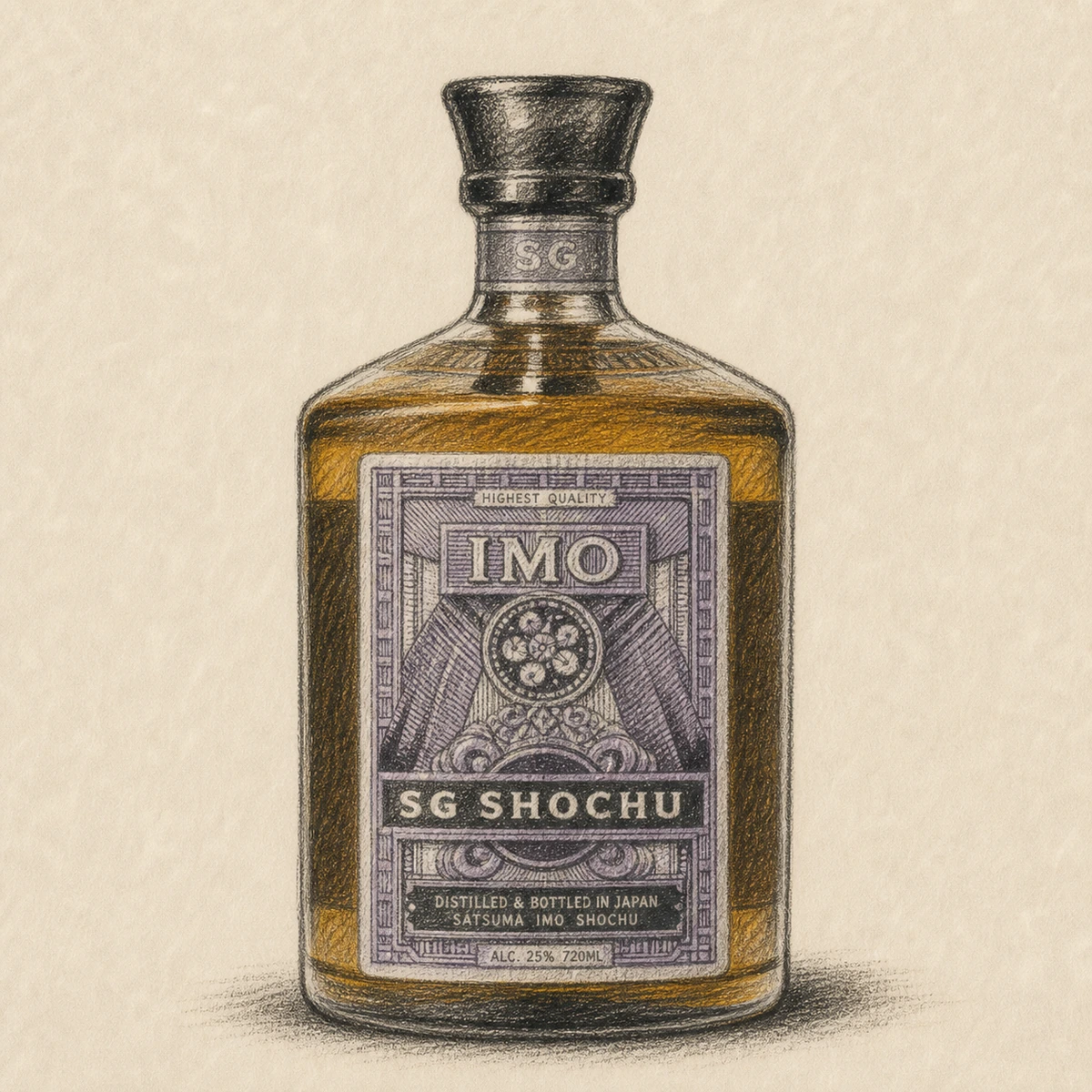
The SG Shochu IMO
Set at 38% for the needs of a bar, IMO uses Kagoshima sweet potato, Japanese rice koji and black koji. Atmospheric distillation keeps the material’s fuller shape intact while the higher proof gives the expression a clear role in mixed-drink programmes.
Thailand · Product information
Product information from Bacchus Global Co., Ltd., based in Bangkok, Thailand. About Bacchus Global
Sensory profile
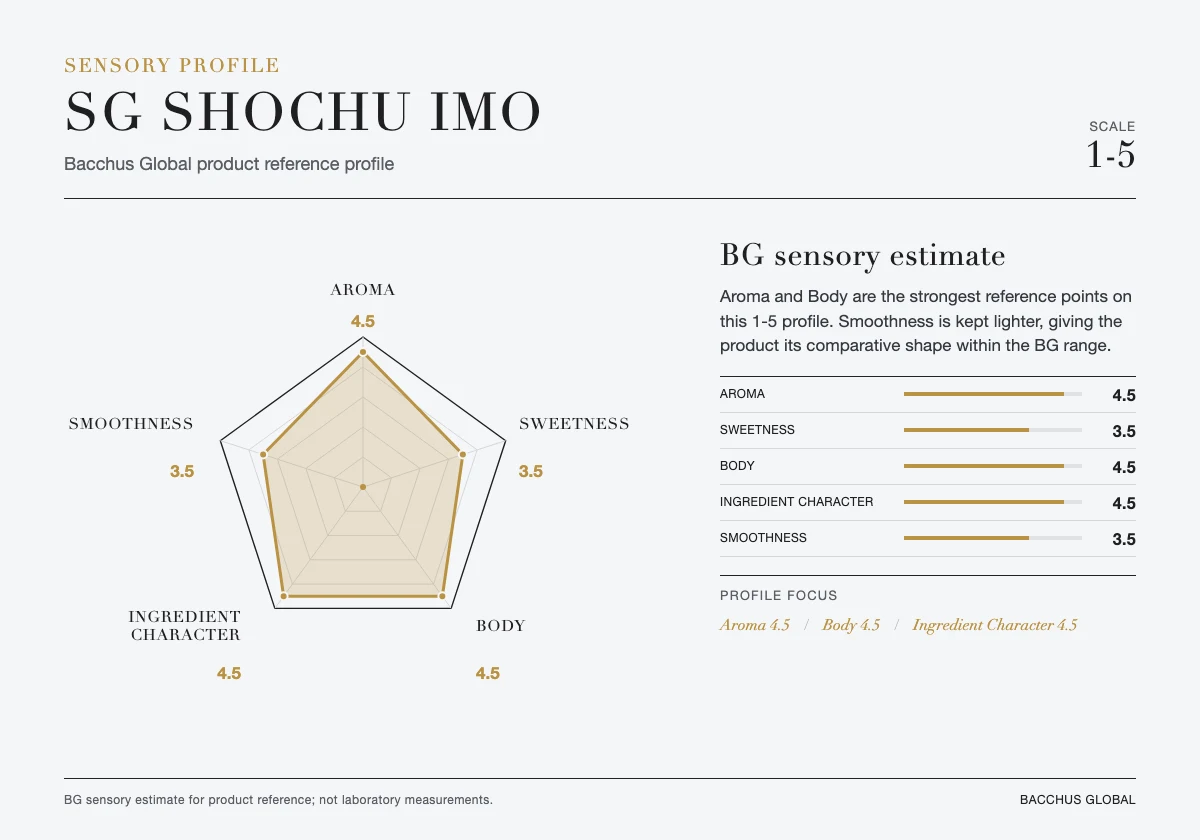
Thirty-eight percent by design
IMO is bottled at 38%, a deliberate departure from the more usual lower-proof shochu format. The strength is part of the design for bar use, allowing the sweet-potato and black-koji structure to remain present alongside other ingredients.
Sweet potato moves quickly from field to distillery
Satsuma Shuzo works with growers in southern Kagoshima and processes the sweet potatoes promptly after harvest.
Award record
The award record shown is specific to this product; it does not guarantee individual preference or quality.
Shingo Gokan × Satsuma Shuzo
The project joins Shingo Gokan, founder of SG Group and winner of the 2012 Bacardi Legacy Global Cocktail Competition, with Satsuma Shuzo of Makurazaki, founded in 1936. Gokan’s bar-side brief called for a sweet-potato spirit whose material character would remain present at cocktail strength. Satsuma Shuzo answered with its local grower network, black rice koji, atmospheric single distillation and a 38% specification.
IMO combines two Kagoshima sweet-potato varieties with different roles: Koganesengan supplies structure and depth, while the purple Eimurasaki contributes floral, nectar-like aromas. Prompt processing after harvest supports the distillery’s emphasis on freshness; atmospheric distillation retains a fuller sweet-potato and black-koji profile. The spirit is rested in enamel tanks. Maturation duration and blend ratios are not disclosed.
The story behind this bottle
A conversation that follows three years: 1936, the 1970s, and one day in February 2020. About seven minutes.
Question 1
Which description matches the roles of Koganesengan and Eimurasaki in IMO?
- Koganesengan provides structure; purple Eimurasaki contributes floral, nectar-like aromas
- Koganesengan is cask wood; Eimurasaki is a koji culture
- Both are rice varieties, with no sweet potato used
Read the answer and explanation
Correct answer: A — Koganesengan provides structure; purple Eimurasaki contributes floral, nectar-like aromas
Both are sweet-potato varieties. The page distinguishes their structural and aromatic roles.
Question 2
Which combination does the page describe for IMO?
- White koji and reduced-pressure distillation
- Black koji and atmospheric single distillation
- Yellow koji with fermentation only inside a cask
Read the answer and explanation
Correct answer: B — Black koji and atmospheric single distillation
The page describes Satsuma Shuzo’s approach using black koji and atmospheric single distillation. This differs from KOME’s white-koji and reduced-pressure path.
Question 3
Which matching of The SG Shochu products and their producers agrees with the page and audio?
- IMO–Sanwa Shurui, KOME–Satsuma Shuzo, MUGI–Takahashi Shuzo
- All three products are made by one distillery
- IMO–Satsuma Shuzo, KOME–Takahashi Shuzo, MUGI–Sanwa Shurui
Read the answer and explanation
Correct answer: C — IMO–Satsuma Shuzo, KOME–Takahashi Shuzo, MUGI–Sanwa Shurui
Three materials correspond to three producers. A shared brand does not mean the three products come from one distillery.
White flowers, orange peel, nectar and earth
White flowers, orange peel, nectar and maple lead into a full-bodied palate with toasted-oat notes. The finish is long and gentle, with caramelised brown sugar, floral sweetness and earthy sweet-potato character.
Floral nectar over a full-bodied, earthy finish
These are not pairings the maker has presented, but readings drawn from the characteristics recorded for this shochu. Starting from its white-flower and nectar-like sweetness, a full body carrying toasted oats, and an earthy undertone, four directions are set out below.
Three producers, three materials, one bar-side question
The SG Shochu launched on 14 February 2020 as three distinct collaborations: IMO with Satsuma Shuzo in Kagoshima, KOME with Takahashi Shuzo in Kumamoto and MUGI with Sanwa Shurui in Oita. Gokan’s shared question was how honkaku shochu could retain its material and koji identity while working at the proof and precision expected in an international bar. Each producer answered with its own regional material and technical strengths; specifications and awards remain product-specific.
For current-lot specifications, availability, storage requirements and trade terms, please contact Bacchus Global.