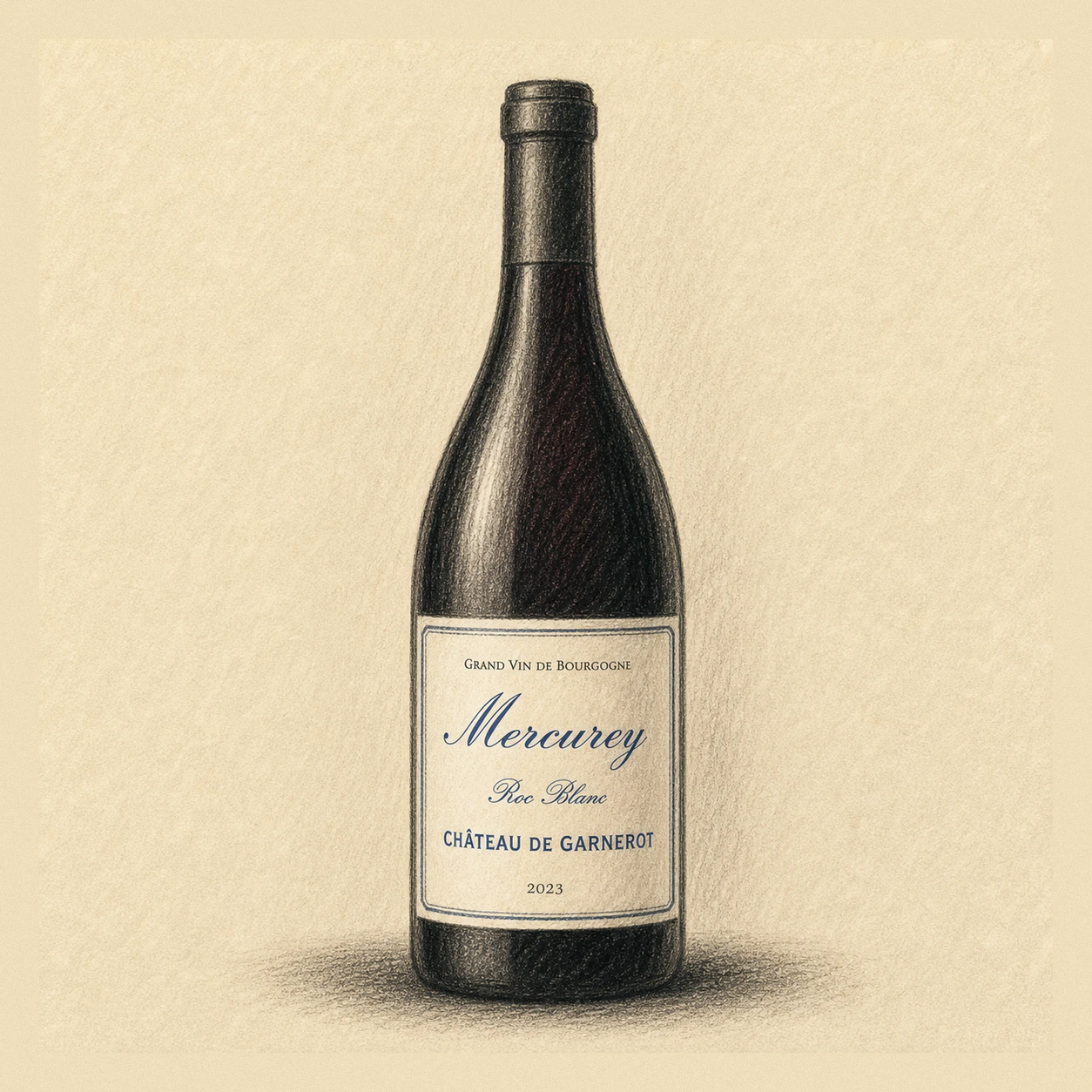
Original bottle illustration — Bacchus Global
Château de Garnerot
CHÂTEAU DE GARNEROTMercurey 'Roc Blanc' Rouge 2023
Named for the pale limestone beneath a single parcel in Mercurey, Roc Blanc traces the story of two women who left unrelated careers to bring an eighteenth-century château back to life, working the vines by hand and letting the site's own yeasts do the rest.
- Wine type
- Dry still red wine
- Grape
- Pinot Noir 100%
- Appellation
- AOC Mercurey (Village)
- Origin
- Mercurey, Côte Chalonnaise, Burgundy, France
- Drinking window
- 5–10 years from vintage
- Recommended temperature
- —
- Alcohol
- 13% vol.
- Bottle size
- —
A Renaissance in Mercurey
Château de Garnerot's eighteenth-century buildings had long served as a social hub for Burgundy's wine community, hosting gatherings such as the Confrérie Saint-Vincent, before Caroline Fyot and Alexia Russo — arriving from insurance and international luxury careers respectively — took over the estate and its vineyards from 2018.
Since then the domaine has moved to organic farming, certified since 2022, with biodynamic practices on selected parcels, native-yeast fermentation and unfiltered bottling, and it participates in the RAW WINE community built around transparent, low-intervention winemaking.
Taste profile
In the glass
MERCUREY 'ROC BLANC' ROUGE 2023
Scale1–5
BG wine structure estimate
Comparative profile within the Bacchus Global wine range.
Layers of red and black fruit — cherry, raspberry, blackberry, cassis — open into rose petal, violet, black pepper, liquorice and an earthy hint of forest floor as the wine breathes.
Silky in texture, with lively acidity framing fresh red fruit and a gentle earthiness. Fine, precise tannins give it structure, closing on an elegant, saline-tinged, lingering finish.
A bright, deep carmine red that shifts toward a blue-tinged garnet at the rim — clear and vivid despite being bottled unfiltered.
Before it reaches the glass
Temperature
—
Timing
Best enjoyed within its youthful fruit phase or after extended cellaring (5–10 years from vintage), when secondary notes of mushroom, leather and forest floor begin to emerge.
Glassware
A large Burgundy-style glass with a wide bowl and tapered rim, suited to concentrating its more delicate aromas.
At the table
The wine's fine tannins, gentle earthiness and bright acidity make it a flexible partner across cuisines built around poultry, mushroom and light red meat.
Its structure — silky texture, precise tannin and a savoury, mineral finish — favours dishes with inherent umami and gentle char, rather than heavy sauces or strong spice.
Japanese
- Yakitori (grilled chicken thigh)
- Dobin-mushi mushroom broth
- Dashimaki tamago (Japanese rolled omelette)
Why it worksFresh red fruit and fine tannin sit comfortably beside the savoury glaze of grilled chicken and the umami of a clear mushroom broth, while the wine's earthy undertone echoes the dish's own mushroom notes.
Thai
- Kai yang (Thai grilled chicken)
- Gaeng khue het pa (wild mushroom soup)
- Yum neua yang (grilled beef salad)
Why it worksBright acidity and light tannin structure stand up to the char and herbal lift of Thai grilled dishes without overwhelming their aromatics.
Western
- Roast chicken
- Duck breast
- Charcuterie and mountain cheeses such as Saint-Nectaire and Reblochon
Why it worksThe saline, mineral finish and fine tannin are a traditional match for the poultry, cured meats and washed-rind cheeses long associated with red Mercurey.
From cellar to bottle
Winemaking
Grapes are hand-harvested and fully destemmed, then given a brief cold maceration at 12°C before fermenting spontaneously with native yeasts over about eight days; the wine matures for fifteen months in oak, of which around 30% is new, before bottling without filtration or fining.
Product detail
Roc Blanc is produced by SARL Chai Garnerot, the négociant arm of Château de Garnerot, from a single parcel of the same name on Mercurey's limestone-clay slopes, farmed organically (Agriculture Biologique certification held since 2022).
Where Roc Blanc Grows
The parcel takes its name from the pale limestone beneath it rather than from the colour of the wine. This name has occasionally appeared attached to a white wine on restaurant lists, but Château de Garnerot's Roc Blanc is produced only as a red, 100% Pinot Noir.
Official producer website→Certification

Agriculture Biologique (EU Organic) · Agriculture Biologique / EU Organic
Certified Organic
The Roc Blanc parcel is farmed organically under Agriculture Biologique certification held since 2022, without synthetic pesticides or herbicides. Biodynamic practices are also applied on selected estate parcels.
Trade information
Contact Bacchus Global for product documentation, availability and trade enquiries.