
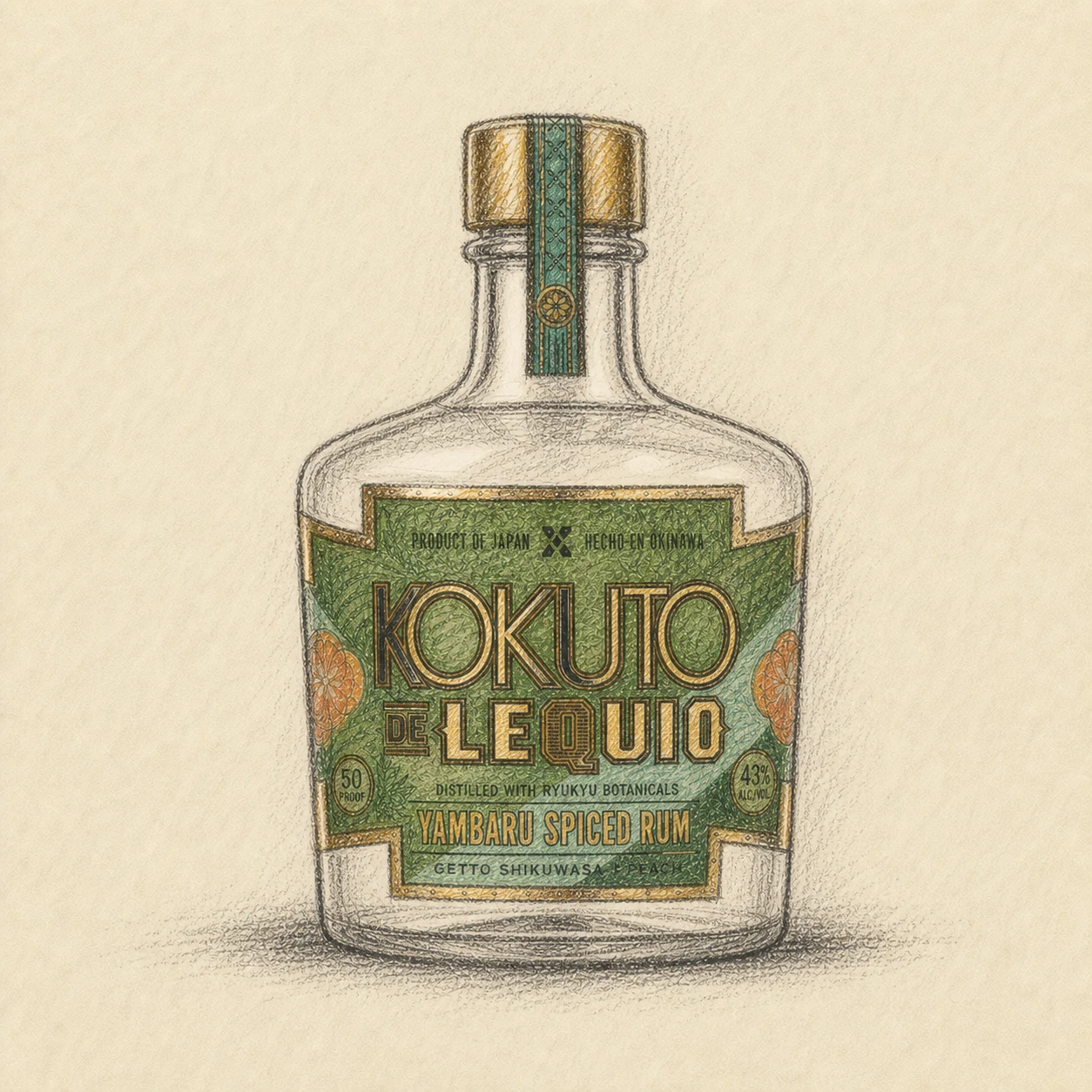
KOKUTO DE LEQUIO Yambaru Spiced Rum
Shikuwasa freshness, shell-ginger perfume and pipachi spice turn Okinawan kokuto rum toward the aromatic clarity of gin.
Thailand · Product information
Product information from Bacchus Global Co., Ltd., based in Bangkok, Thailand. About Bacchus Global
Three Okinawan botanicals, each with a distinct aromatic role.
A 100% Okinawan kokuto white-rum base is composed with shikuwasa, shell ginger and pipachi. Citrus lifts the top note; floral-herbal shell ginger and peppery pipachi lengthen the finish.
Maceration between the second and third distillation.
Build the base
Okinawan kokuto rum is distilled twice in a stainless pot still.
Macerate botanicals
Shikuwasa, shell ginger and pipachi are introduced after the second distillation.
Redistil in copper
A final copper-hybrid distillation integrates the aromatic layers.
The story behind this bottle
Spiced rum usually means a finished rum with spices added afterwards. This one adds them, and then distils the whole thing again — the way a craft gin is made. A conversation about three botanicals from Yambaru and three passes through a still. About five and a half minutes.
Question 1
Which spirit is used as the base of Yambaru Spiced Rum?
- Rum made from kokuto black sugar
- Awamori made with sakura yeast
- Gin
Read the answer and explanation
Correct answer: A — Rum made from kokuto black sugar
The base is rum made from Okinawan kokuto black sugar. The comparison with gin in the text describes the aromatic style; it does not mean that the base spirit is gin.
Read the relevant passageQuestion 2
Which combination does the text identify as the three botanicals used?
- Jasmine, green papaya and juniper
- Shikuwasa, shell ginger and pipachi
- Lemon, lime and honeysuckle
Read the answer and explanation
Correct answer: B — Shikuwasa, shell ginger and pipachi
The three botanicals used are shikuwasa, shell ginger and pipachi. Jasmine, green papaya and similar references appear in the text as descriptions of aroma and flavour. The key is to distinguish the ingredient list from the language used to describe flavour.
Read the relevant passageQuestion 3
In this product’s production process, what happens after the botanicals are macerated in the rum?
- It is bottled directly without redistillation
- It is aged in casks for a long period
- It is distilled again
Read the answer and explanation
Correct answer: C — It is distilled again
After the botanicals are macerated, the spirit is distilled again. For this product, the process does not end with adding the botanicals; a further distillation follows.
Read the relevant passageCitrus-bright, floral and spicy, with kokuto depth underneath.

Lemon-lime soda, honeysuckle and calamansi lead into lime peel, jasmine, green papaya and juniper-like lift. Kokuto sweetness grounds the profile; shell ginger and pipachi shape an oriental-spice finish.
Treat it as both rum and an aromatic alternative to gin.
Tonic water sharpens the citrus and botanical line.
Use it where citrus, freshness and rum structure need to move together.
A clean highball lets shell ginger and pipachi remain visible.
Dishes that layer onto Okinawa’s botanicals
KOKUTO DE LEQUIO Yambaru Spiced Rum layers shikuwasa citrus, shell ginger (gettou) and pipachi spice onto an Okinawan black-sugar rum, giving it the clarity of a gin. The pairings below are not an official recommendation from the distillery or its collaborators, but a reading based on the flavor characteristics recorded on this page.
Based on the idea in The Science of Food Pairing (summary) that citrus and herbal aromas tend to share common notes and resonate with one another, this reading pairs KOKUTO DE LEQUIO’s botanicals with acid- and herb-forward dishes. The way black sugar’s sweetness supports richer, sweet-savory dishes follows the structural axis described in Logical Pairing (summary).
Okinawan kokuto rum shaped by bartenders and a Shuri distillery.
KOKUTO DE LEQUIO is developed by SG Group, Mizuho Shuzo and OneSpirit. Mizuho Shuzo has distilled in Shuri since 1848; the project brings that Okinawan base together with a bartender-led approach to aroma and service.
SG Group
SG Group, led by founder and bartender Shingo Gokan, co-developed KOKUTO DE LEQUIO Yambaru Spiced Rum, bringing its experience in bar culture and product development to the project.
Shingo Gokan
Gokan began his bartending career in 2001 and moved to the United States in 2006, where he developed his craft in New York. In 2012 he represented the United States and won the global Bacardi Legacy competition. He opened Speak Low in Shanghai in 2014.
His work also includes collaborations with Japanese producers on shochu, liqueurs and spirits. SG Group’s February 2026 profile lists Tokyo, New York, Madrid, Shanghai, Hong Kong and Okinawa as his activity bases.
The group
SG Group develops and operates bars and restaurants with distinct concepts in Japan and overseas. Its team includes bartenders with national and international competition records, and its venues have appeared in The World’s, Asia’s and North America’s 50 Best Bars. Alongside venue operations, the group collaborates with Japanese producers on product development and the international presentation of Japanese spirits.
Shingo Gokan’s individual awards
- 2012
- Bacardi Legacy: global winner, representing the United States.
- 2017
- Tales of the Cocktail: International Bartender of the Year.
- 2019
- Asia’s 50 Best Bars: Altos Bartenders’ Bartender.
- 2021
- Asia’s 50 Best Bars: Roku Industry Icon Award.
Career and activity bases follow SG Group’s February 2026 announcement.
SG Group official profile SG Group biography (February 2026) 2017 award record 2021 award record Product development source
Continue through the KOKUTO DE LEQUIO series in English.
Contact Bacchus Global for product documentation, availability and trade information.
Make a trade enquiry →
