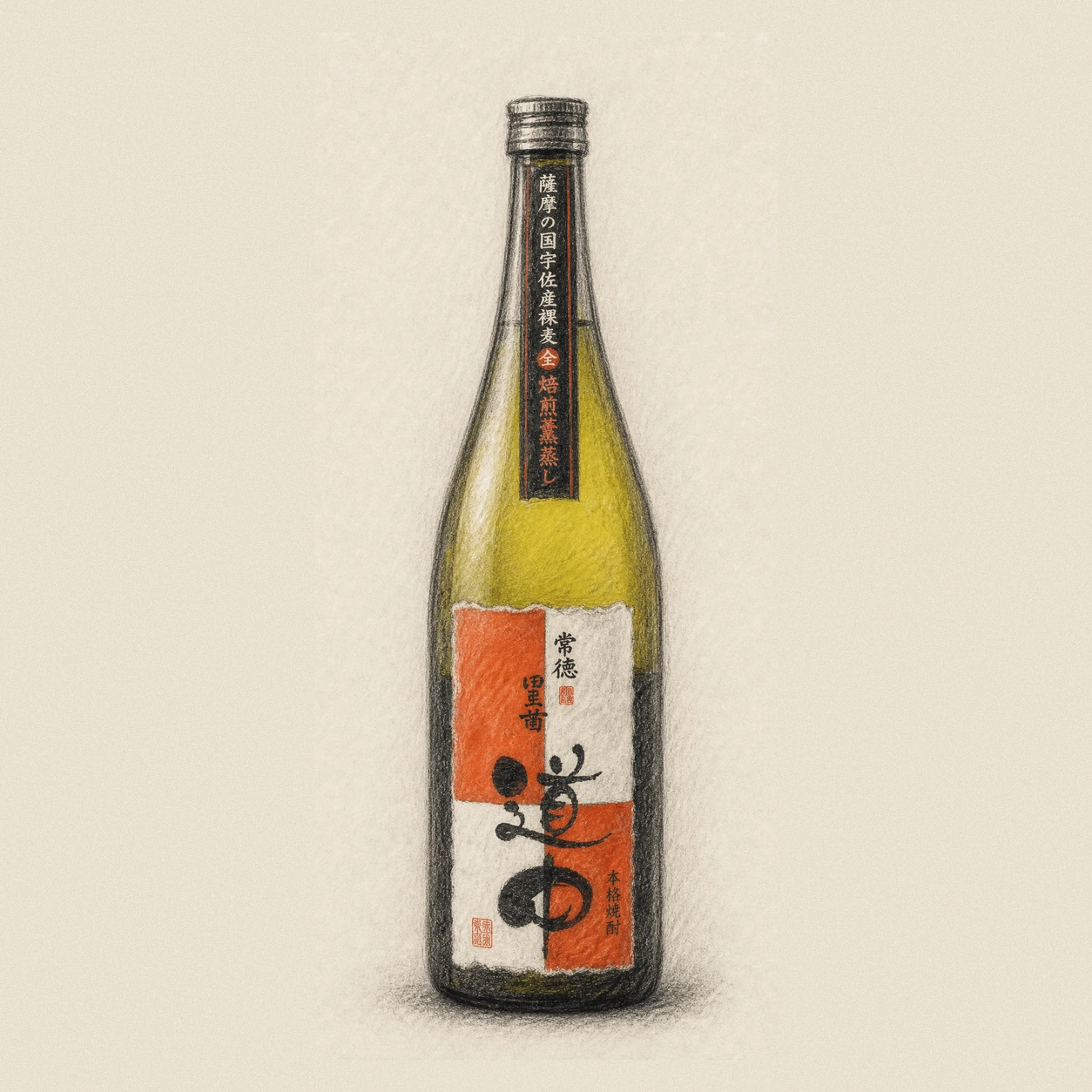
JYOTOKUYA DOCHU
A barley shochu that gives roasted grain a deliberate second life. Local naked barley is slowly roasted, returned to the second mash, and allowed to settle for two years until its fragrance moves from raw char toward a deep, composed roast.
Roasted barley is returned to the mash
Jyotokuya slowly roasts its local naked barley, then introduces it during the second mash rather than treating the roast as a finishing flavour. The spirit is distilled at atmospheric pressure and rested for two years. That waiting period is central: the brewery describes the roasted aroma as opening only after the sharper freshly distilled character has settled.
ALL USA — Usa, Oita
The house works with naked barley from the Usa plain and groundwater from the same area. “USA” is not a marketing abbreviation but the Roman spelling of Usa, the Oita city where the brewery stands. It makes the product’s single-place logic unusually easy to read: grain, water, distillation and bottling all return to Usa.
Roast without calling it smoke
The official name uses the word “kunjo”, but the documented process is roasted barley, not a separately verified smoking stage. Its profile is therefore best understood through roasted barley tea, toast, cocoa, coffee and nuts, with a clean line of bitterness rather than through claims of smoke.
Another way to layer roasted aroma
The pairings below are not a combination presented officially by the brewery, but a reading drawn from the aroma characteristics recorded on this page.
This pairing rationale draws on the following reference books: The Science of Food Pairing describes how aroma groups formed through roasting share sensory cues with coffee, nuts, and cacao. Read through that framework, the roasted character built by Jyotokuya Douchu’s roasted barley tends to sit easily alongside dishes carrying aroma in the same direction. Logical Pairing’s description of shochu as a spirit that “does not interfere with the dish but supports it through aroma” is one way to read the roasted character this spirit develops by adding roasted barley into its second mash.
A second beginning in Usa
Jyotokuya Shuzo began as a sake brewery in 1907 in Usa, Oita. In 2003, Makoto Nakazono led a renewed start for the Jyotokuya name with a small team of family and brewery workers. The decision to make shochu from the local six-row naked barley became the core of that new chapter.
For current-lot specifications, availability, storage requirements and trade terms, please contact Bacchus Global.