Blog
Dryness Is Not a Single Number: Two Rice-Polishing Ratios in Heiwa Shuzo’s KID Junmai Ginjo Karakuchi Kid
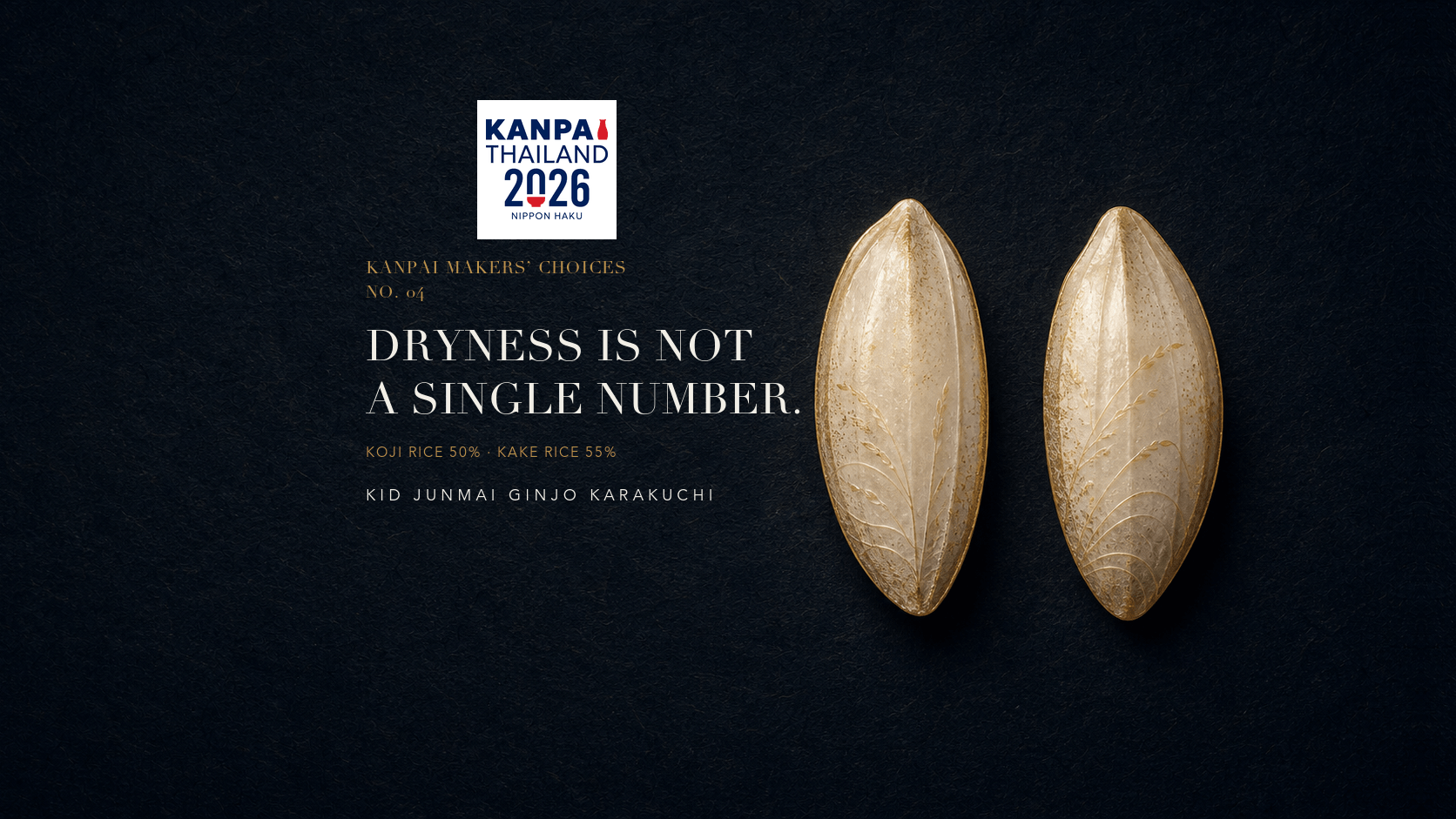
KANPAI Makers’ Choices No.04
“Dryness” in sake may sound straightforward, yet it cannot be determined by a single number.
Labels and product descriptions often use the Sake Meter Value, or SMV, as a guide. A reading farther into positive territory is generally associated with a drier profile. According to the National Research Institute of Brewing, however, perceived sweetness and dryness are broadly explained by the balance between residual sugar and acidity, while aroma and mouthfeel also play a part. The National Tax Agency’s explanation of sake components likewise describes SMV as a measure based on specific gravity, while acidity and amino-acid value convey different information.
Heiwa Shuzo of Kainan, Wakayama Prefecture, places the word karakuchi, meaning “dry,” directly in the name of KID Junmai Ginjo Karakuchi Kid. Yet tracing the design of this sake reveals another pair of numbers, separate from SMV.
The koji rice has a polishing ratio of 50%, while the kake rice has a polishing ratio of 55%. Rice entering the same mash is not milled uniformly.
What can these two numbers tell us, and where does the public record stop?
SMV Is a Clue, Not an Answer
SMV does not directly measure sweetness itself. It indicates the specific gravity of sake: the lower its specific gravity relative to water, the more positive the reading becomes. In general, fewer dissolved components such as sugars result in a lower specific gravity and a more positive value, which is why SMV has long been used as a guide to dryness.
Yet even at the same sugar level, higher acidity can make sweetness seem less pronounced. Conversely, a ginjo sake with lower acidity may seem sweeter than its analytical values suggest. SMV is therefore an important clue, but it cannot speak for the entire sensory impression.
When reading Karakuchi Kid, the guide called “dryness” and the manufacturing information called “rice-polishing ratio” cannot be treated as indicators of the same kind. The published specifications distinguish the koji rice at 50% from the kake rice at 55%.
Rice, Divided into Two Roles
Not all rice performs the same work in sake brewing.
Koji rice is steamed rice on which the koji mold has been cultivated. Enzymes produced by the koji break rice starch down into sugars that yeast can use, a process called saccharification. Kake rice, by contrast, is steamed rice added to the mash. It is dissolved by those enzymes and becomes material for fermentation.
One supports saccharification; the other is dissolved by koji enzymes and becomes material for fermentation. Both are rice, but koji rice and kake rice carry different responsibilities within the brewing process.
These two tasks do not simply finish one after the other. In the same mash, koji enzymes convert starch into sugar while yeast converts that sugar into alcohol. Sake brewing advances these processes in parallel through what is known as multiple parallel fermentation. Koji rice and kake rice have distinct roles, yet they are inseparable within a single mash.
The point confirmed by the published specifications is precise: two ingredient categories are listed, with a 50% polishing ratio for the koji rice and a 55% polishing ratio for the kake rice.
A rice-polishing ratio states how much of the original brown-rice weight remains after milling. The rice intended for koji is therefore milled until 50% of its original weight remains, while the rice intended for kake is milled until 55% remains. The difference may appear to be only five percentage points, but the published manufacturing information shows that the two ingredient categories are not assigned the same figure.
A Five-Percentage-Point Difference: What Is Known and What Is Not
A rice-polishing ratio is not a ranking in which a smaller number is automatically superior. It is processing information that indicates how much of the grain’s outer portion has been removed, and the selected ratio depends on the intended design of the sake.
What can be confirmed for this product is that the koji rice and kake rice are separated by purpose and milled to polishing ratios of 50% and 55%, respectively. Heiwa Shuzo has not publicly explained why it selected this five-percentage-point difference. The difference in the two roles cannot be declared the direct reason for the two ratios, nor do public materials establish how the gap contributes to the dry character of this sake.
The meaning of a number and the reason for choosing it are separate questions. The former can be explained. Filling the latter with conjecture would turn an account of manufacturing information into an invented story. Stating the limits of what is known, and leaving what is unknown intact, is also a way of approaching a maker’s work with care.
Reading “Karakuchi” by Returning to the Process
Heiwa Shuzo was founded in 1928, and its official website carries the phrase, “Sake is a living thing; people are the bridge.” In the story presented on that site, the company directs attention to the people behind its products, including farmers, those involved in distribution, and the brewery team.
This phrase offers another way to read “dry.” Rather than treating it only as a word for the impression of the finished sake, we can return to the brewing processes behind it. Saccharification by koji and fermentation by yeast proceed in parallel. Perceived sweetness and dryness involve sugar, acidity, aroma, and mouthfeel. The name is concise, but the processes behind it are multiple.
The name Karakuchi Kid expresses the intended direction of the sake in a single, readily understood word. Yet even when the published numbers are placed side by side, they do not disclose the full design. Which number describes what, and where does undisclosed information begin? Distinguishing those boundaries brings the outline of the brewing design into view.
No.04 Records the Choice to Keep Things Separate
No.01 recorded a choice behind Shichiken HAKUSHIN: milling rice to a 27% polishing ratio and waiting for one year at −5°C. No.02 recorded a choice behind HANEYA KIRABI: broadening the brewing season while narrowing the selected portion through nakagumi. No.03 recorded a choice behind Shirakane Shuzo’s SHIRAKANE-NO-TSUYU: assessing each sweet potato individually and deciding which parts would not enter the secondary mash.
No.04 records one word, “dry,” and the multiple processes that precede it in KID Junmai Ginjo Karakuchi Kid. Koji rice 50%; kake rice 55%. These two numbers are not positions in a ranking of quality. They are manufacturing information corresponding to two different ingredient categories.
The perception called dryness involves sugar, acidity, aroma, and mouthfeel. By contrast, the figures of 50% for koji rice and 55% for kake rice are manufacturing specifications for separate ingredient categories. Public information does not establish how this difference contributes to the dry character of the product.
One word and two numbers should not be connected by a causal relationship that public information cannot verify. Keeping what is known separate from what is unknown is itself part of recording a maker’s choice.
This article is intended solely to provide factual and cultural information about Heiwa Shuzo and KID Junmai Ginjo Karakuchi Kid, including its brewing design. It does not aim to promote or encourage the purchase or consumption of alcohol. It is intended for readers aged 20 and over.
บทความนี้จัดทำขึ้นเพื่อให้ข้อมูลเชิงข้อเท็จจริงและวัฒนธรรมเกี่ยวกับ Heiwa Shuzo และ KID Junmai Ginjo Karakuchi Kid รวมถึงแนวคิดด้านการผลิตเท่านั้น มิได้มีเจตนาเพื่อส่งเสริมการซื้อหรือการบริโภคเครื่องดื่มแอลกอฮอล์ บทความนี้จัดทำขึ้นสำหรับผู้อ่านอายุ 20 ปีขึ้นไป
Related Product & Reading
No.05: The Precision of Timing Behind Sasshu Sekitoba Matcha / Product information: KID Junmai-Ginjo Karakuchi-Kid / Product information: TANIGAWADAKE Junmai Super-Dry Karakuchi / Product information: TOSATSURU Azure Ginjo / Product information: BORN Junmai 55 Karakuchi / Product information: HANEYA Tokubetsu Junmai / Beyond the Dry Era: how the meaning of dry sake is changing / Related reading: “Extra Dry” Reinterpreted — Yukinobijin Through Rice, Yeast, and Acidity
Discover the culture behind every bottle
We share brewery stories, tasting notes and the craft of koji & fermentation — for educational and cultural purposes only.
เราถ่ายทอดเรื่องราวจากผู้ผลิต บันทึกรสชาติ และศาสตร์แห่งโคจิและการหมัก — เพื่อการศึกษาและวัฒนธรรมเท่านั้น
Follow on Instagram Facebook