Perspectives
The Shape of the Glass Changes More Slowly Than the Wine: The Champagne Coupe and Flute
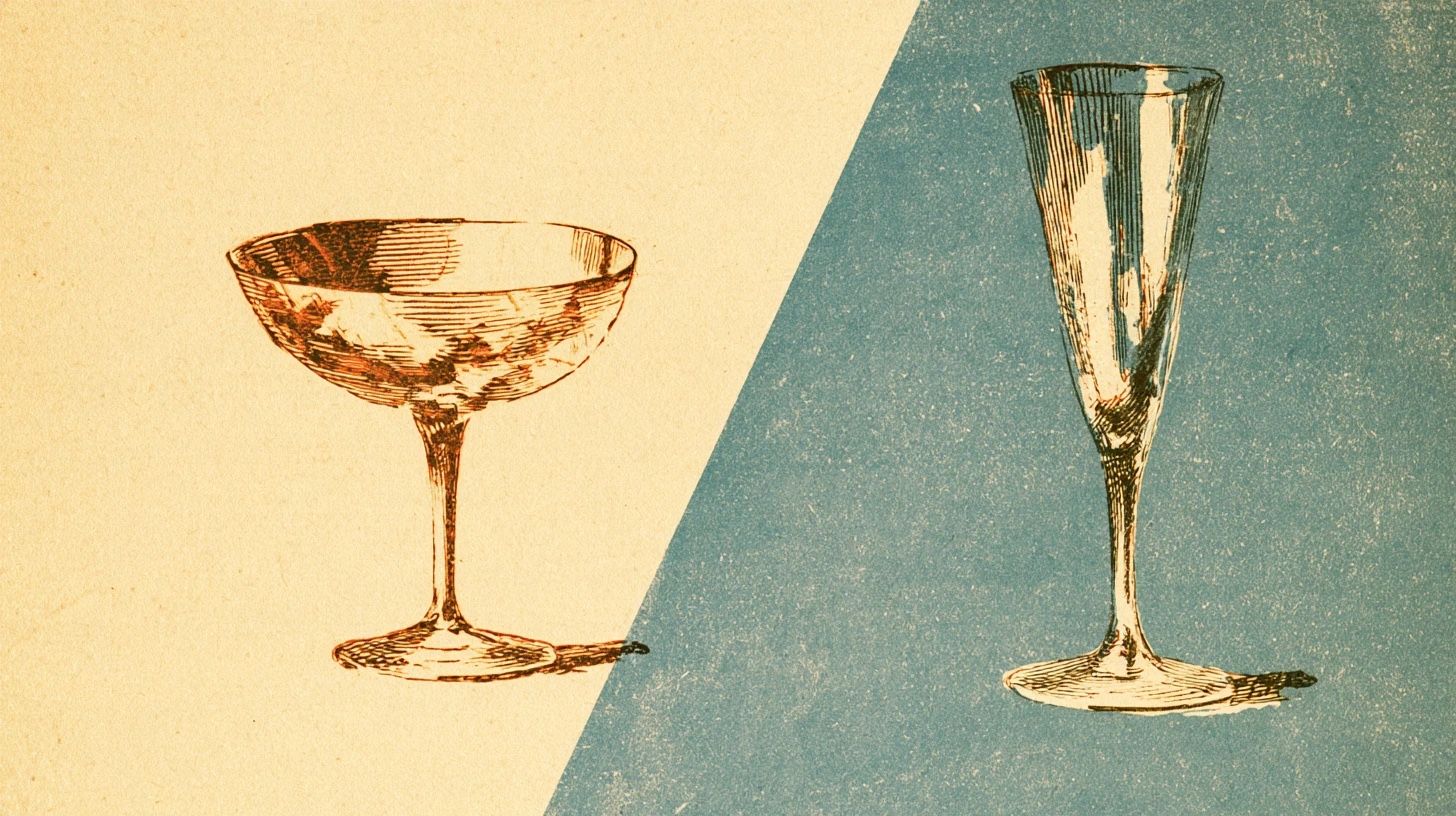
In 1874, Madame Louise Pommery, who headed the Pommery champagne house in France’s Champagne region, created a champagne for the London market with significantly less sugar. It is considered the beginning of the dry style later known as “Brut.” At the time, sweet champagne was the norm, and dry champagne was the exception.
In the Age of Sweet Champagne, the Wide-Mouthed Coupe Was in Use
Champagne gets its bubbles from a second fermentation inside the bottle. After the sediment produced during fermentation is removed, a sugar-containing liqueur may be added as needed. This process is known as dosage. Whether the finished wine is classified as sweet or dry depends on how much sugar it contains.
In the 19th century, the sweetness of champagne varied according to the export market, with some wines said to contain anywhere from 100 to 300 grams of sugar per liter. Under current European regulations, champagne is divided into seven categories based on sugar content. Brut contains less than 12 grams per liter, while the sweetest category, “Doux,” contains more than 50 grams. The sweet champagnes of the 19th century could thus contain far more sugar than even the minimum level required for today’s sweetest classification.
One of the glasses used in the 19th century was the coupe, a shallow glass with a wide rim. The coupe is famously said to have been modeled on the breast of Marie Antoinette, Queen of France. But if the coupe was indeed created in England around 1663, as one account holds, the dates do not add up: Marie Antoinette was born in 1755. A porcelain vessel supposedly modeled on the queen’s breast does survive, but it was made for drinking milk, not champagne.
The Coupe Remained in Use Even After Dry Champagne Became Popular
Madame Pommery’s dry champagne found favor in Britain, where a less sweet style was preferred, and in the 20th century dry champagne became the dominant style.
It was also in the 20th century that the tall, slender flute became widespread. The continuous stream of bubbles rising from the bottom of the glass is known in French as “perlage,” a reference to its resemblance to a string of pearls. Because the flute is tall, the bubbles have farther to travel as they rise. It is a shape designed to put the bubbles on display.
But the emergence of dry champagne and the shift in glassware did not happen at the same time. The coupe continued to be used into the 20th century, even after dry champagne had become widespread.
Today, Attention Turns to Aroma as Well as Bubbles
According to a book published in 2026 by a Japanese wine journalist, a growing number of restaurants are serving champagne not in flutes, but in slightly larger tulip-shaped glasses or white-wine glasses. A tulip glass has a fuller bowl that narrows toward the rim. The reasoning is that the complex aromas of champagne aged for long periods have too little room to develop in an overly narrow glass.
Sweetness, bubbles, aroma: the qualities noted in champagne have shifted over time. The changing shape of the glass reflects those changing priorities.
A similar development can be seen with sake, where wine glasses are sometimes used for the aromas of ginjo sake.
What Madame Pommery reduced in 1874 was the sugar. The coupe, however, remained in use into the following century. The wine changed first; the glass took longer to catch up.
This article is intended solely to explore the winemaking artistry and cultural heritage of Champagne and its glassware, and does not aim to promote or encourage the consumption of alcohol. / บทความนี้จัดทำขึ้นเพื่อนำเสนอข้อมูลเกี่ยวกับศิลปะการทำไวน์และมรดกทางวัฒนธรรมของแชมเปญและแก้วที่ใช้เท่านั้น มิได้มีเจตนาเพื่อส่งเสริมหรือโฆษณาเครื่องดื่มแอลกอฮอล์ สำหรับผู้มีอายุ 20 ปีขึ้นไป โปรดดื่มอย่างรับผิดชอบ
Related Articles
“Why Is a Vessel Shaped the Way It Is? A Small Mystery About Form and Aroma” / “Same Blend, Different Time: Understanding Bruno Paillard’s Cuvée 72” / “Champagne! 1.”
Related Product(s)
Discover the culture behind every bottle
We share brewery stories, tasting notes and the craft of koji & fermentation — for educational and cultural purposes only.
เราถ่ายทอดเรื่องราวจากผู้ผลิต บันทึกรสชาติ และศาสตร์แห่งโคจิและการหมัก — เพื่อการศึกษาและวัฒนธรรมเท่านั้น