Blog
Why Is a Vessel Shaped the Way It Is? A Small Mystery About Form and Aroma
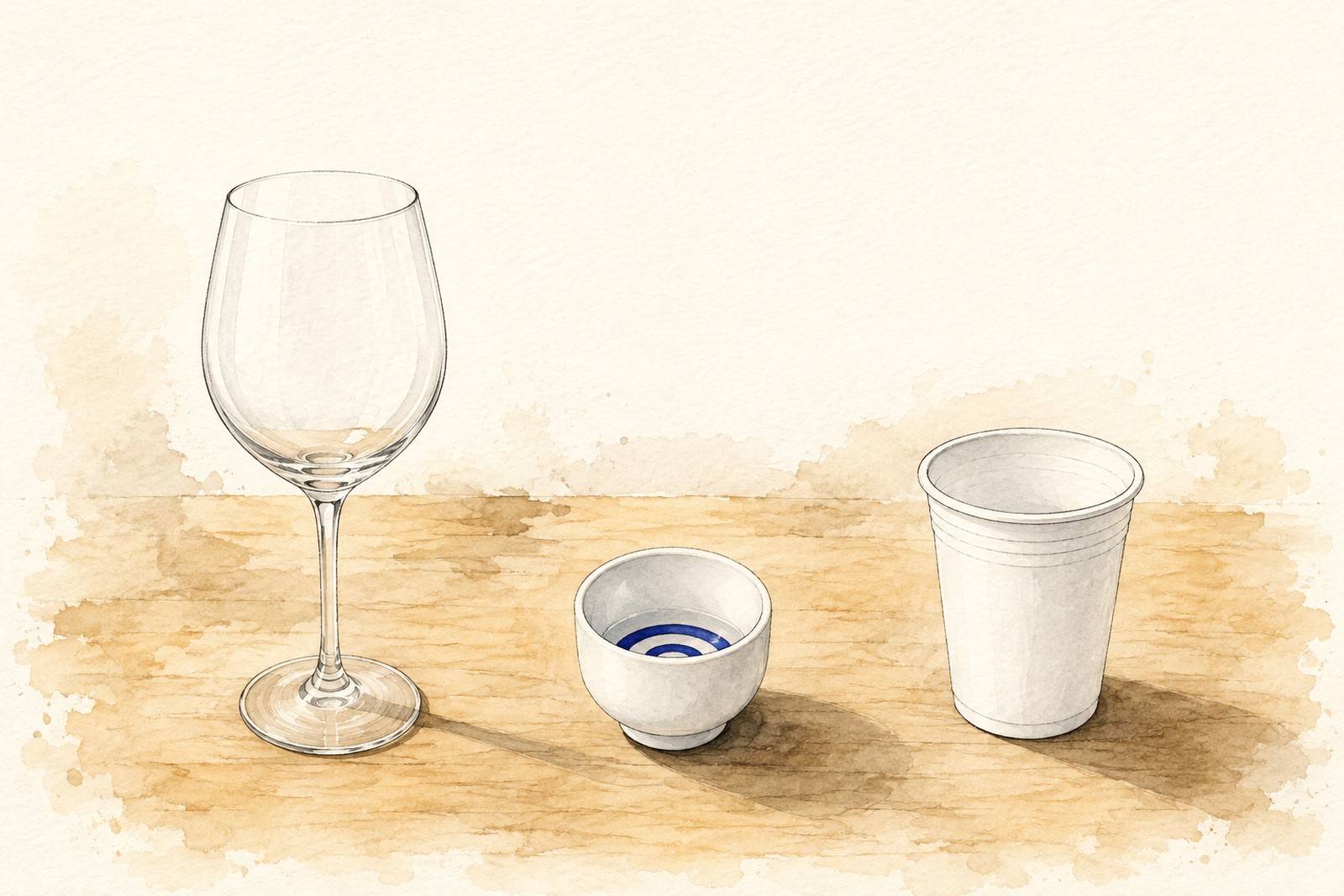
Set three vessels side by side on a table. A wine glass with a long stem. A small white porcelain cup with two blue concentric circles at its base. And a plain white plastic cup. The third one may come as a surprise: it is the vessel actually used at Japan’s official judging of sake. Set before the same wine or sake, each of the three answers a different question.
What Is Happening Inside the Glass
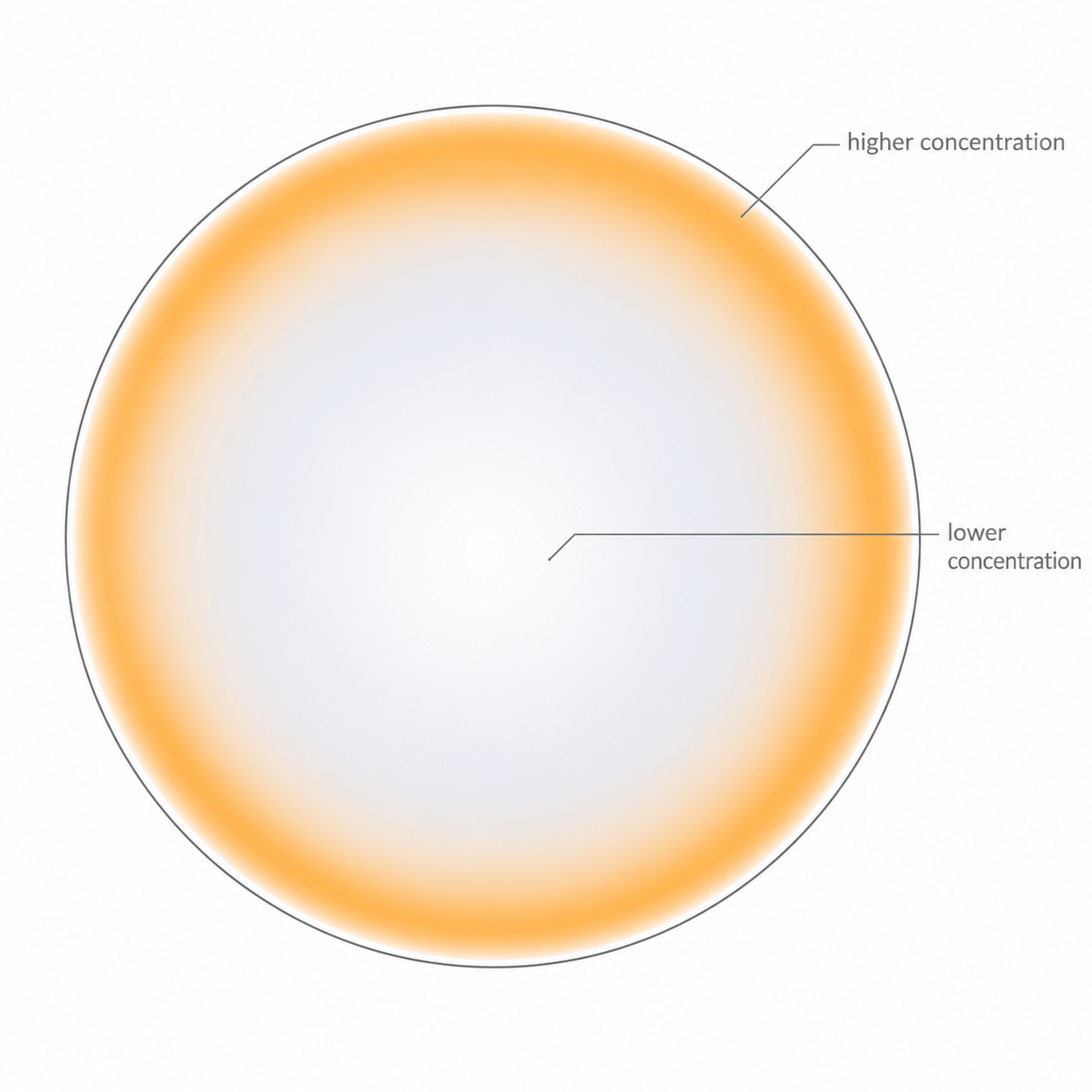
In 2015, Takahiro Arakawa and colleagues, writing in the journal The Analyst, managed to photograph where the ethanol vapor rising from wine actually sits.
Their method: a special mesh that glows when ethanol vapor touches it, photographed with a high-sensitivity camera. The brighter the light, the denser the vapor.
The team compared a wine glass, a cocktail glass, and a straight-sided glass. In the wine glass, an interesting pattern appeared: dense ethanol vapor formed a ring near the rim, while the center was thinner.
Under that condition, the vapor’s concentration varied by shape.
The wine was at 13°C. That was a condition of the experiment; what the paper states is how things looked under that condition, nothing more.
Take a wine glass apart and you have three parts. The bowl sets the surface area of the wine and the size of the space above it. The rim sets the width of that space’s opening. The stem puts distance between the palm of the hand and the liquid. None of the three creates aroma, since the aroma is already in the wine. All three determine is where it sits.
Can the Nose Actually Tell the Difference?
If the distribution inside the vessel changes, can people register that difference?
A 2002 experiment took this on. Its method is the interesting part: participants were blindfolded, unable to see or touch the glass, in order to remove the influence of any assumption that an expensive-looking glass must be the better one. The participants were ordinary people, not wine professionals.
Four vessels were used. Two of them were specialist glasses, one made for Chardonnay and one made for Bordeaux. The wine was a California Cabernet Sauvignon, exactly the kind of wine the Bordeaux glass is designed for.
The conclusion: the glass “does have a limited, but subtle, impact.” But only one difference emerged as statistically significant, and it ran the opposite way to what one might expect. The Bordeaux glass, designed for precisely this wine, was rated as having the lowest aroma intensity of the four.
A 2003 experiment involved 181 participants. The vessels were matched in height, with comparable opening diameters, so that only the shape differed, removing “because the glass was bigger” as a competing explanation. The result again showed shape moving the ratings, and this difference did not track the esthetic impression the glasses made: it was not a story about a handsome glass feeling better.
The work has continued: nine shapes compared in 2008, and Bordeaux and Burgundy shapes compared across three sizes in 2023. Two things come into view. First, no study identified here has concluded that shape makes no difference. Second, which way the effect runs is not consistent.
In 2012, a study measured both sides at once. One white wine went into five vessels, including, for comparison, an Erlenmeyer flask (the conical flask from a school science lab). The wine was then held for three different periods before measurement: 0, 5, and 10 minutes. The composition of the air above each vessel and the aroma ratings were measured together.
The result came in three parts. The composition of the air above the vessel varied significantly with shape and with time. The aroma ratings also varied significantly with shape and time. And third: no correlation was found between the shape parameters this study measured (capacity, height, opening diameter, maximum diameter, the ratio between them, fill volume) and the intensity of the aroma ratings.
Japan’s Vessels Were Reading Something Else Entirely
The second vessel on the table: the kikichoko. Inside the base of a white porcelain cup, two concentric circles in cobalt blue, a pattern called janome.
What this vessel is built to read is not aroma. It is color. Over the blue, how clear the sake is; over the white, the color of the sake itself. Where the wine glass designs the shape of a space, this one designs the color of a background. The same word, vessel, covers both, and yet the problem each is solving is entirely different.
And the third vessel. Japan holds an official judging of sake called the Annual Japan Sake Awards, run by the National Research Institute of Brewing, an incorporated administrative agency. The document setting out how it is conducted states:
“For the sensory judging, in both the preliminary and the final rounds, the original plastic cup of the National Research Institute of Brewing is used.”
Not the janome kikichoko. The image of the janome cup as the emblem of sake judging is widely shared, but what the official document specifies is the institute’s own plastic cup. The document specifies only what is used; it does not say why. What it establishes is that the same one vessel is used in both rounds.
Three Vessels, Three Purposes
Set the three side by side once more. The wine glass designs where vapor sits. The janome kikichoko designs how color and clarity are read. What can be confirmed about the judging’s plastic cup, from the official document, is that the same institute-issue cup is used in both the preliminary and final rounds.
There is no ranking among the three. Each is answering a different question. And once the three are lined up, the question “which vessel is the best one” turns out not to hold together in the first place. Whether something is better is settled only once you have settled what you want to know.
Two things remain unexplained. The first is the 2002 result: the vessel designed for that very wine was rated the weakest, and why has not been accounted for since. The second is the 2012 result: shape acted on the wine’s side and the human side alike, yet which dimension of the vessel carried that effect could not be identified. The effect is real, confirmed many times over. What it is about the shape that does the work is still unknown.
This article does not say which vessel to choose. What can be said goes as far as what each is observing, and what each is holding constant.
This article is intended solely to explore the physical and cultural background of vessels used for wine and sake, and does not aim to promote or encourage the consumption of alcohol.
บทความนี้จัดทำขึ้นเพื่อนำเสนอข้อมูลเกี่ยวกับภูมิหลังทางกายภาพและวัฒนธรรมของภาชนะที่ใช้กับไวน์และสาเก เพื่อเป็นข้อมูลความรู้เท่านั้น มิได้มีเจตนาเพื่อส่งเสริมหรือโฆษณาเครื่องดื่มแอลกอฮอล์ สำหรับผู้มีอายุ 20 ปีขึ้นไป โปรดดื่มอย่างรับผิดชอบ
Discover the culture behind every bottle
We share brewery stories, tasting notes and the craft of koji & fermentation — for educational and cultural purposes only.
เราถ่ายทอดเรื่องราวจากผู้ผลิต บันทึกรสชาติ และศาสตร์แห่งโคจิและการหมัก — เพื่อการศึกษาและวัฒนธรรมเท่านั้น
Follow on Instagram Facebook