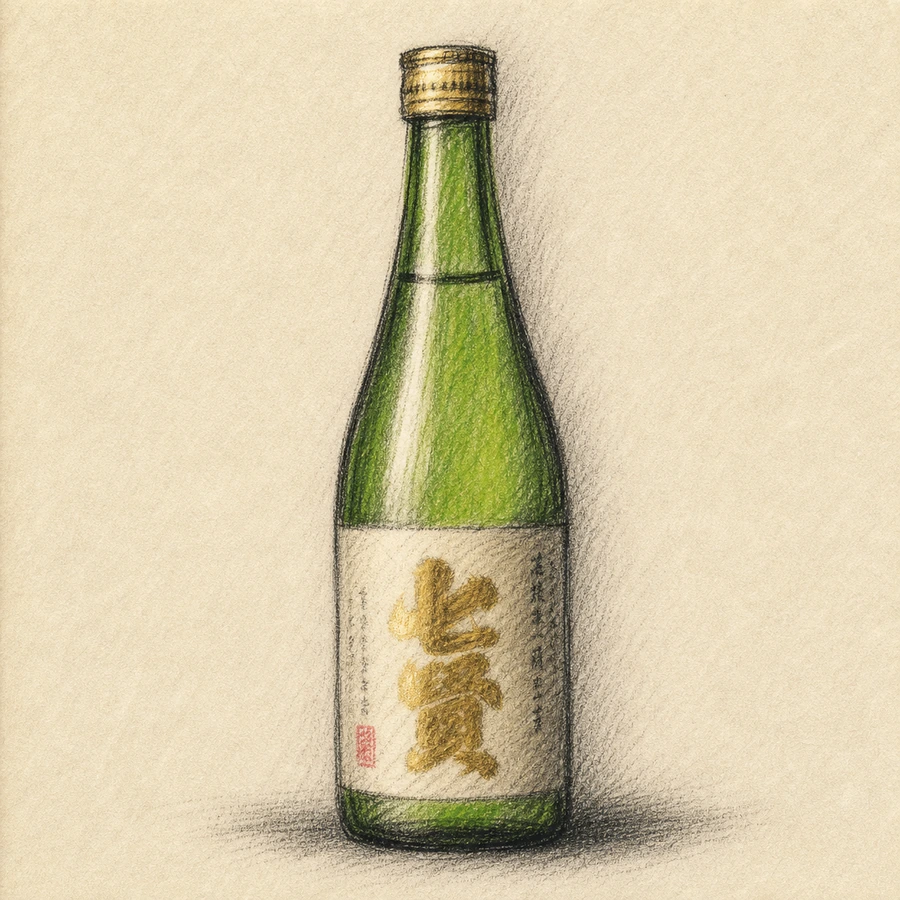
SHICHIKEN Birodo no Aji Junmai-Ginjo
Yumeyamasui polished to 57%, given a long cold fermentation with Hakushu subsoil water — a junmai ginjo joining a smooth texture to fruit and a trace of herbs.

Yumeyamasui and Hakushu water, shaped into a velvet texture
This junmai ginjo is brewed using 100% Yumeyamasui rice, polished to 57%. Subsoil water from Mount Kaikomagatake and a long, low-temperature fermentation draw the fruit aroma and rice umami together into a texture as smooth as the name promises — “birodo no aji,” the taste of velvet.
ABV is 15%. Some distribution materials list a different rice variety or polishing ratio, but this page follows Yumeyamasui at 57%, matching the brewery’s own records and competition entries.
Pear and melon, with a hint of herb

Fruit aromas recall pear, white peach and melon, with a faint hint of mint and greenery. The texture is smooth as velvet, and rice umami spreads quietly. A gentle acidity and a touch of bitterness tighten the finish.
The pear and melon aroma stays gentle from the first sip to the close.
The water of Hakushu, and the Shichiken name carried forward
Yamanashi Meijo was founded in 1750 in Daigahara, Hakushu-cho, Hokuto City, Yamanashi Prefecture. The brewery draws its brewing water from the subsoil flow of Mount Kaikomagatake in the Southern Alps, and gentle fermentation shapes a soft, clear character in its sake.
The name “Shichiken” comes from a transom carving of the “Seven Sages of the Bamboo Grove,” presented in 1835 by the lord of Takato Castle. In 1880, the brewery’s main house served as a lodging for Emperor Meiji during his travels. Carrying forward this historic building and its water, the brewery has since broadened its range to include junmai sake, bottle-fermented sparkling sake, and spirits distilled from its own sake lees.
Verified international recognition
Listed only where the official Kura Master record and the designated consolidated report match this exact product name. Other labels and variants are excluded, and IWC’s Commended distinction is not treated as a medal.
A velvet texture that carries food smoothly forward
The brewery does not publish an official food pairing for this sake. What follows are four directions read from the aromas and taste structure that can be confirmed. Fruit aromas recall pear, white peach and melon, with a faint hint of mint and greenery. The texture is smooth as velvet, rice umami spreads quietly, and a gentle acidity with a touch of bitterness tightens the finish. This two-sided character — fruity opening, botanical undertone — is the guide for choosing dishes.
Food-pairing literature records that aromas close to black pepper, mint and greenery tend to connect with Thai dishes built on lemongrass, galangal and mint, in the direction of freshness and spice. Sharing an aromatic direction does not, however, resolve chilli heat itself. At 15% ABV, mild-to-medium heat is the guide.
Related products
Compare a closely related expression, a contrasting bottle and a reference from the same range.
Interested in listing SHICHIKEN Birodo no Aji Junmai-Ginjo at your restaurant or retail venue? Our team can provide information on availability, storage requirements and trade terms.