Drink
Rice Polished to 27%, Sake Held at −5°C for One Year: The Design of Shichiken Hakushin
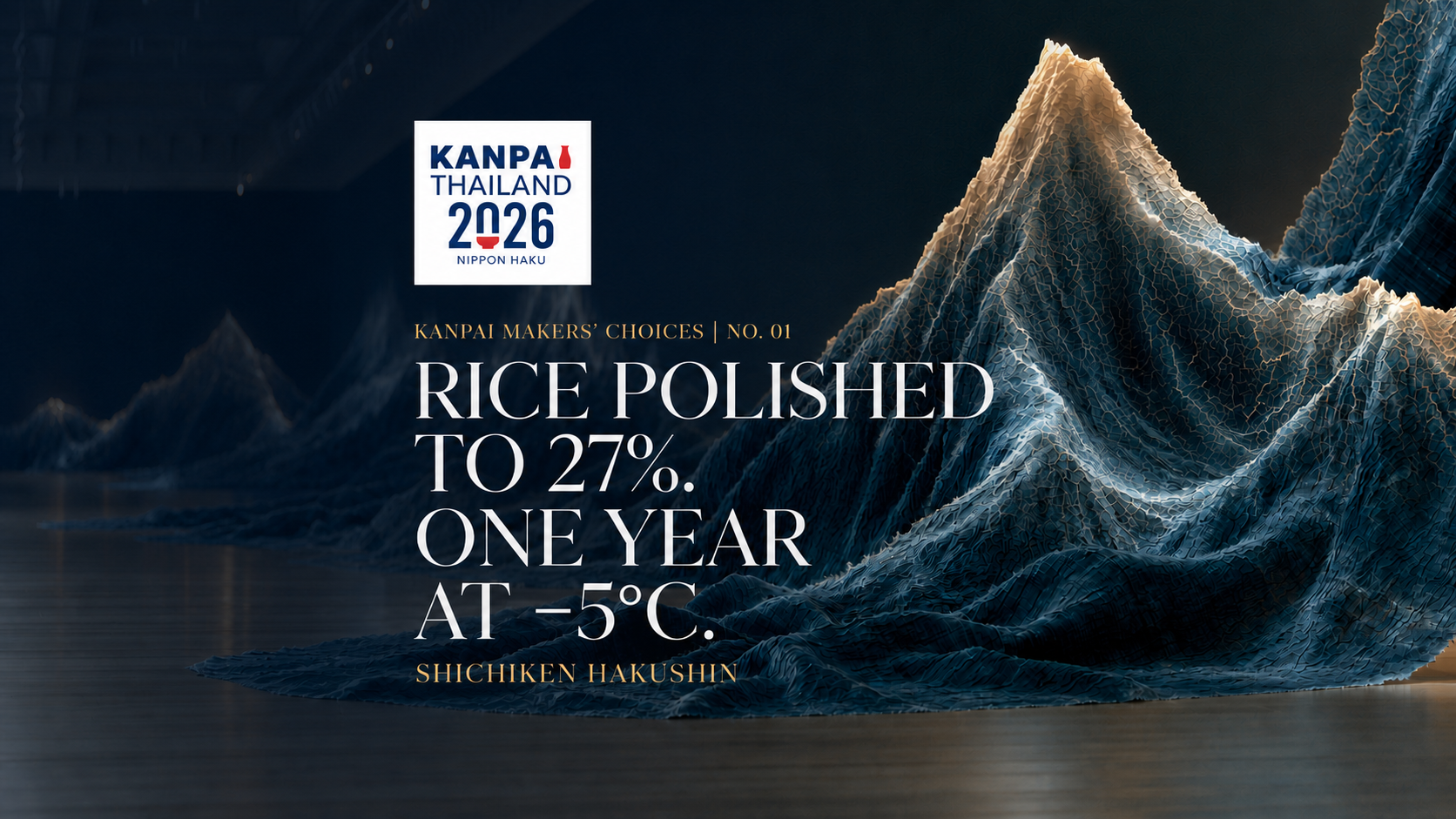
KANPAI Makers’ Choices No. 01
The Sake Staircase concluded after examining nine products and tracing differences in raw materials, fermentation, distillation and classification. KANPAI Makers’ Choices begins with a different focus. It shifts from classification to the decisions that shape a single product.
This first article considers Shichiken Hakushin, a Junmai Daiginjo made by Yamanashi Meijo and included in the planned lineup for KANPAI THAILAND 2026.
In information published by Japanese producers, Junmai Daiginjo is a designation for sake made from rice, rice koji and water, with the rice substantially polished before brewing. This Japanese designation does not determine how the product is classified in Thailand for import, excise or labeling purposes.
The brewery’s published information gives four points: Yumesansui sake rice, a polishing ratio of 27%, −5°C and one year of ice-temperature maturation. Read in sequence, they outline the production design behind Hakushin.
27% Describes What Remains
A rice-polishing ratio compares the weight of polished rice with the weight of the original brown rice. At 27%, 73% of the original weight has been milled away and 27% remains for brewing.
The outer layers of rice contain relatively higher levels of protein and lipids, while starch makes up a greater proportion nearer the center. Deep polishing is not a matter of lowering a figure for its own sake. It changes the relative composition of the grain as part of shaping the intended profile of the sake.
Hakushin uses Yumesansui sake rice cultivated in Hakushu. According to the brewery, it is grown with reduced use of pesticides and chemical fertilizers, using groundwater from Mount Kaikomagatake in the Southern Alps, the same water source used in Shichiken’s brewing. Here, groundwater means water moving through layers of gravel and other permeable material beneath the surface. Hakushin’s 27% figure is tied to where the rice is cultivated. It is a decision about how far to polish rice from Hakushu.
A Further Year After Brewing
The second decision concerns time. Hakushin is brewed at low temperature, then kept at −5°C for one year. The brewery calls this process ice-temperature maturation.
Here, the term refers specifically to keeping the brewed sake at −5°C for one year. The end of brewing is not treated as the end of the process; a further year is built into the making of Hakushin.
Polishing removes the outer part of the rice before brewing. Ice-temperature maturation holds the brewed sake at a set temperature afterward. In Hakushin, the decisions of how far to polish and how long to wait occur on either side of brewing.
Rice and Water from Hakushu
Shichiken traces its brewing history to 1750, when its founder, Ihei Kitahara, began making sake in Daigahara on the Kōshū Kaidō route, now part of Hakushu in Hokuto City, Yamanashi. The brewery identifies Hakushu’s natural water as the one element unchanged since that beginning. Yamanashi Meijo Co., Ltd. was incorporated in 1925.
The Yumesansui used for Hakushin is cultivated in the same area as the brewery. According to Yamanashi Meijo, the same Hakushu water system supports both rice cultivation and brewing. Hakushin’s relationship to place lies not only in a name, but in the connection of its rice and brewing water to the same place.
The White Mountain Silhouette on the Label
The label carries the outline of white mountains centered on Mount Kaikomagatake. It was created by Ena Furuya, a textile artist from Yamanashi. The brewery describes her practice as centered on rōketsuzome, a wax-resist dyeing technique in which wax prevents dye from reaching selected areas of the cloth.
The mountain motif refers to Hakushu, the place supporting the production of Hakushin. It does not illustrate the 27% polishing ratio or the year of ice-temperature maturation. Considered alongside the production details, however, it offers a visual frame for the role of place in Hakushin.
The Making Before the Award
The official record of the International Wine Challenge (IWC), an international competition held in the United Kingdom, identifies “Shichiken Hakushin Junmai Daiginjo 2023/2024” as the recipient of the 2025 Junmai Daiginjo Trophy and Champion Sake. Champion Sake is selected from the trophy recipients across the competition’s categories.
The result is part of Hakushin’s public record, but it is not the subject of this article. The focus is the sequence that precedes judging: rice, polishing, brewing water and maturation. A separate news article sets out the broader context of IWC 2025.
Hakushin shows how a single specification, the polishing ratio, sits within a sequence of decisions involving rice, water, temperature and time. Future articles in KANPAI Makers’ Choices will read specifications in the same manner, not as a hierarchy of value, but as evidence of how each maker shapes the production process.
This article presents the production choices and cultural background behind Shichiken Hakushin. It is not intended to advertise alcoholic beverages or encourage their purchase or consumption. It is intended for readers aged 20 and over.
บทความนี้นำเสนอข้อมูลเกี่ยวกับแนวคิดด้านการผลิตและภูมิหลังทางวัฒนธรรมของ Shichiken Hakushin เท่านั้น มิได้มีวัตถุประสงค์เพื่อโฆษณา หรือส่งเสริมการซื้อหรือการบริโภคเครื่องดื่มแอลกอฮอล์ บทความนี้จัดทำขึ้นสำหรับผู้อ่านอายุ 20 ปีขึ้นไป
Discover the culture behind every bottle
We share brewery stories, tasting notes and the craft of koji & fermentation — for educational and cultural purposes only.
เราถ่ายทอดเรื่องราวจากผู้ผลิต บันทึกรสชาติ และศาสตร์แห่งโคจิและการหมัก — เพื่อการศึกษาและวัฒนธรรมเท่านั้น
Follow on Instagram FacebookRelated Articles
The Sake Staircase: Three Questions Across Nine Products / Shichiken Hakushin and IWC 2025 / Hakushu’s Water and the 1880 Imperial Lodging / Dryness Is Not a Single Number: Two Rice-Polishing Ratios in KID Karakuchi-Kid