Drink
“Authorized Distributor” Status Is Reviewed Annually: Juyondai and Official Distribution in Thailand

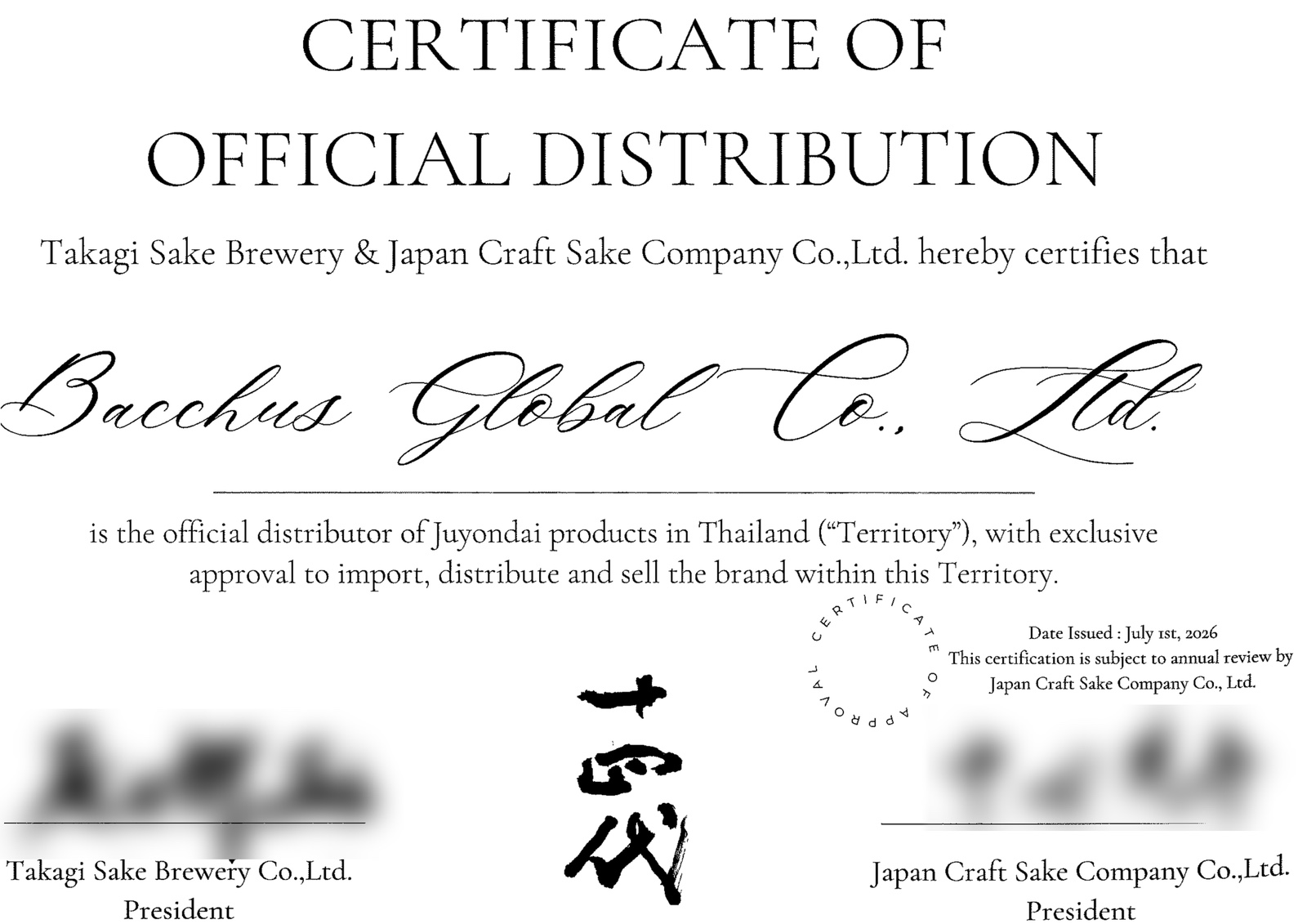
On July 1, 2026, a certificate was issued jointly by Takagi Shuzo of Yamagata Prefecture and Japan Craft Sake Company Co., Ltd., a company whose name appears alongside Takagi Shuzo in Juyondai’s official brand book. The certificate states that Bacchus Global (“BG”) is Juyondai’s official distributor in Thailand, authorized to carry out the exclusive import, distribution, and sale of the brand in this region.
What draws the eye, however, is not the prominent name in the center, but a quiet line of print on the right: “This certification is subject to annual review by Japan Craft Sake Company Co.,Ltd.”
What “Authorized” Actually Means
The term “authorized distributor” is widely used, but what qualifies a distributor as authorized varies considerably from one brand to another. In the case of Juyondai, the brewery has set out specific requirements.
Takagi Shuzo officially began exporting its sake in 2017. According to the brand book, Juyondai supplied through its official distribution partners is handled under strict temperature control at -5°C (23°F), together with a recordkeeping and traceability system known as the Sake Blockchain. Each bottle carries its own serial number and unique QR code, which are used to track its handling and provenance. The brand book also explains that labels used for overseas markets differ from those used in Japan, so that products distributed through official channels can be readily identified.
In other words, for Juyondai, being “authorized” means more than simply having permission to sell the product. It means delivering the sake under three conditions: controlled temperature, traceable records, and individual bottle identification.
Why the Brewery Sets the Conditions
Takagi Shuzo was founded in 1615 in Murayama, Yamagata Prefecture. Located in one of Japan’s heaviest snowfall regions, the brewery has long made sake shaped by the area’s soft groundwater and long, cold winters. In 2016, sake produced in Yamagata received Geographical Indication (GI) status, making it the first designation in Japan to cover an entire prefecture as a sake-producing region.
In 1994, 15th-generation Tatsugoro Takagi (Akitsuna Takagi) made his debut as the brewery’s toji, or master brewer. At the time, the prevailing style of sake was known as tanrei karakuchi, clean, light, and dry, with restrained sweetness. Takagi established a distinctly different style known as hojun umakuchi, marked by pronounced aroma and a richness reminiscent of fruit.
A style refined by a brewer over many years does not end at the brewery doors. Sake is sensitive to changes in temperature, and whether it retains the condition the brewer intended throughout overseas distribution depends on how it is handled after leaving the brewery. Takagi Shuzo’s decision to set specific conditions for distribution can be understood as treating delivery itself as an extension of the brewing process.
What It Means to Be Reviewed Every Year
This returns the focus to that single line on the certificate.
The certificate states that the authorization is subject to annual review, but it does not specify the criteria used in that review. The brand book, meanwhile, describes requirements involving temperature control, recordkeeping, and individual bottle identification. The certificate alone does not confirm whether these particular requirements form part of the annual review.
What the wording does make clear is that the authorization is not presented as a one-time approval. It is granted on the understanding that it will be reviewed again each year.
BG regards this certificate not as a frame for something already achieved, but as a document that sets out the responsibility it carries from this point forward. The certificate is dated July 1, 2026. And the review does not end with a single occasion. It repeats every year.
This article is intended solely to explore the brewing philosophy and cultural heritage of Takagi Sake Brewery and the Juyondai brand, and does not aim to promote or encourage the consumption of alcohol. / บทความนี้จัดทำขึ้นเพื่อนำเสนอข้อมูลเกี่ยวกับปรัชญาการผลิตและมรดกทางวัฒนธรรมของ Takagi Sake Brewery และแบรนด์ Juyondai เท่านั้น มิได้มีเจตนาเพื่อส่งเสริมหรือโฆษณาเครื่องดื่มแอลกอฮอล์ สำหรับผู้มีอายุ 20 ปีขึ้นไป โปรดดื่มอย่างรับผิดชอบ
Related Articles
“Juyondai” / “Why Juyondai Quietly Remains at the Top” / “In the Quiet of the Royal Palace”
Related Product(s)
JUYONDAI Gold / JUYONDAI Black / JUYONDAI Red
Discover the culture behind every bottle
We share brewery stories, tasting notes and the craft of koji & fermentation — for educational and cultural purposes only.
เราถ่ายทอดเรื่องราวจากผู้ผลิต บันทึกรสชาติ และศาสตร์แห่งโคจิและการหมัก — เพื่อการศึกษาและวัฒนธรรมเท่านั้น