Blog
Learning Together, Not Brewing Alone: The AKABU Team
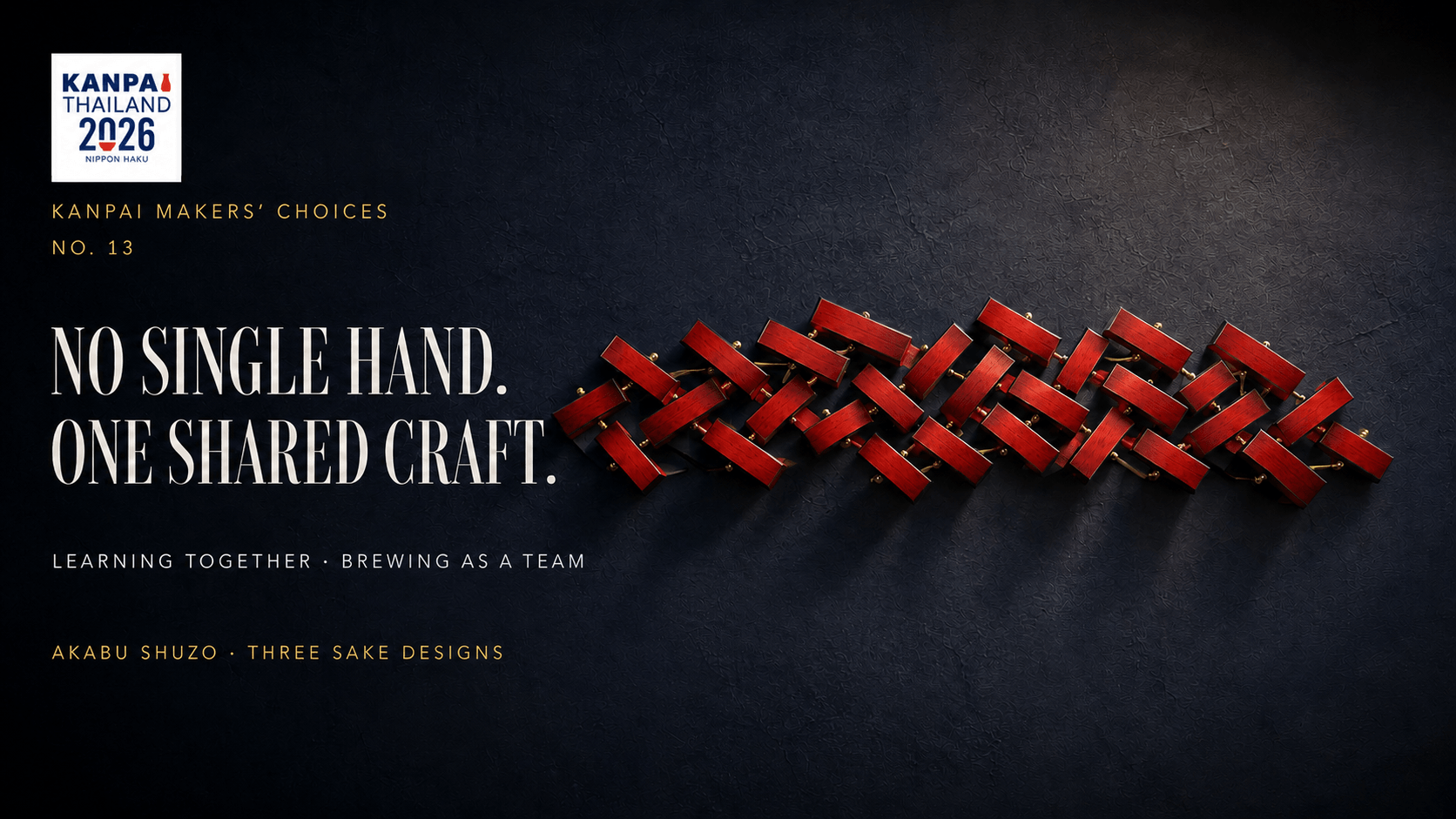
KANPAI Makers’ Choices No.13
At a brewery where almost no one possessed prior experience in sake making, who would support the master brewer?
In 2013, Akabu Shuzo completed a new facility in Morioka, Iwate Prefecture|two years after its original coastal home in Otsuchi was swept away by the Great East Japan Earthquake.
The structure was new, but the cadence of production could not simply be restored to what it once was. Before the disaster, Akabu Shuzo had relied on an external Nanbu Toji to guide its brewing. A transition toward an employee-led model was already underway when the disaster struck; by the time the Morioka doors opened, no seasoned production team remained.
The role of toji fell to Ryunosuke Furudate, a sixth-generation family member who had returned to the business after university. In 2014, Furudate and a small collective of young artisans launched a new label: AKABU.
This was not merely a physical reconstruction. It represented a fundamental shift away from reliance on the singular expertise of one master, choosing instead a model grounded in shared evolution and collective growth.
At First, the Toji Carried Almost Everything Alone
When production began in Morioka, Furudate was surrounded by young team members with no previous background in brewing. Initially, he carried the weight of the entire process on his own shoulders, managing nearly every stage himself.
Yet sake resists solitary labor. Washing and steaming the rice, cultivating the koji, monitoring the fermenting moromi mash, and pressing the liquid from the lees|each phase flows intimately into the next, every decision casting a shadow on the outcome.
Recognizing that long-term craft cannot be sustained by one person alone, Furudate shifted course. Rather than shouldering the burden individually, the entire team would master the work, one discipline at a time. What defined AKABU was not the isolated skill of a young toji, but the quiet transformation of novices into a unified brewing collective.
Architecture for Shared Craftsmanship
Building a team-led brewery demands more than instruction; it requires a workspace designed for intuitive collaboration.
The Morioka brewery was intentionally designed to be compact and efficient|an environment where inexperienced artisans could navigate the intricacies of production. This was not about simplifying traditional techniques, but about creating a structural foundation that allowed multiple brewers to comprehend and share the same operational rhythm.
At Akabu Shuzo, young brewers gather around their toji under a unified philosophy: defining the craft of sake for their era. The innovation lies not merely in flavor profiles or visual identity, but in the organizational culture|in how knowledge is held, shared, and passed forward.
One Team, Three Expressions
This article covers three sake products: AKABU Junmai, AKABU Junmai-Ginjo, and AKABU Junmai-Daiginjo. All three are made with Ginginga, a sake rice from Iwate Prefecture, and have rice-polishing ratios of 60%, 50%, and 40%, respectively.
These percentages indicate the proportion of the grain remaining after polishing, but they do not indicate the brewer’s skill or a ranking of the products. What matters is that one team makes three sake styles with different designs. Making the three sakes with one team means that multiple brewers need to understand how rice handling and fermentation management differ by product. Public information does not specify who is responsible for each process or how these techniques are taught. Even so, the policy of having young brewers learn together is understood to support the AKABU brand as a whole, not just a single product.
AKABU and the Red Helmet: A Symbol Recognized at a Glance
AKABU’s label shows a samurai wearing a red helmet alongside the name “AKABU” in large Roman letters. Mr. Furudate explains that one of the brewery’s employees drew the image. It was designed so that people who cannot read kanji could still remember the name and image at a glance.
The label is inseparable from the work of the young team: they considered not only how to create a new brand, but also how to make it memorable. Rather than restoring the old sign to the new brewery, the team created the sake, name, and visual image together. The result is the red helmet shared by all three products.
No. 13: Choosing to Pass on the Craft Together, Not Alone
The KANPAI Makers’ Choices series has examined what producers choose and choose not to do, based on publicly available facts about their production processes. How far to polish the rice; which portion to separate during pressing; which parts of an ingredient not to use in the mash; when to add tea and how to distill it; whether to use activated carbon to adjust the spirit or add water; and how to choose a base spirit, aging vessel, botanical maceration conditions, and production partner. Across the first twelve episodes, the focus has been not only on the character of the finished drink, but also on the decisions made before it takes shape.
In the final episode, No. 13, Akabu Shuzo shows a choice not to make sake production depend on the experience of one person. Young people with no prior experience learn one task at a time and become a team supporting the same brand. AKABU’s new history did not begin as the story of one young toji; it began with building an organization where sake-making knowledge could be shared.
This article is intended solely to provide factual and cultural information about Akabu Shuzo, the AKABU brand, and its approach to team-based sake brewing. It does not aim to promote or encourage the purchase or consumption of alcohol. It is intended for readers aged 20 and over.
บทความนี้จัดทำขึ้นเพื่อให้ข้อมูลเชิงข้อเท็จจริงและวัฒนธรรมเกี่ยวกับ Akabu Shuzo แบรนด์ AKABU และแนวทางการผลิตสาเกโดยอาศัยการทำงานเป็นทีมเท่านั้น มิได้มีเจตนาเพื่อส่งเสริมการซื้อหรือการบริโภคเครื่องดื่มแอลกอฮอล์ บทความนี้จัดทำขึ้นสำหรับผู้อ่านอายุ 20 ปีขึ้นไป
Related Products
AKABU Junmai / AKABU Junmai-Ginjo / AKABU Junmai-Daiginjo
Related Reading
KANPAI THAILAND 2026: All Episodes / Forging a New Legacy / Sake Chosen by the Hand That Brews It
Discover the culture behind every bottle
We share brewery stories, tasting notes and the craft of koji & fermentation | for educational and cultural purposes only.
เราถ่ายทอดเรื่องราวจากผู้ผลิต บันทึกรสชาติ และศาสตร์แห่งโคจิและการหมัก | เพื่อการศึกษาและวัฒนธรรมเท่านั้น
Follow on Instagram Facebook