Drink
Polishing Is Not Only for Rice: The “Migaki-Imo” Behind SHIRAKANE-NO-TSUYU
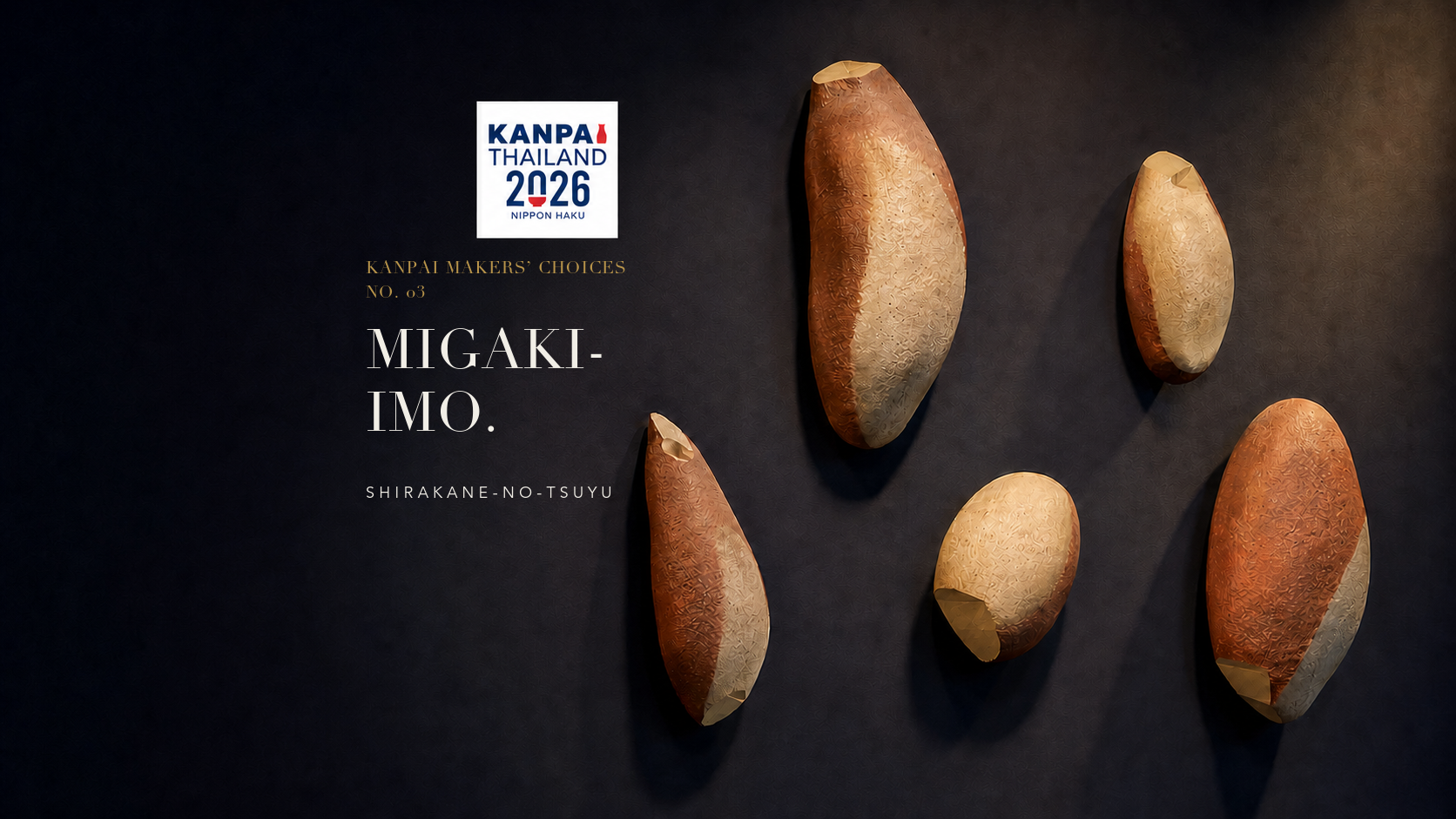
KANPAI Makers’ Choices No.03
Shochu makers have an old saying: “First comes koji, second comes the starter mash, and third comes the rest of the process.” Shirakane Shuzo, based in Aira, Kagoshima Prefecture, also presents these words on its official website. Koji, fermentation, and distillation are usually where an explanation of shochu begins.
Shirakane Shuzo’s approach, however, leads to a quieter stage: the work carried out before the sweet potatoes enter the secondary mash. Fresh potatoes are washed and peeled. Each one is then inspected by hand so that the stem ends and damaged areas can be removed. The brewery calls potatoes prepared to this point migaki-imo, or “polished potatoes.”
In the world of Japanese alcoholic beverages, “polishing” commonly brings rice milling to mind. Migaki-imo is not the same process. It does not remove a fixed proportion from every potato. It is a decision about how to prepare an agricultural ingredient whose shape and condition vary from one piece to the next.
Why devote so much attention to a stage that comes before the potatoes are added to the secondary mash?
Migaki-Imo Is Not a Decorative Name
According to Shirakane Shuzo’s account of the process, fresh sweet potatoes arrive from the fields shortly after five each morning during the production season. Sweet potatoes arrive with soil on their skins and vary from one to the next in size, shape, and condition. An agricultural ingredient is not uniform from the outset.
After washing and peeling, workers remove the stem ends and damaged sections by hand. The brewery explains that these parts can contribute bitterness. Once prepared, the potatoes have a polished sheen. Their appearance gave rise to the name migaki-imo.
The purpose is not cosmetic. It is to determine what should not enter the secondary mash. Shirakane Shuzo applies this preparation not only to selected special labels but to every shochu it makes. Raw-material preparation is therefore not presented as an exceptional gesture. It is part of the brewery’s daily production standard.
Another Kind of Polishing, Beyond a Percentage
Rice polishing can be described numerically. A rice-polishing ratio of 60 percent, for example, means that 40 percent of the original brown rice has been removed and 60 percent remains. The proportion left after milling is decided in advance and appears as part of the product’s technical information.
Migaki-imo has no single removal ratio. One potato may need attention only around its stem end; another may also have a damaged section. The amount removed depends on the individual potato. If rice milling is “polishing to a set ratio,” migaki-imo is “polishing by assessing each ingredient’s condition.”
This is not a hierarchy between two methods. Different ingredients require different ways of creating consistency. Rice is a collection of grains, so a proportion can serve as a useful measure. Potatoes differ in shape and condition, so each one must be assessed individually. The same word, “polishing,” can contain two distinct approaches to production design.
Deciding What Does Not Enter the Mash
Accounts of production often focus on what is introduced and how each later stage proceeds: the type of koji, the yeast, fermentation management, and the form of distillation. Migaki-imo reveals the other side of that design. Before adding the sweet potatoes, the brewery decides which parts will not proceed to the mash.
The Japan Sake and Shochu Makers Association’s production guide explains that, in a common method for honkaku shochu, water and yeast are added to rice koji or another koji base to form the primary mash. Steamed sweet potatoes or another main ingredient are then added to prepare the secondary mash. After fermentation, the mash is distilled in a pot still. Migaki-imo belongs to the stage before the sweet potatoes, as the main ingredient, enter that secondary mash.
Once the potatoes move forward, it becomes difficult to distinguish and handle the condition of each one individually. It also becomes difficult to trace a particular section back to a particular potato. The inspection therefore happens while each potato can still be assessed as an individual agricultural ingredient. Seen as part of the process, the handwork is not a nostalgic ornament. It is a way of addressing natural variation before the secondary mash is prepared.
The absence of a fixed removal ratio does not make the method imprecise. It means that differences a percentage cannot capture are assessed by people. Migaki-imo shows that production control begins well before the fermentation tank or still.
Daily Decisions Behind More Than a Century
Shirakane Shuzo was founded in 1869 as Kawada Jozo-ten. Its core label, SHIRAKANE-NO-TSUYU, dates to 1912. It is an imo shochu from Kagoshima made with sweet potatoes and white koji.
Founding dates and historic buildings offer visible symbols when a label’s history extends beyond a century. Yet history does not continue through dates alone. Fresh potatoes arrive, are washed and peeled, and are inspected one by one. The same judgment is repeated not only for special releases but also for an everyday core label. Tradition, in this sense, is a procedure established in the past and carried out again in the present.
What SHIRAKANE-NO-TSUYU Records Before the Secondary Mash
No.01 in this series considered Shichiken HAKUSHIN, for which rice is polished to 27 percent and then held for one year at minus five degrees Celsius. No.02 examined HANEYA KIRABI, where four-season brewing broadens the production calendar while nakagumi narrows the portion selected at pressing.
No.03, SHIRAKANE-NO-TSUYU, turns to a decision that cannot be fully expressed through a percentage or a temperature. After washing and peeling, each potato is inspected and the unsuitable sections are removed. This happens before the potatoes are added to the rice-koji primary mash to form the secondary mash, and long before the fermented mash reaches the still.
An ingredient list can state “sweet potatoes,” but it cannot show this distinction. The question is not only which ingredient was selected. It is also how that ingredient was prepared before moving to the next stage. Shirakane Shuzo’s term migaki-imo gives a concise name to the judgments made before the secondary mash begins.
This article is intended solely to provide factual and cultural information about Shirakane Shuzo and SHIRAKANE-NO-TSUYU. It does not aim to promote or encourage the purchase or consumption of alcohol. It is intended for readers aged 20 and over.
บทความนี้จัดทำขึ้นเพื่อให้ข้อมูลเชิงข้อเท็จจริงและวัฒนธรรมเกี่ยวกับโรงกลั่นชิราคะเนะและ SHIRAKANE-NO-TSUYU เท่านั้น มิได้มีเจตนาเพื่อส่งเสริมการซื้อหรือการบริโภคเครื่องดื่มแอลกอฮอล์ บทความนี้จัดทำขึ้นสำหรับผู้อ่านอายุ 20 ปีขึ้นไป
Discover the culture behind every bottle
We share brewery stories, tasting notes and the craft of koji & fermentation — for educational and cultural purposes only.
เราถ่ายทอดเรื่องราวจากผู้ผลิต บันทึกรสชาติ และศาสตร์แห่งโคจิและการหมัก — เพื่อการศึกษาและวัฒนธรรมเท่านั้น
Follow on Instagram FacebookRelated Articles
Polishing Rice to 27%, Then Waiting a Year at −5°C: The Design of Shichiken HAKUSHIN / Broadening the Brewing Season, Narrowing the Selection: HANEYA KIRABI, Four-Season Brewing, and Nakagumi / Dryness Is Not a Single Number: Two Rice-Polishing Ratios in KID Karakuchi-Kid