

How Climate Change is Redrawing the Global Wine Map
Burgundy’s Harvest: A Changing Agricultural Rhythm In France’s Burgundy region, the start of the harvest has moved forward by an average of roughly two weeks over the past 30 years. Bordeaux is seeing the same pattern. The vendange, once a quintessential October ritual, now often begins as early as late August.
This is not merely a shift in the agricultural calendar. Rising sugar levels in grapes drive up alcohol content, while declining acidity softens the structural backbone of the wine. Recent meteorological studies indicate that under a scenario in which the global average temperature rises 2°C above pre-industrial levels, a significant majority of traditional winegrowing areas in Spain and Italy could become climatically challenging. Warm, historic regions such as Rioja, Chianti, and the Barossa Valley are facing a profound redefinition of the terroir they have cultivated over centuries.
The Northern Frontier: England, Scandinavia, and Hokkaido Yet, on the other side of this environmental shift, a new map is beginning to emerge.
Climate models suggest that by the end of this century, Europe’s suitable winegrowing zones could shift northward by about eight degrees of latitude. In southern England, sparkling wines crafted from chalky soils reminiscent of Champagne have already earned international acclaim, and efforts to produce exceptional still wines are accelerating. In Nordic countries such as Norway and Finland, vineyard development is quietly but steadily moving forward.
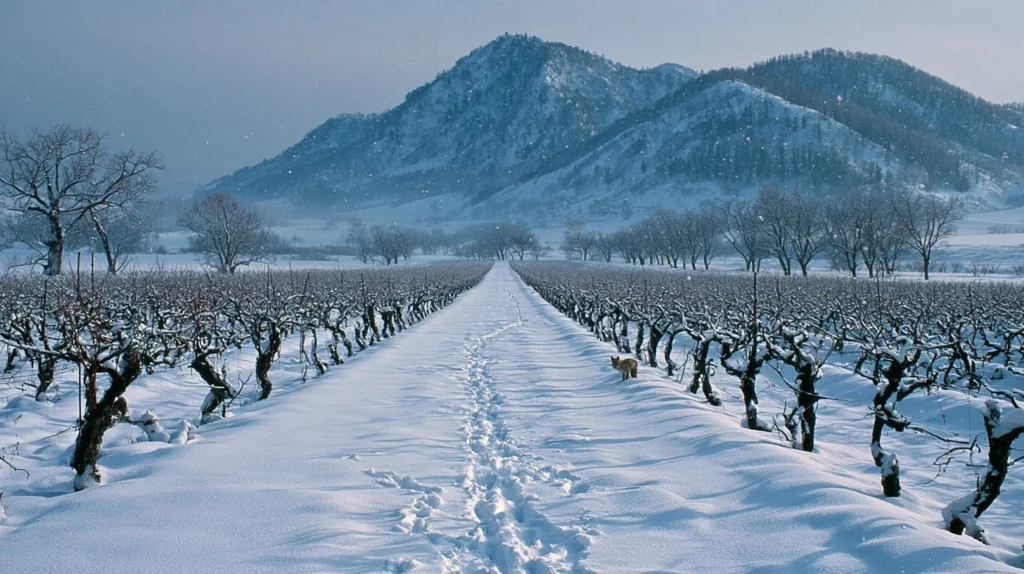
A parallel transformation is taking place in Japan. Climatological research reveals that since the late 1990s, the entirety of Hokkaido has entered the optimal temperature range for Pinot Noir, a grape notorious for its demand for precise climatic conditions. Furthermore, northern Tohoku and high-altitude mountainous areas in central Japan are seeing significantly improved suitability for premium grape cultivation.
Domaine Takahiko: A Symbol of Hokkaido’s New Terroir One producer that elegantly embodies this northern shift is Domaine Takahiko in Yoichi, Hokkaido.
In 2010, Takahiko Soga established his own domaine in Noboricho, Yoichi. From the very beginning, he focused exclusively on Pinot Noir, embracing native yeast fermentation and maintaining a philosophy of minimal intervention. His flagship wine, Nanatsumori Pinot Noir, has since become celebrated among sommeliers and connoisseurs globally, often spoken of with the same reverence reserved for Premier Cru Burgundy.
Domaine Takahiko’s significance, however, goes far beyond a single celebrated label. Soga has generously opened his vineyards as a training ground for young winemakers, actively supporting their paths to independence. As a result, a vibrant new generation of wineries has taken root in and around Yoichi, helping the region earn international recognition as Japan’s preeminent Pinot Noir terroir. It is a beautiful testament to how one artisan’s philosophy can act as a catalyst in a frontier opened by the changing climate. Today, areas long dismissed as “too cold”—such as Iwamizawa, Furano, and Okushiri Island—are stepping onto the central stage of Japanese viticulture.
The Front Line of Adaptation: Heritage Meets Innovation The traditional regions, meanwhile, are not standing still.
Innovations are advancing in the vineyards, from sophisticated canopy management to control sunlight exposure, to highly strategic harvest timing and regulated deficit irrigation. Smart agriculture, utilizing soil moisture sensors and automated weather stations, now allows vignerons to monitor vine water stress in real time with unprecedented precision.
The vines themselves are also changing. In Bordeaux, the deeply protected AOC regulations were revised in 2021 to officially permit the use of resilient varieties such as Touriga Nacional and Albariño. The alteration of rules that have governed permitted varieties for centuries speaks volumes about the industry’s commitment to the future.
Collective action is accelerating as well. The International Wineries for Climate Action (IWCA), founded in 2019, now includes more than 170 wineries worldwide working meticulously to decarbonize the industry. Their commitment to reducing the average weight of still wine bottles is a concrete measure aimed at cutting carbon emissions from global transportation.
The Resonance Within Bangkok’s Gastronomy This paradigm shift resonates deeply within Bangkok’s evolving gastronomy scene.
Thailand’s premium wine market has historically been anchored by the great estates of France and Italy. However, as climate change subtly alters the rhythm of production in these historic regions, a diversification of the cellar becomes a natural progression. English sparkling wines, Hokkaido Pinot Noir, and elegant vintages from emerging high-altitude regions will undoubtedly play a more prominent role. The curation of wine lists in Bangkok’s finest establishments is poised for a fascinating evolution over the next decade.
What deserves particular reflection is the expansion of the very concept of “terroir.” Traditionally, it referred to the totality of soil, climate, topography, and the accumulated history of human activity. But in an era of climatic transformation, the essence of terroir is shifting from “historical preservation” toward “the capacity for graceful adaptation.” The attitude of producers relentlessly searching for what is truest to their land and climate at this exact moment in time is what now defines the contemporary spirit of winemaking.
From a broader cultural perspective, this shift is profoundly suggestive. Changing climates alter the distribution of native yeasts and the subtle nuances of fermentation itself. This reality confronts not just winemakers, but the artisans behind sake, shochu, soy sauce, and all fermented traditions that rely on the delicate dialogue between microorganisms and the environment.
Terroir: From Preservation to Creation The global wine map is being gently but irrevocably redrawn. This is not simply a narrative of challenge for traditional regions; it is a story of profound resilience, where ancestral wisdom meets modern innovation. Simultaneously, exciting new chapters are being written in previously uncharted territories.
The quiet moments Takahiko Soga spends observing his vines in Yoichi, and the thoughtful contemplation of Burgundy vignerons adjusting to an earlier harvest, are separated by vast oceans and latitudes. Yet, they are fundamentally united by the same dedication to the vine. Their shared reality is the true meaning of terroir today.
Beyond the glass in Bangkok, a quiet transformation of the earth is underway. To understand this shift is to taste the evolving history of our world in every pour. (Mr. Bacchus)
This article is intended solely to explore the structural transformation of the global wine industry under climate change, including the northern shift of grape-growing regions and the emergence of Hokkaido and Domaine Takahiko as a symbolic case in Japan, and is not intended to promote or encourage the consumption of alcohol. / บทความนี้จัดทำขึ้นเพื่อนำเสนอข้อมูลเกี่ยวกับการเปลี่ยนแปลงเชิงโครงสร้างของอุตสาหกรรมไวน์ระดับโลกภายใต้การเปลี่ยนแปลงสภาพภูมิอากาศ การเคลื่อนตัวขึ้นเหนือของพื้นที่ปลูกองุ่น และการเติบโตของฮอกไกโดและ Domaine Takahiko ในฐานะกรณีสัญลักษณ์ของญี่ปุ่น เท่านั้น มิได้มีเจตนาเพื่อส่งเสริมหรือโฆษณาเครื่องดื่มแอลกอฮอล์ สำหรับผู้มีอายุ 20 ปีขึ้นไป โปรดดื่มอย่างรับผิดชอบ
Related Product(s)
GOKUJYO TSUTSUMI / TOKISOBA / GINKUMA / KID Junmai-Ginjo Karakuchi-Kid / KID Muryozan Junmai
Discover the culture behind every bottle
We share brewery stories, tasting notes and the craft of koji & fermentation — for educational and cultural purposes only.
เราถ่ายทอดเรื่องราวจากผู้ผลิต บันทึกรสชาติ และศาสตร์แห่งโคจิและการหมัก — เพื่อการศึกษาและวัฒนธรรมเท่านั้น
Follow on Instagram FacebookRelated Articles
“More Than a Downturn” / “In a Shrinking World of Wine, Where Is Value Headed? ” / “Diverging Paths in the Wine Market” / “Organic Wine Leaves the “Niche” Behind” / “Tropical Wine and the Redefinition of “Origin””