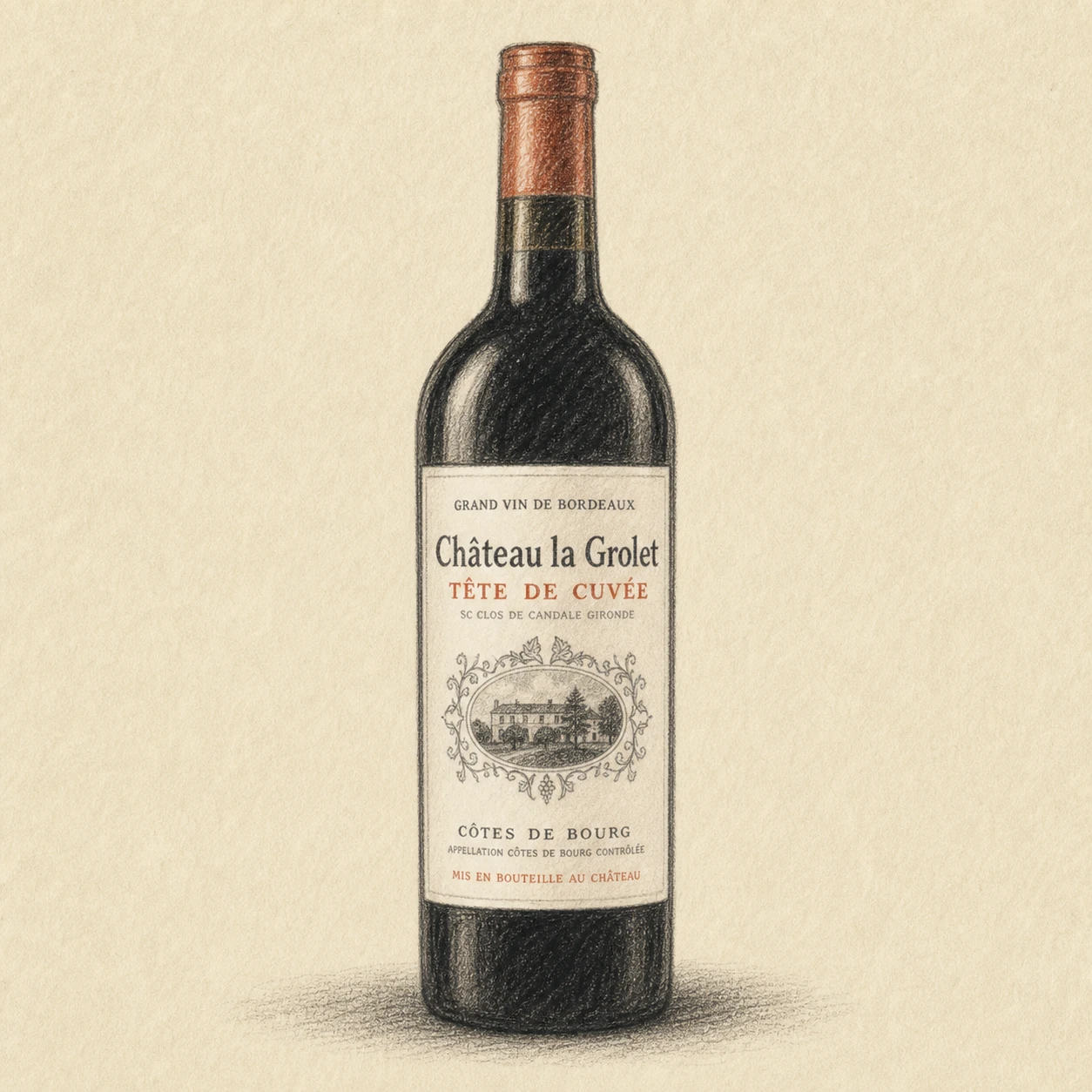
Original bottle illustration — Bacchus Global
Bordeaux Right Bank · AOC Côtes de Bourg
CHÂTEAU LA GROLETTête de Cuvée
Grown where two winemaking families finally met across the Gironde, this is Château La Grolet's most concentrated expression — the fruit of its oldest vines and the barrels judged worthy of the name Tête de Cuvée.
- Wine type
- Red wine, full-bodied
- Grape
- Merlot 85%, Cabernet Sauvignon 10%, Malbec 5%
- Appellation
- AOC Côtes de Bourg
- Origin
- Saint-Ciers-de-Canesse, Bordeaux right bank, France
- Drinking window
- Estimated 2026–2032
- Recommended temperature
- 16–18°C
- Alcohol
- Approx. 14.4–14.5% ABV
- Bottle size
- 750 ml
About the Wine
Château La Grolet is a family-run estate on the right bank of the Gironde in Côtes de Bourg. Jean-Luc and Catherine Hubert took over the property in 1997 and began converting it to biodynamic farming, achieving Demeter certification from the 2000 vintage. Catherine's family has grown grapes at Château Peybonhomme-les-Tours since 1890.
Tête de Cuvée is the estate's top selection, drawn from its oldest vines and the barrels judged best each year. It carries a higher proportion of Merlot than the classic bottling and is aged in French oak including new barrels, giving it a fuller, more velvety character.
Taste profile
In the glass
TÊTE DE CUVÉE
Scale1–5
BG wine structure estimate
Comparative profile within the Bacchus Global wine range.
Ripe blackberry, cassis and morello cherry jam layered with toasted oak, chocolate, cocoa, eucalyptus and mint, joined by notes of fine tobacco as the wine ages.
A full, fleshy mid-palate carried by firm acidity and structured tannin, closing with a velvety texture and notably long finish.
Dense purple-red robe.
Before it reaches the glass
Temperature
Serve at 16–18°C, starting toward the cooler end and letting the glass warm gradually.
Timing
An estimated drinking window of 2026–2032, with the wine likely to show particularly well around 2027–2030 based on the estate's overall style.
Glassware
A large-bowled Bordeaux glass suited to full-bodied reds.
At the table
The wine's fleshy structure and firm backbone of acidity and tannin call for dishes with richness and umami depth.
Rather than pointing to a single perfect match, the wine's structure suggests which directions work best across different culinary traditions.
Japanese
- Wagyu akami (lean cut) steak
- Sukiyaki with a lightly sweet-savory sauce
- Beef shigureni simmered in soy
Why it worksThe umami of soy-based seasoning and the natural fat of lean red-meat cuts meet the wine's fleshy body and firm tannin without being overwhelmed.
Thai
- Massaman beef curry (mild spice level)
- Charcoal-grilled pork, Isaan style
- Beef dishes finished in rich, dark sauces
Why it worksMild, richly seasoned preparations complement the wine's ripe fruit and structure, while chili- or lime-forward dishes are better avoided as they can clash with the tannin.
Western
- Roast saddle of lamb
- Bordeaux-style entrecôte with marchand de vin sauce
- Roast squab with truffle or mushroom accompaniments
Why it worksClassic Bordeaux pairings of roasted red meat with truffle or mushroom notes echo the wine's own oak-derived depth and firm tannic structure.
From cellar to bottle
Winemaking
Fermentation begins spontaneously with the estate's indigenous yeasts in concrete vats, followed by a two-week post-fermentation maceration and gentle, pump-free gravity-flow transfers. The wine is then aged in French oak barriques, including new oak, for at least a year, with only the best barrels selected for the final blend before bottling on a biodynamic 'fruit day.'
Product detail
Sourced from the estate's oldest plots (vine age averaging 50–55 years across the estate) and its best-performing parcels, the wine is unfined and unfiltered and produced at 6,600 bottles a year in the traditional 750 ml Bordeaux format.
Origin
The estate has been farmed by the Hubert family since 1997, when Jean-Luc and Catherine Hubert took over La Grolet and began its conversion to organic and biodynamic practice, achieving Demeter certification from the 2000 vintage. A dedicated biological corridor of unfarmed grassland, woodland and wetland runs through the property, supporting wildlife and natural pest control.
Official producer website→Certifications

Certified Organic

Biodynamic · Demeter
Organic, biodynamic and vegan-friendly
The estate farms organically and biodynamically, certified by Demeter since the 2000 vintage, and follows vegan-friendly practices in the cellar — using no fining at all in place of traditional egg-white fining, so the wine reaches bottle without animal-derived inputs.
Trade information
Contact Bacchus Global for product documentation, availability and trade enquiries.