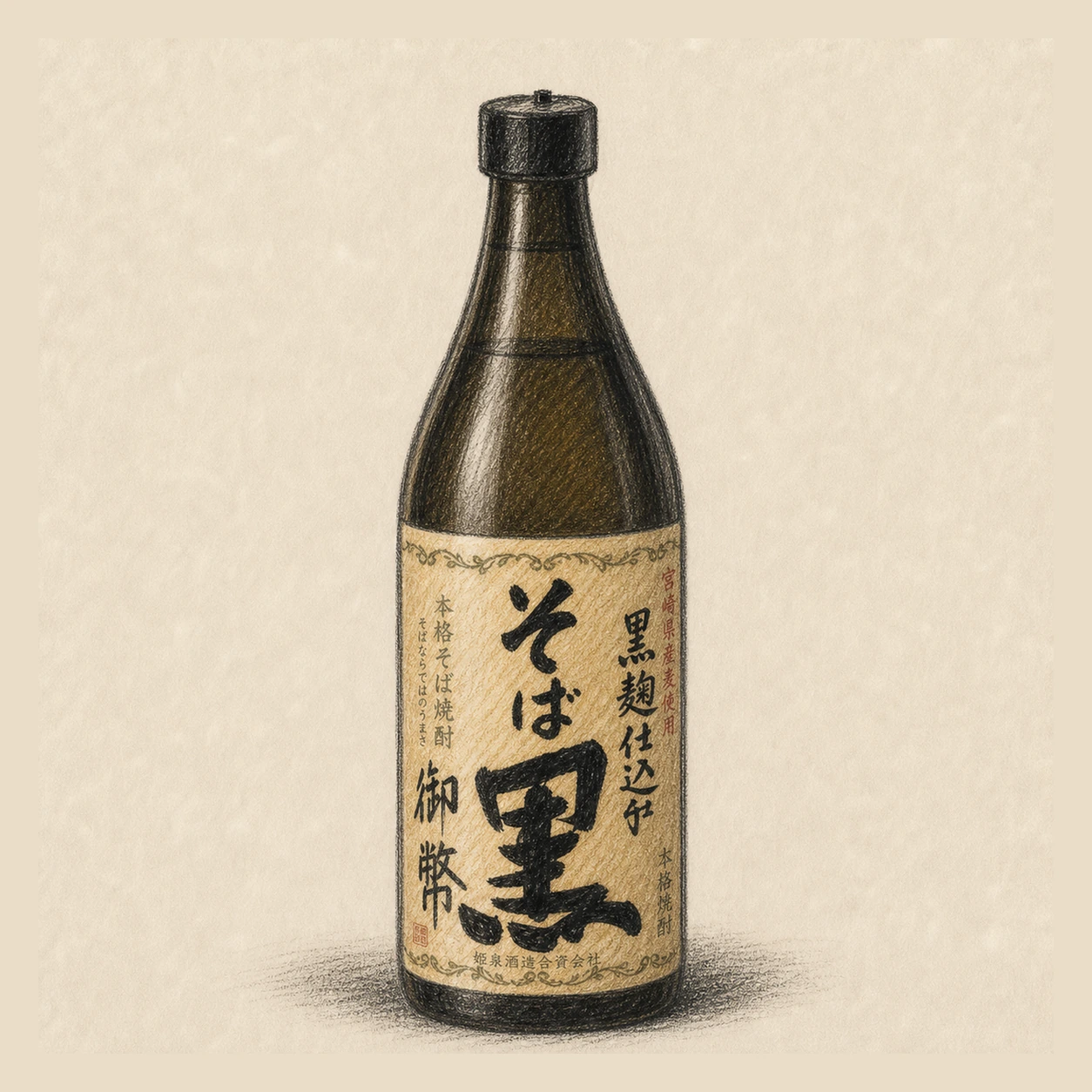
SOBAKURO GOHEI
A buckwheat shochu that deliberately takes a fuller route: black koji, rice koji without barley, and one atmospheric distillation. It carries the clarity of soba while leaving room for a deeper, longer shape.
Black koji and rice koji, without barley
SOBAKURO GOHEI is built from buckwheat and rice koji, without the barley koji commonly used to support fermentation in soba shochu. Black koji gives the structure added depth, while a single atmospheric distillation keeps the grain’s fragrance and savoury presence in view.
A shinto offering in the land of Yokagura
“Gohei” is the folded white paper offering used in Shinto practice. In Miyazaki, it is also part of the winter Yokagura tradition that welcomes the deities. Himeizumi offers its Gohei shochu at these rites, tying the name to a living local custom rather than borrowing an image from elsewhere.
Clarity of buckwheat, depth of the cellar
Hinokage lies in the Kyushu Mountains near Takachiho, along the Gokase River valley. The brewery uses spring water that has travelled through the Aso volcanic system and works in its long-established cellar. The result is a soba-shochu expression with an unusually deliberate contrast between a clean grain impression and a more resonant finish.
Where buckwheat’s clarity and black koji’s depth meet the table
The pairings below are not the producer’s own recommendations, but a reading of the recorded flavour characteristics. The depth that black koji brings, together with a buckwheat clarity that carries through to a finish with backbone, guides four directions.
Sushi and Japanese Cuisine Pairing Principles positions shochu, which carries almost no iron, as a spirit that does not interfere with the taste of food. SOBAKURO GOHEI, holding both buckwheat’s clarity and black koji’s depth, does not crowd the savoury depth of dashi or mushrooms, and instead places the aroma of buckwheat directly on the table.
Himeizumi Shuzo — a small house since 1831
Founded in 1831, Himeizumi Shuzo makes its spirits in Hinokage, Miyazaki. The house is known for hand-led production and an old fermentation cellar; SOBAKURO GOHEI stands alongside its sweet-potato sibling as a distinctly different expression of the same place.
For current-lot specifications, availability, storage requirements and trade terms, please contact Bacchus Global.