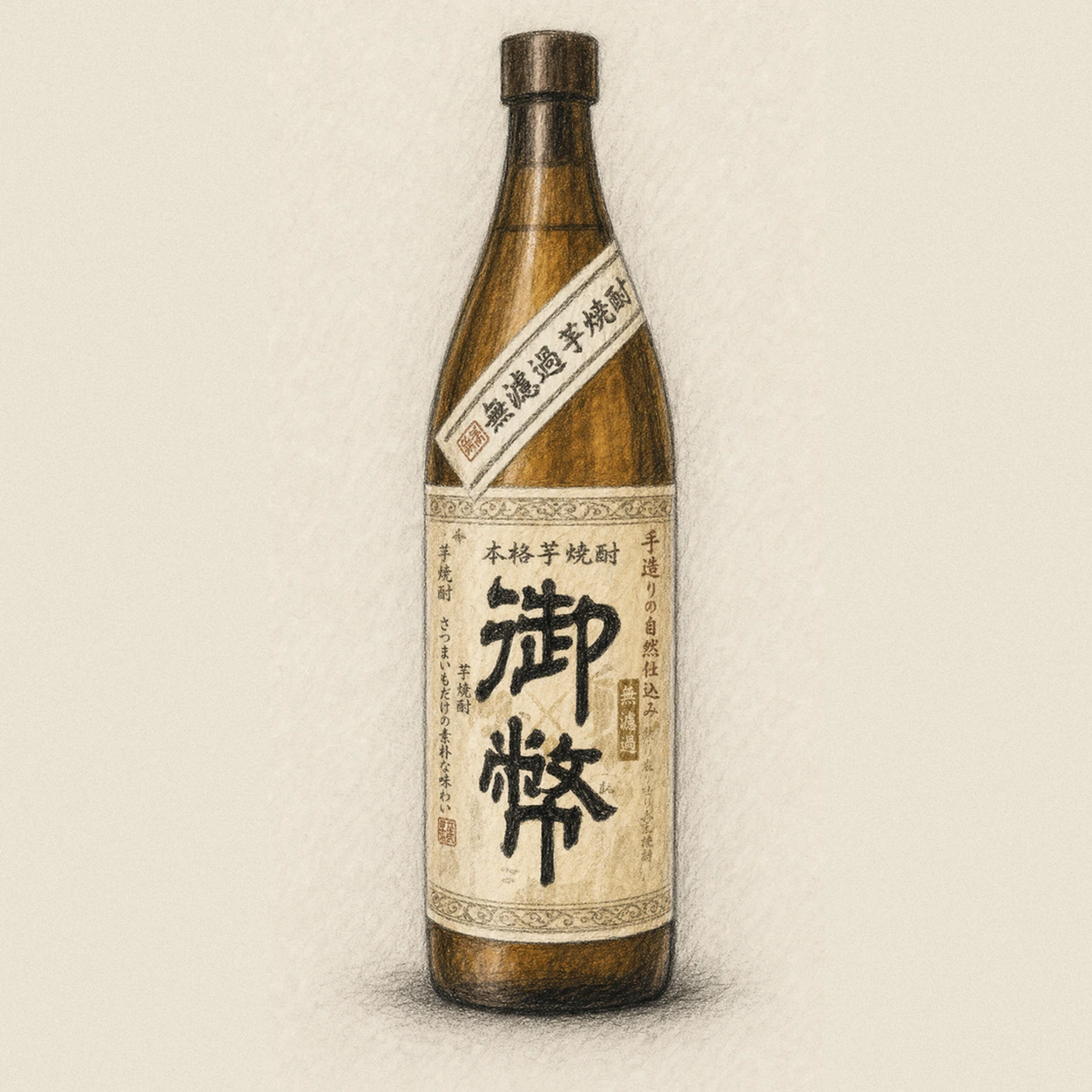
GOHEI MUROKA IMO
An unfiltered sweet-potato shochu shaped in the mountain town of Hinokage. Rather than mechanically filtering away its character, Himeizumi removes only excess surface oils by hand and lets the texture of the spirit remain.
To leave character in the spirit
“Muroka” is not a decorative word here. After distillation, Himeizumi avoids mechanical filtration and hand-skims only the excess oxidised oils that rise to the surface. The intent is precise: to keep the aromatic and textural components that give sweet-potato shochu its depth, without allowing unwanted notes to take over.
A living environment, not a neutral backdrop
The brewery’s working cellar is more than 130 years old. Its darkened beams, pillars and earthen walls have been shaped by generations of fermentation, and the house describes the resident yeasts and koji moulds as part of the place itself. That accumulated environment sits behind the small-scale, hand-led character of the range.
A softer 20% interpretation
This standard expression pairs Koganesengan sweet potato with white koji and atmospheric distillation. At 20%, it was refined for an approachable, unhurried rhythm: the unfiltered savoury dimension remains, while the alcohol impression is gentler and the finish stays composed.
Where a gentle savouriness meets the table
The pairings below are not the producer’s own recommendations, but a reading of the recorded flavour characteristics. An unfiltered savoury dimension that stays present, with a gentler mouthfeel and finish that does not become heavy through the meal, guides four directions.
This pairing rationale draws on the following reference book: Logical Pairing places matching the “weight” of food and drink at the starting point of pairing. Muroka Gohei, with its gentled mouthfeel and finish, matches easily with the weight of light poultry, fish and the sweetness of root vegetables, while carrying the oil of fried food without tipping out of balance.
Hinokage, Miyazaki — making since 1831
Himeizumi Shuzo was founded in 1831 in Hinokage, a mountain town near Takachiho in Miyazaki. The house made sake until around 1968, then turned its attention to shochu. Today, it works on a small scale, drawing on mountain spring water and a long tradition of careful fermentation management.
For current-lot specifications, availability, storage requirements and trade terms, please contact Bacchus Global.