KODAI-IKKO
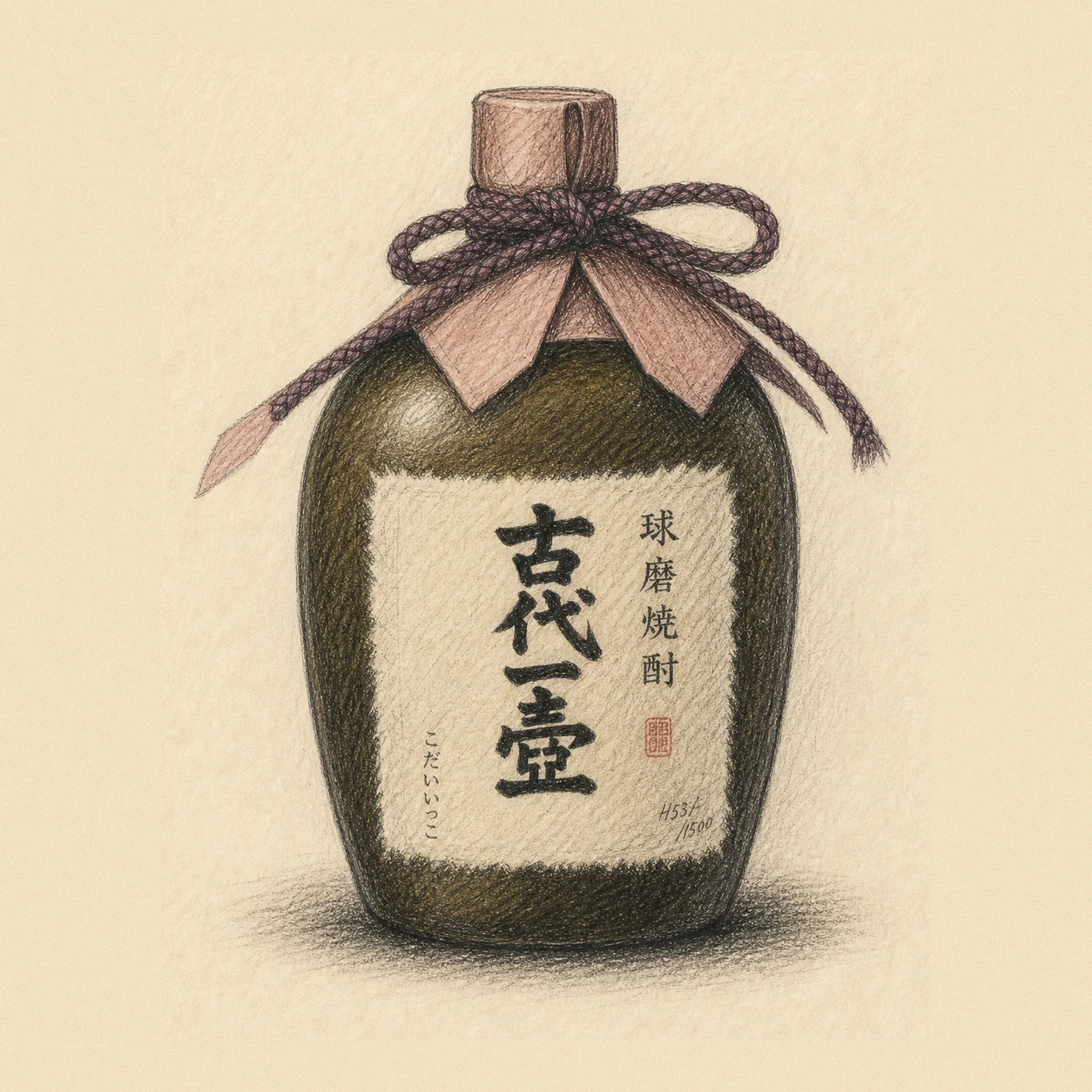
KODAI-IKKO is built around rice spirits that have spent eleven years or more in oak. The time gives its Kuma shochu foundation a deeper amber register while keeping rice and cask in deliberate balance.
Thailand · Product information
Product information from Bacchus Global Co., Ltd., based in Bangkok, Thailand. About Bacchus Global
Eleven years and beyond
KODAI-IKKO brings together long-aged rice spirits, with an eleven-year-or-more oak-cask component at its centre. Maturation supplies the amber hue and composed length, but the starting point remains the rice distillate of Kuma.
Records attached to this product
KODAI-IKKO received TWSC Highest Gold in 2020 and 2021.
Award record
The award record shown is specific to this product; it does not guarantee individual preference or quality.
Question 1
What is the spirit’s foundation?
- Rice shochu from Kuma
- Awamori from Okinawa
- Grape spirit
Read the answer and explanation
Correct answer: A — Rice shochu from Kuma
Answer: Rice shochu from Kuma. The linked section gives the source detail.
Question 2
How long was the core spirit aged in oak casks?
- At least 3 months
- At least 11 years
- At least 30 years
Read the answer and explanation
Correct answer: B — At least 11 years
Answer: At least 11 years. The linked section gives the source detail.
Question 3
Which wood is used for the ageing casks?
- Only Mizunara oak
- Cedar
- Oak
Read the answer and explanation
Correct answer: C — Oak
Answer: Oak. The linked section gives the source detail.
Balance and quiet, matched
The record for this bottle shows an amber depth from more than eleven years of cask aging, a balance between rice and cask, and a settled finish that does not assert itself. The page does not state a specific aroma as a confirmed fact, so no aroma note is claimed here. Instead, the four directions below are built around the recorded qualities of “balance” and “quiet” as texture, not aroma. These are not pairings the maker has stated officially; they are a reading of the recorded characteristics.
In approaches that match the weight and texture of a dish to a drink, slow-cooked dishes and dishes with a richer fat content are said to find harmony when placed next to a drink of similar weight. Unlike wine or sake, shochu carries little assertion from the five basic tastes, which is one reason it is often described as a spirit that sits alongside a dish’s structure rather than covering it. For this bottle as well, the directions here were built on the recorded quality of “balance” as texture, rather than on aroma.
Kuma, Kumamoto — Rokuchoshi Distillery
Rokuchoshi Distillery works in Kuma, Kumamoto, where rice distillates carry the Kuma GI. Its aged expressions use time in oak as a continuation of the base spirit, not as an ornament placed over it.
For current-lot specifications, availability, storage requirements and trade terms, please contact Bacchus Global.