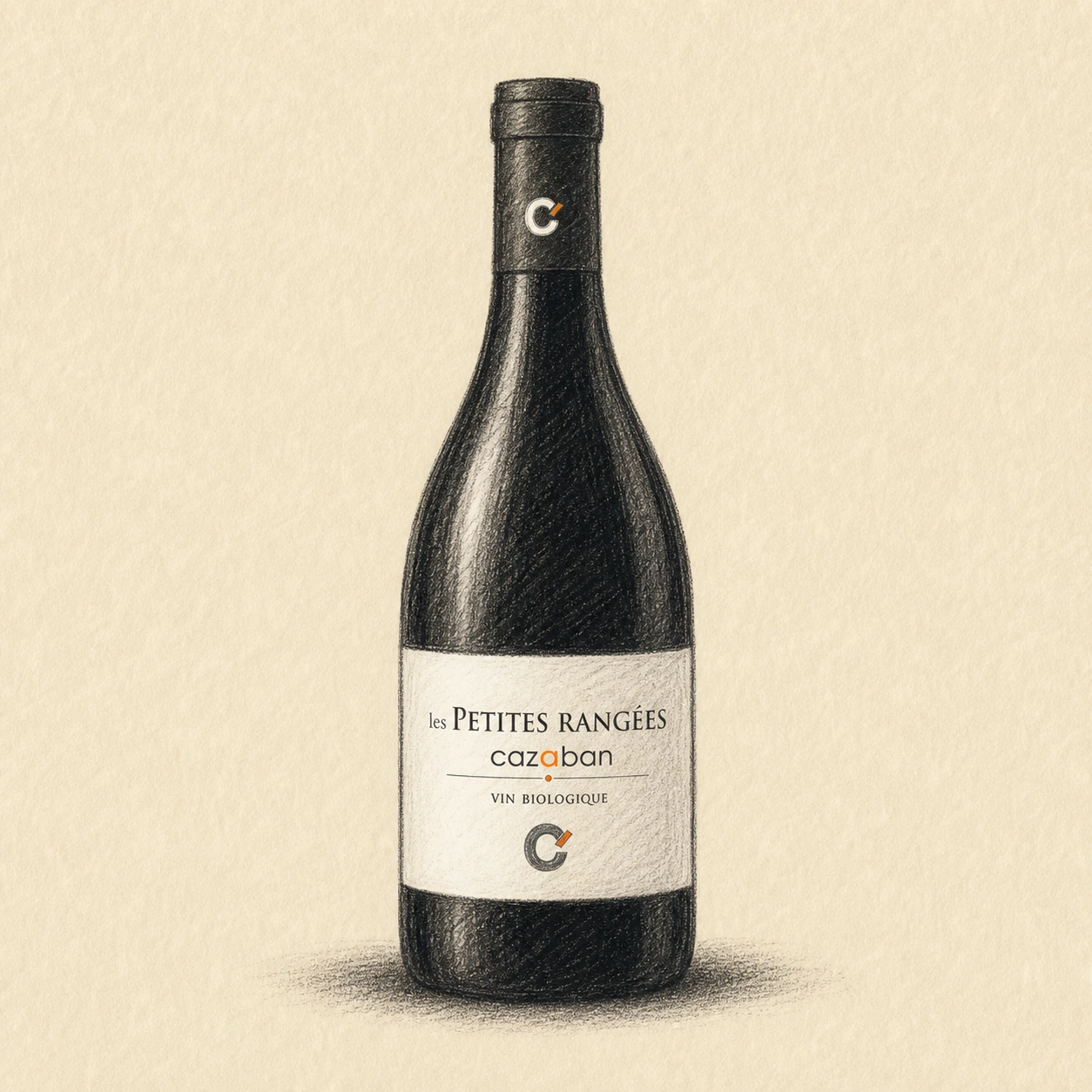
Original bottle illustration — Bacchus Global
AOP Cabardès
DOMAINE DE CAZABANLes Petites Rangées
At the point where Mediterranean warmth meets Atlantic freshness, Domaine de Cazaban blends two grapes born of two different winds into a single glass — a quiet meeting written into the very rules of Cabardès.
Thailand · Product information
Product information from Bacchus Global Co., Ltd., based in Bangkok, Thailand. About Bacchus Global
- Wine type
- Red wine
- Grape
- Syrah 60% / Cabernet Sauvignon 40%
- Appellation
- AOP Cabardès
- Origin
- Cabardès, Languedoc, France
- Drinking window
- 2025–2032
- Recommended temperature
- 16–17°C
- Alcohol
- 14%
- Bottle size
- 750 ml
About Les Petites Rangées
Domaine de Cazaban farms 22 hectares along the southern slopes of the Montagne Noire, north of Carcassonne, where Mediterranean warmth and Atlantic freshness meet over Cabardès' clay-limestone and schist soils. Vin Méthode Nature-certified, this cuvée is produced from hand-harvested fruit, fermented spontaneously with native yeasts, and moved by gravity rather than pumps.
Les Petites Rangées 2021 blends Syrah and Cabernet Sauvignon — one grape shaped by Mediterranean sun, the other by Atlantic air — echoing the appellation's own rule that both traditions must appear in every glass. Aged nine months in old 227-litre Burgundy barrels, it moves from garrigue, eucalyptus and roasted fennel toward morello cherry, dark chocolate and graphite, framed by fine, firmly structured tannins.
Taste profile
In the glass
LES PETITES RANGÉES
Scale1–5
BG wine structure estimate
Comparative profile within the Bacchus Global wine range.
Garrigue, eucalyptus and roasted fennel give way to morello cherry, dark chocolate and graphite
Fine, silky yet firmly structured tannins, concentrated black fruit and spice, with a long finish
Deep, dark ruby
Before it reaches the glass
Temperature
16–17°C
Timing
Drinking window 2025–2032; younger examples show firmer tannins that soften with aeration
Glassware
A Bordeaux-style glass with a wide bowl, to open the aromatics of Syrah and Cabernet Sauvignon
Question 1
Which grapes are listed in the product facts?
- Syrah 60% / Cabernet Sauvignon 40%
- Melon de Bourgogne, Sauvignon Blanc, Sémillon
- Clairette, Grenache Blanc, Bourboulenc, Roussanne, Marsanne, Viognier
Read the answer and explanation
Correct answer: A — Syrah 60% / Cabernet Sauvignon 40%
The linked part of this page lists Syrah 60% / Cabernet Sauvignon 40%.
Read the relevant passageQuestion 2
Which appellation is listed in the product facts?
- AOC Côtes de Bourg
- AOP Cabardès
- AOC Anjou Blanc
Read the answer and explanation
Correct answer: B — AOP Cabardès
The linked part of this page lists AOP Cabardès.
Read the relevant passageQuestion 3
Which origin is listed in the product facts?
- Chablis, Yonne, Burgundy, France
- Côte Chalonnaise, Burgundy, France
- Cabardès, Languedoc, France
Read the answer and explanation
Correct answer: C — Cabardès, Languedoc, France
The linked part of this page lists Cabardès, Languedoc, France.
Read the relevant passageAt the table
The wine's firm tannins and concentrated black fruit sit well alongside dishes rich in fat and umami.
The following pairings, drawn from Japanese, Thai and Western kitchens, show how the wine's structure responds to different styles of cooking.
Japanese
- Wagyu steak
- Sukiyaki
- Charcoal-grilled beef tongue
Why it worksFirm tannins meet the richness and umami of grilled and simmered beef, each softening the other
Thai
- Massaman neua (beef massaman curry)
- Neua yang jim jaew (mild grilled beef)
- Braised lamb
Why it worksRich beef and gently spiced dishes sit comfortably with the wine's fruit and tannin; dishes with intense chili heat tend to clash with the tannin structure
Western
- Lamb chops
- Boeuf bourguignon
- Aged hard cheese
Why it worksClassic Southwest French red meats and rich braises meet the wine's structure on familiar ground
From cellar to bottle
Winemaking
Hand-harvested fruit is sorted and destemmed, then moved only by gravity, without pumping. Fermentation relies on native yeasts, with a long maceration of three to five weeks and little to no added sulphites.
Product detail
The wine is aged nine months in old 227-litre Burgundy barrels, clarified through natural settling, and bottled by gravity.
About the origin
Cabardès sits where Mediterranean and Atlantic climates meet, and its rules require both Mediterranean and Atlantic grape varieties to appear in every blend.
Official producer website→Trade information
Contact Bacchus Global for product documentation, availability and trade enquiries.