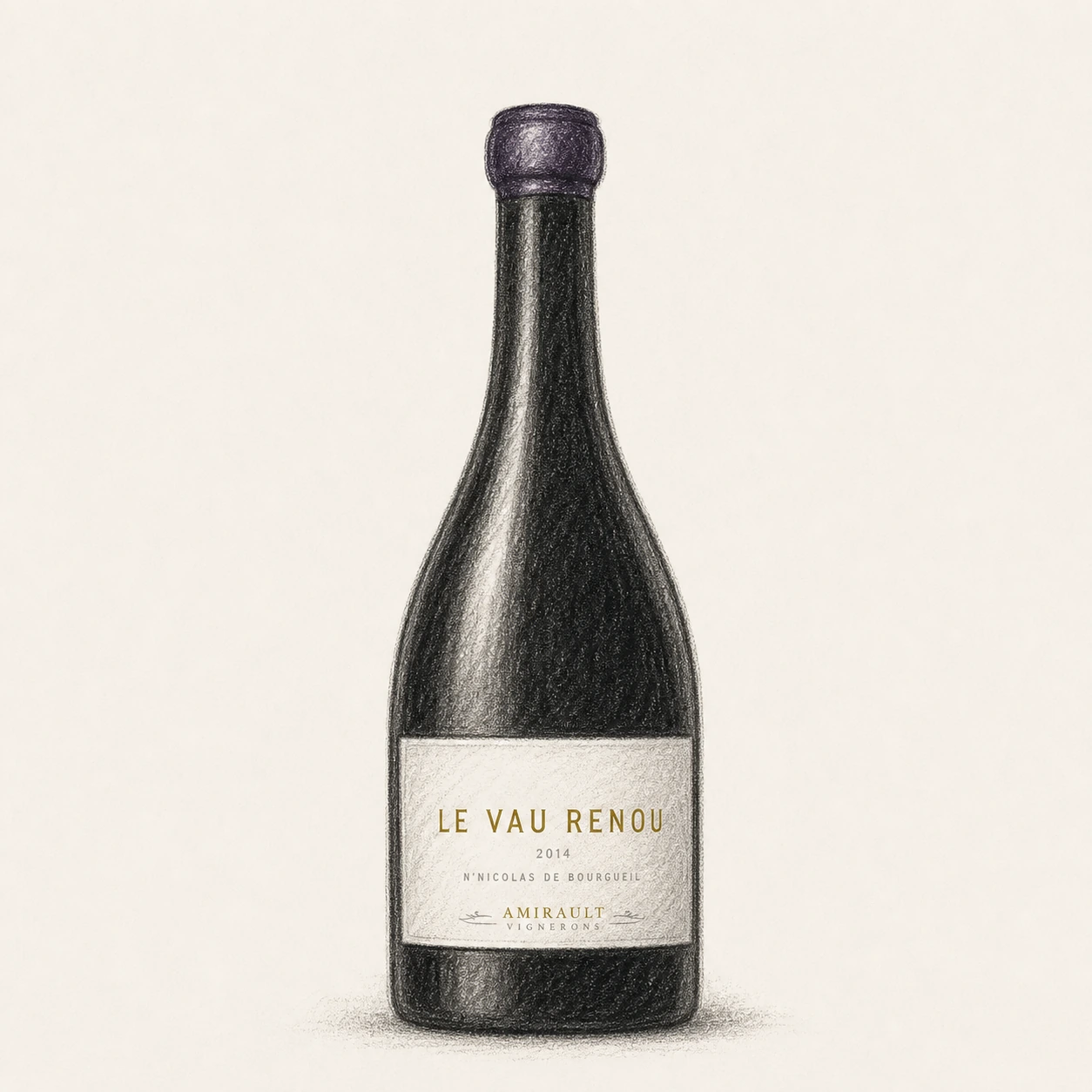
Original bottle illustration — Bacchus Global
AOC Saint-Nicolas-de-Bourgueil, Loire Valley
DOMAINE AMIRAULT (XAVIER & AGNÈS AMIRAULT, LE CLOS DES QUARTERONS)Le Vau Renou 2020
In Saint-Nicolas-de-Bourgueil, a single vineyard called Le Vau Renou holds two entirely different soils — one that shaped the walls of the estate's own underground cellar, the other perched fifteen meters above it. Their quiet tension defines this Cabernet Franc: a wine born from contrast rather than compromise.
- Wine type
- Red wine
- Grape
- Cabernet Franc 100% (Breton)
- Appellation
- AOC Saint-Nicolas-de-Bourgueil
- Origin
- Saint-Nicolas-de-Bourgueil, Touraine, Loire Valley, France
- Drinking window
- 2026–2032+
- Recommended temperature
- 16°C
- Alcohol
- —
- Bottle size
- 750 ml
About the Wine
Domaine Amirault (Xavier & Agnès Amirault, Le Clos des Quarterons) is a family-run estate in Saint-Nicolas-de-Bourgueil, in the Loire Valley's Touraine region, farmed across six generations spanning more than 180 years. The vineyard and the estate's underground cellar, Cave du Vau-Renou, share the name Le Vau Renou; the cellar's walls are formed by the same tuffeau limestone found in one of the vineyard's two sub-parcels, the other being a flint-and-clay parcel fifteen meters higher.
Made entirely from Cabernet Franc, known locally as Breton, the wine is hand-harvested and fermented with native yeasts alone, then aged for months in oak inside the cool, constant-temperature cellar. The 2020 vintage, from an unusually early and concentrated harvest, was named an Editors' Choice by Wine Enthusiast.
Taste profile
In the glass
LE VAU RENOU 2020
Scale1–5
BG wine structure estimate
Comparative profile within the Bacchus Global wine range.
Dark cherry, plum, spice, Darjeeling tea, flint, violet, and blackcurrant, with blueberry compote emerging after aeration.
Supple yet structured tannins, elegant acidity from the tuffeau soils, and a mineral, flint-tinged finish.
Before it reaches the glass
Temperature
Around 16°C
Timing
Best decanted 1–3 hours ahead; drinking window 2026–2032+
Glassware
A large Burgundy glass or a medium tulip glass suited to Cabernet Franc
At the table
Le Vau Renou's structure and bright acidity give it range across cuisines built on grilled proteins and gentle spice.
The wine's tannin backbone and mineral finish work best with dishes that have some richness or char, while its acidity keeps it fresh alongside herb-forward, lightly seasoned preparations.
Japanese
- Duck with sansho pepper
- Wagyu thigh steak
- Grilled shiitake mushrooms
Why it worksThe wine's dark-fruit core and firm tannins stand up to the richness of grilled duck and wagyu, while its mineral finish echoes the umami of charred shiitake.
Thai
- Nuea pad nam man hoi (beef in oyster sauce)
- Gai yang takrai (lemongrass grilled chicken)
- Pla samli yang (grilled mackerel with mild herbs)
Why it worksMild, savory Thai grills let the wine's tuffeau-driven acidity and fruit come through without competing against strong chili heat or coconut richness.
Western
- Grilled red meat
- Game birds such as pigeon
- Veal sweetbread in cream sauce
Why it worksClassic Loire pairings of grilled meat and game match the wine's tannin structure, while the cream sauce softens its edges without masking the flint minerality.
From cellar to bottle
Winemaking
Grapes are hand-harvested and double-sorted in the vineyard and cellar, then fermented spontaneously with native yeasts and no additives. Malolactic fermentation occurs naturally, and the wine is aged 12–18 months in 500-liter oak demi-muids inside the underground Cave du Vau-Renou, held at a constant 13°C, with total sulphur kept at or below 28 mg/L and no filtration.
Product detail
Produced entirely from Cabernet Franc grown across two contrasting sub-parcels of Le Vau Renou — tuffeau limestone forming the cellar walls and a flint-and-clay parcel fifteen meters higher — bottled under natural cork in 750 ml format.
Origin
The vineyard and the estate's underground cellar, Cave du Vau-Renou, share the name Le Vau Renou; the cellar's walls are formed by the same tuffeau limestone found in one of the vineyard's two sub-parcels.
Official producer website→Certifications

Ecocert · Ecocert

Demeter · Demeter
Organic and Biodynamic Farming
Domaine Amirault farms its Saint-Nicolas-de-Bourgueil vineyards, including Le Vau Renou, under Ecocert organic and Demeter biodynamic certification at the estate level, and follows the Vin Méthode Nature charter for natural winemaking.
Recognition
Wine Enthusiast
Wine Enthusiast named the 2020 Le Vau Renou an Editors' Choice selection among its Cabernet Franc ratings.
Trade information
Contact Bacchus Global for product documentation, availability and trade enquiries.